

Have you ever seen someone become a manager and suddenly realize the job is no longer about doing great work alone?
The meetings feel familiar. The tools, clients, dashboards, and deadlines are still there.
But the pressure changes.
Now the manager has to help other people do good work. They have to explain priorities, give feedback, handle tension, manage stakeholders, protect team focus, and make decisions when the answer is not clean.
That shift exposes the skills that technical expertise cannot cover on its own.
Soft skills for managers are the human, communication, thinking, and leadership behaviors that help managers guide people, solve problems, build trust, handle conflict, and turn business priorities into team action.
At Arthur D. Little and McKinsey, and now while coaching professionals through High Bridge Academy, I have watched managers grow fastest when they improve the behaviors people feel every day: clearer thinking, sharper communication, better feedback, stronger judgment, and calmer handling of difficult moments.
In this blog, we will cover:
- The 9 soft skills that matter most for managers
- What each skill looks like in real work
- How managers can practice and measure these skills
Let’s start with what soft skills mean when someone is responsible for a team, not only their own performance.

What Are Soft Skills for Managers?
Soft skills for managers are workplace behaviors such as communication, emotional intelligence, problem-solving, coaching, adaptability, decision-making, and conflict management. They help managers lead people, align teams, and handle situations where technical knowledge alone is not enough.
A technical skill helps a manager understand the work.
A soft skill helps them lead the people doing the work.
For example, a manager in a finance team needs to understand financial models. That matters. But once they manage people, the role expands. They need to explain priorities, review work clearly, coach analysts, handle stakeholder pressure, and make decisions when the data is incomplete.
That is where soft skills become visible.
They show up when:
- A team member misses a deadline
- A senior leader asks for a sharper update
- Two people disagree over ownership
- A project starts drifting
- The team feels overloaded
- A client pushes back
- A new tool changes how the team works
This is why I dislike treating soft skills as personality traits. They are behaviors you can practice, observe, and improve.
A manager who communicates clearly is not “naturally good with people.” They have learned how to structure a message. A manager who handles conflict well is not avoiding discomfort. They know how to name the issue without making the conversation personal.
For managers, the focus is more specific: which behaviors help a team perform better every week?
That is the lens I will use here.
Why Soft Skills Matter More for Managers in Modern Teams
Managers sit between leadership expectations and team reality.
A senior leader sets a target. A client changes the scope. A process breaks, a new tool enters the workflow, or a deadline moves. The manager has to turn all of that into clear priorities and useful action.
That job has become harder.
Here’s why modern management feels more complex:
- Teams are more cross-functional
- Remote and hybrid work have increased reliance on written communication
- AI is changing how people research, draft, analyze, and make decisions
- Employees expect more from managers:
- Clearer feedback
- Better coaching
- Honest communication
- Real development support
LinkedIn’s 2025 Workplace Learning Report makes this manager-development gap visible. It found that only 15% of employees said their manager helped them build a career plan in the past six months, down from the previous year.
That matters because many managers are expected to support career growth without enough structure or training.
Many managers are overloaded because they are expected to:
- Deliver results
- Support employee growth
- Keep morale steady
- Adopt new tools
- Manage stakeholder pressure
- Stay available to their teams
When I coach managers, I often see the same pattern. The manager is trying to help, but the team experiences:
- Unclear priorities
- Vague feedback
- Too many half-finished decisions
- Silence around difficult issues
The manager’s intention is good, but the behavior needs work.
Microsoft’s 2025 Work Trend Index also points to a major shift in how work is changing. It describes organizations moving toward AI-operated, human-led work, where human judgment, creativity, and connection-building remain essential.
That is exactly why soft skills for managers matter.
AI can support managers with drafts, summaries, options, and analysis. The manager still owns the judgment: how the message lands, what trade-off makes sense, and what the team needs next.
The World Economic Forum’s Future of Jobs Report 2025 also highlights how jobs and skills are changing through 2030.
For managers, the lesson is simple:
- The work keeps changing
- The human behaviors that help teams adapt become more valuable
9 Essential Soft Skills for Managers Who Want Stronger Teams
Before we go deeper, here is a quick overview of the 9 soft skills for managers we will cover.
| Soft Skill | What It Helps Managers Do | What It Looks Like at Work |
| Structured problem-solving | Make messy issues easier to solve | The manager defines the real issue before assigning actions |
| Clear communication | Turn priorities into shared understanding | The team knows what matters, why it matters, and what happens next |
| Emotional intelligence | Lead with self-awareness and control | The manager responds calmly when pressure rises |
| Coaching and feedback | Help people improve performance | Feedback is specific, practical, and tied to the work |
| Delegation and ownership | Build trust and accountability | Team members know the outcome, standard, and decision rights |
| Decision-making under uncertainty | Move forward without perfect information | The manager separates facts, assumptions, and trade-offs |
| Stakeholder management | Keep people aligned across functions | Expectations are clear before tension grows |
| Conflict resolution | Address disagreement early | The manager names the issue and guides the team toward an agreement |
| Adaptability and AI-era judgment | Lead through changing tools and priorities | The team uses AI and new workflows without losing human judgment |
Now let’s look at each skill in real management situations.
1. Structured Problem-Solving
Managers face messy problems every week.
It can be a project that misses deadlines, a team member that underperforms, a client that keeps changing direction, a process that creates rework, or a senior leader who asks for answers before the team has fully understood the issue.
The best managers slow the problem down before asking the team to solve it.
Structured problem-solving means defining the real problem, separating symptoms from causes, breaking the issue into parts, and using evidence before deciding what to do.
I learned this early in consulting.
Many teams were working hard on the most visible issue, not the real one. Once we changed the problem definition, the solution changed as well.
Take a team that keeps missing deadlines.
A rushed manager says, “The team needs to be more productive.”
A structured manager looks at the system:
- Are priorities changing too often?
- Are approvals taking too long?
- Is ownership unclear?
- Are people waiting for inputs from another team?
- Is the work estimated badly?
- Are there too many projects running at once?
The problem moves from “people are slow” to “the workflow has unclear ownership and too many approval delays.”
That is a different conversation.
It is also a more useful one.
Managers do not need to turn every team issue into a full consulting project, but they do need the discipline behind structured problem-solving, issue trees, and MECE thinking.
| The 5-Minute Problem Check (You Can Practice As a Manager) |
| Before solving a team issue, write:What is happening?Where is it happening?Who is affected?What evidence do we have?What are we assuming?If the answers feel vague, the team is not ready to jump into solutions. |
2. Clear Communication
A manager’s communication becomes the team’s operating system.
If the message is unclear, the team slows down. People ask the same questions, make different assumptions, and wait for someone else to clarify what matters. Clear communication means explaining priorities, giving enough context, repeating the main point when needed, and making the next step easy to understand.
I usually look for one thing when reviewing manager communication: is the main point visible quickly?
If the team has to search through a long message to understand the decision, the manager has already created extra work.
For example, this message creates confusion:
“Let’s improve client communication.”
It sounds reasonable, but it does not tell the team what to do differently.
A clearer version would be:
“Every client update should include the decision, the reason, the next step, and the owner.”
Now the team has a standard.
Clear communication also works in different directions:
- Downward: explaining team priorities and expectations
- Upward: giving senior leaders concise updates
- Across: aligning with peers and stakeholders
- One-on-one: giving feedback, coaching, and support
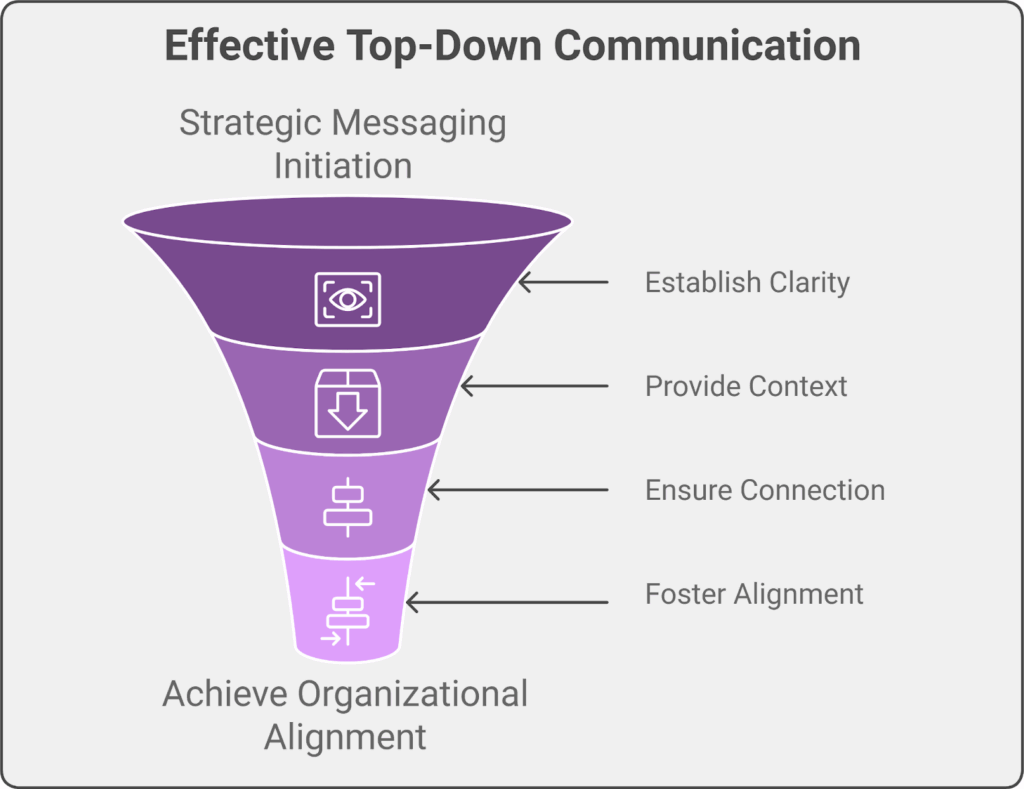
This is where top-down communication matters.
When a team needs direction, the manager has to translate business priorities into practical action. The same skill also connects with executive communication, the Pyramid Principle, and action titles. The principle is simple: put the point where people can see it.
A manager who communicates well makes work feel lighter. The team knows what matters, work moves faster, and fewer misunderstandings take over the room.
3. Emotional Intelligence
Managers set the emotional temperature of the team.
A manager’s reaction to pressure tells the team whether it is safe to bring problems early.
Emotional intelligence means understanding your own reactions, reading the room, responding with control, and recognizing the person behind the performance issue. For example, if a team member misses a deadline, a low-awareness response sounds like:
“Why is this late again?”
That immediately puts the person on defense.
A stronger manager asks:
“What happened, what was unclear, and what needs to change before the next deadline?”
That question keeps the conversation focused on the work.
Emotional intelligence does not mean avoiding accountability. It means handling accountability in a way that keeps the conversation useful.
When I coach managers, I often ask them to review the last difficult conversation they had. I ask them to look beyond the words and notice what their reaction made possible:
- Did the person become clearer?
- Did they shut down?
- Did the real issue come out?
- Did the conversation end with a better next step?
That reflection tells a manager a lot about their leadership style.
4. Coaching and Feedback
Managers do more than assign tasks.
They help people improve how they think, communicate, and perform.
Coaching and feedback mean giving people specific guidance they can use. It also means knowing when to ask questions instead of giving the answer immediately.
A vague feedback comment sounds like this:
“This report needs to be better.”
The person leaves with pressure, not clarity.
A useful version sounds like this:
“Your analysis is strong, but the recommendation is buried. Start with the answer, then show the three reasons behind it.”
Now the person knows what worked, what needs improvement, and what to do next.
This is one reason we use drills, simulations, and direct feedback inside High Bridge Academy’s Business Excellence Bootcamp. People improve faster when they practice in real business situations rather than just reading advice.
The same is true for managers.
Reading about feedback helps. Practicing it in real conversations changes behavior.
If you want to strengthen this within a team, our guide on real-world exercises to improve soft skills offers practical ways to move from theory to practice. When building a manager training plan, it also helps to clarify what soft skills training includes so practice does not stay too generic.
| Feedback Script Managers Can Use |
| Try this structure in your next feedback conversation:What workedWhat needs improvementWhy it mattersWhat to do nextThis keeps feedback practical instead of personal. |
5. Delegation and Ownership
Delegation is one of the hardest shifts for new managers.
Many early managers were promoted because they produced excellent work themselves. Then they enter management and discover that doing everything personally does not scale. Delegation means giving someone the task, context, decision rights, quality standard, and check-in rhythm they need to succeed.
A poor delegation message sounds like:
“Prepare the client deck.”
That leaves too much unsaid.
A better version sounds like:
“Own the first draft of the client deck. The goal is to explain the retention issue, show three options, and recommend one path. Let’s review the storyline before you build the slides.”
That gives the person:
- The outcome
- The goal
- The expected structure
- The first review point
- A chance to own the work without guessing
One thing I often tell new managers is this: delegation is not a test of whether someone can read your mind.
- If the standard matters, explain it.
- If the person owns a decision, say so.
- If you want a check-in before they go too far, schedule it.
This is where work documentation supports better management. Written expectations, examples, and decision logs reduce confusion.
Delegation also connects with presentation storytelling when the output involves slides, client updates, or leadership communication. Managers need to explain the quality bar before reviewing the final version.
Good delegation gives people ownership without forcing them to guess the standard.
6. Decision-Making Under Uncertainty
Managers rarely get perfect information.
They still need to make clear, responsible decisions.
Decision-making under uncertainty means separating facts from assumptions, using hypotheses, understanding trade-offs, and knowing when more analysis helps.
In consulting, we often had to make progress before every answer was available. The discipline was knowing which assumption we were testing before asking the team to act.
Here is a common manager example.
A team is underperforming, and the first instinct is to buy more training.
Before approving the training, the manager tests the real issue:
- Are expectations unclear?
- Are handoffs poor?
- Are examples missing?
- Are people lacking a specific skill?
- Are priorities changing too often?
- Is the workload unrealistic?
The answer changes the decision.
- If the issue is unclear briefs, training does not fix it. Better briefing does.
- If the issue is missing examples, a shared library helps.
- If the issue is a real skill gap, training makes sense.
Hypothesis-driven thinking gives managers a way to move forward without guessing blindly.
Managers also benefit from understanding business decision-making frameworks and how professionals use AI to structure business problems faster. AI can help generate options, summarize data, and pressure-test assumptions, but the manager still owns the judgment.
7. Stakeholder Management
Managers often work through people they do not fully control.
That includes senior leaders, peers, other teams, clients, vendors, and direct reports.
Stakeholder management means understanding what different people care about, aligning expectations early, communicating trade-offs, and keeping work moving through competing priorities. This is one of the most underrated soft skills.
Many projects fail because people were not aligned on the decision, the timeline, the trade-off, or the owner.
Imagine a product manager, sales lead, and operations manager arguing over a launch timeline.
- Sales wants speed because a client is waiting.
- Product wants more time because the feature still has issues.
- Operations wants clarity because support teams need training.
A strong manager does not let this tension sit in side conversations; they bring the trade-off into the open:
“We can launch faster with a higher support risk, or delay by two weeks and reduce the number of expected customer issues. Which risk are we choosing?”
Now the group is making a decision instead of protecting separate priorities.
That is stakeholder management in action.
8. Conflict Resolution and Difficult Conversations
Managers cannot avoid conflict.
They need to make disagreement useful before it becomes personal.
Conflict resolution means addressing tension early, listening to both sides, naming the issue clearly, keeping the conversation focused on behavior and impact, and creating an action agreement.
Many managers wait too long because they want to keep harmony.
In practice, silence often makes the conflict more expensive.
A small ownership issue becomes resentment, a misunderstood comment becomes a trust problem, and a missed handoff becomes a pattern. By the time the manager steps in, the conversation carries more emotion than the original issue deserved.
I have seen this situation often in companies.
Two team members disagree over who owns client follow-up. One thinks the other is slow and the other thinks the process was never clear.
The manager brings them together and says:
“I want to clarify what happened, how it affected the work, and what we need to change before the next project.”
That opening keeps the conversation grounded.
Then the manager clarifies:
- Who owns the first client update
- Who reviews the message
- When the handoff happens
- Where the process is documented
- How they will handle exceptions
For recurring tension, managers need the language to disagree courageously and teach people how to ask for help at work before small issues become larger conflicts.
9. Adaptability and AI-Era Judgment
Managers now lead through changing tools, shifting priorities, remote collaboration, and AI-assisted work.
Adaptability means knowing what to change, what to protect, and how to help the team adjust without creating panic.
AI has made this skill even more important.
Microsoft’s 2025 Work Trend Index describes the rise of human-agent teams and AI-operated, human-led work. For managers, that creates a new responsibility: helping teams use AI without losing quality, accountability, or judgment.
Let’s say a team starts using AI for first drafts.
A careless approach says:
“Use AI to speed things up.”
A better manager sets standards:
“AI can help with options, summaries, and first drafts. The team still owns accuracy, reasoning, tone, and final judgment.”
That one sentence protects the quality bar.
When I discuss AI with professionals, I try to move the conversation away from tool excitement and toward work quality. The question is not “Are we using AI?” The better question is: “Where does AI improve the workflow, and where does human judgment need to stay visible?”
For example:
- AI can summarize meeting notes, but the manager confirms decisions and owners.
- AI can draft feedback, but the manager adjusts tone and context.
- AI can generate options, but the manager chooses the trade-off.
- AI can analyze patterns, but the team checks whether the conclusion makes business sense.
Adaptability helps the team respond to change without losing clarity.
Soft Skills for Managers: Quick Workplace Comparison Table
Different management problems require different soft skills. This table helps connect common manager situations with the skill that solves the real issue.
| Manager Situation | Most Useful Soft Skill |
| The team keeps missing deadlines | Structured problem-solving |
| An employee repeats the same mistake | Coaching and feedback |
| A cross-functional project gets stuck | Stakeholder management |
| A senior leader asks for a quick update | Clear communication |
| Two team members are in conflict | Conflict resolution |
| A new AI tool enters the workflow | Adaptability and AI-era judgment |
| A remote team loses momentum | Clear communication and emotional intelligence |
| A decision needs to be made with incomplete data | Decision-making under uncertainty |
| A team member loses confidence | Emotional intelligence and coaching |
How Managers Can Develop Soft Skills Through Real Practice [My 4-Week Action Plan]
Managers improve soft skills through deliberate practice.
Reading definitions helps at the beginning, but real improvement happens when managers practice in meetings, feedback conversations, project reviews, stakeholder updates, and difficult conversations.
When I coach professionals, I tell them to avoid trying to improve every skill at once. Just pick one behavior and practice it until it starts changing how work feels.
For example:
- If your updates are unclear, practice leading with the main point.
- If feedback conversations feel vague, practice giving one specific example.
- If delegation creates rework, practice defining the expected outcome before assigning the task.
- If conflict gets avoided, practice naming the issue earlier.
- If decisions stall, practice writing the assumption you are testing.
Inside our Business Excellence Bootcamp, professionals not only learn frameworks. They practice them through business cases, simulations, communication drills, and direct feedback because soft skills become real when people use them under pressure.
Here is a simple 30-day plan that I have created for managers.
| Week | Focus | Practice Activity | What to Review |
| Week 1 | Communication clarity | Rewrite one team update using the main point first | Did people understand the priority and next step? |
| Week 2 | Feedback and coaching | Give one piece of specific feedback using the four-part script | Did the person know what to improve and how? |
| Week 3 | Problem-solving and decision-making | Use the 5-minute problem check before solving one team issue | Did the team define the real problem? |
| Week 4 | Stakeholder management and conflict conversations | Hold one alignment conversation before tension grows | Did the conversation clarify ownership, trade-offs, or next steps? |
The plan is simple on purpose.
Managers do not need a complicated development system to begin. They need one behavior, one real situation, and one useful review loop.
How to Measure Soft Skills in Managers Without Making Them Vague
Soft skills should not stay vague.
You can measure them through behavior, team signals, and work outcomes.
The question I prefer is simple:
“Can people feel the skill in how work happens?”
For example, communication clarity shows up when people leave meetings knowing what matters. Delegation shows up when team members own outcomes without constant correction. Emotional intelligence shows up when people bring problems earlier instead of hiding them.
Here are some practical ways to measure soft skills in managers:
1. Team Clarity After Meetings
Ask team members to repeat the decision, owner, and next step after a meeting. If answers differ, the communication needs work.
2. Quality of Feedback Conversations
Review whether feedback includes specific behavior, business impact, and a next action. Vague feedback creates vague improvement.
3. Repeated Questions
Track the questions the team keeps asking. Repeated questions reveal unclear expectations, missing documentation, or weak communication.
4. Escalation Patterns
Look at how often issues escalate late. Late escalation often points to weak ownership, low psychological safety, or unclear decision rights.
5. Decision Speed
Review how long decisions sit open. Slow decisions often show unclear criteria, too many stakeholders, or fear of making trade-offs.
6. Employee Confidence
Listen for how team members talk about their work. Confident teams understand expectations, know where to get help, and can explain their priorities.
7. Stakeholder Trust
Ask stakeholders whether the manager communicates risks early, follows through, and keeps expectations clear. Trust grows through repeated reliability.
8. Conflict Resolution Time
Track whether conflicts are addressed early or left until they damage the work. Fast, respectful conflict resolution protects team energy.
9. Follow-Through on Delegated Work
Review whether delegated tasks come back with the expected quality, ownership, and judgment. If work constantly returns incomplete, the delegation process needs improvement.
Identifying soft skills gaps helps managers focus on the specific behavior slowing the team down. The goal is to find the behavior creating friction and practice the right skill.
- If a manager gives project instructions and the team asks the same five clarification questions every week, the communication skill needs work.
- If a manager avoids difficult conversations and small issues keep growing, conflict resolution needs work.
- If a manager assigns tasks and then rewrites everything at the end, delegation needs work.
Measure the behavior first and then practice the skill.
Which Soft Skill Should Managers Improve First?
Managers do not need to improve everything at once.
Start with the skill creating the most friction in the work. The team’s repeated problems usually point to the manager behavior that needs attention first.
You can use my guide:
- If your team keeps asking “what matters most,” start with communication clarity.
- If your team brings problems without structure, start with problem-solving.
- If people avoid difficult topics, start with conflict resolution.
- If employees repeat the same mistakes, start with coaching and feedback.
- If projects stall across teams, start with stakeholder management.
- If delegated work keeps coming back unfinished, start with delegation and ownership.
- If decisions stay open too long, start with decision-making under uncertainty.
- If people hesitate to raise risks, start with emotional intelligence.
- If AI or new tools are creating confusion, start with adaptability and judgment.
This is how I would approach it with a manager in a coaching conversation.
Instead of starting with a generic list of weaknesses, we would look:
- Where is the team losing time?
- Where do people keep getting confused?
- Which conversations keep getting delayed?
- Which decisions keep coming back?
The answer gives you the starting point.
Build the Manager Skills Your Team Needs Every Day
Soft skills for managers are visible behaviors that shape how teams understand priorities, handle pressure, solve problems, and trust their manager.
A manager with strong soft skills makes work clearer. They coach instead of only correcting, address conflict early, communicate decisions clearly, delegate with context, and use AI and new tools without losing judgment.
Most importantly, they help the team think and act with more confidence.
That is what people remember.
High Bridge Academy helps managers and professionals build these skills through the Business Excellence Bootcamp. Our program combines structured problem-solving, logical storytelling, flawless communication, stakeholder management, and high-performance mindsets with realistic drills, simulations, and feedback from former McKinsey, Bain, and BCG consultants.
We have trained 1,000+ professionals across business roles and are currently rated Excellent on Trustpilot, with a 4.8 rating and hundreds of learner reviews.
To build these skills inside your team, explore the Business Excellence Bootcamp or schedule a free insight call with High Bridge Academy to discuss the right training path.
FAQs About Soft Skills for Managers
Clear communication is often the first skill to improve because it affects priorities, feedback, delegation, conflict, and team trust. Without clarity, other management skills become harder to apply consistently.
Yes. Managers improve soft skills through practice, feedback, reflection, and real workplace application. Role-play, coaching, meeting reviews, and structured exercises help turn these skills into daily habits.
Common signs include repeated confusion, poor feedback conversations, unresolved conflict, low ownership, slow decisions, and team members hesitating to raise issues or ask for help.
Managers still need technical understanding, but their impact increasingly depends on communication, judgment, coaching, and alignment. As responsibility grows, success depends more on helping others perform well.
Managers practice soft skills every day through meetings, feedback, delegation, prioritization, and conflict conversations. The best development happens when managers review real interactions and improve one behavior at a time.