

Most professionals waste hours on problems that could be solved in minutes. Not because they lack intelligence — because they lack structure. AI changes that equation entirely.
The fastest thinkers in business don’t just use AI to write emails or summarize documents. They use it to build structured analyses, test hypotheses, and organize complex decisions. That’s a consulting-grade skill used inside top firms like McKinsey & Company, Bain & Company, and Boston Consulting Group — and it’s now accessible to professionals everywhere.
This guide walks you through five steps for using AI to structure business problems faster. Each step combines a consulting framework with a practical AI prompt you can use today. No consulting background required.
Why structure comes before the prompt
Most AI outputs are only as good as the inputs you give them. If your problem is vague, your AI output will be vague. Structure comes first — AI accelerates it.
Elite consulting firms have used structured problem solving for decades: MECE thinking, issue trees, hypothesis-driven analysis. These are the same practical tools used by consultants at McKinsey, Bain and BCG to turn ambiguous situations into clear, actionable decisions.
AI doesn’t replace this structure. It supercharges it. Here’s how to put them together.
Step 1: Define the problem precisely
Before you open an AI tool, write one sentence that describes what you’re actually trying to solve. This sounds obvious. It’s harder than it sounds.
A well-defined problem statement describes the gap between current state and desired outcome. It should include who is affected and why it matters. AI can help you refine it — but you need a first draft first.
Try this prompt: “I’m trying to solve the following problem: [your draft]. Help me sharpen the problem statement so it’s specific, measurable, and decision-focused.” Iterate until it’s tight.
Step 2: Build a MECE issue tree
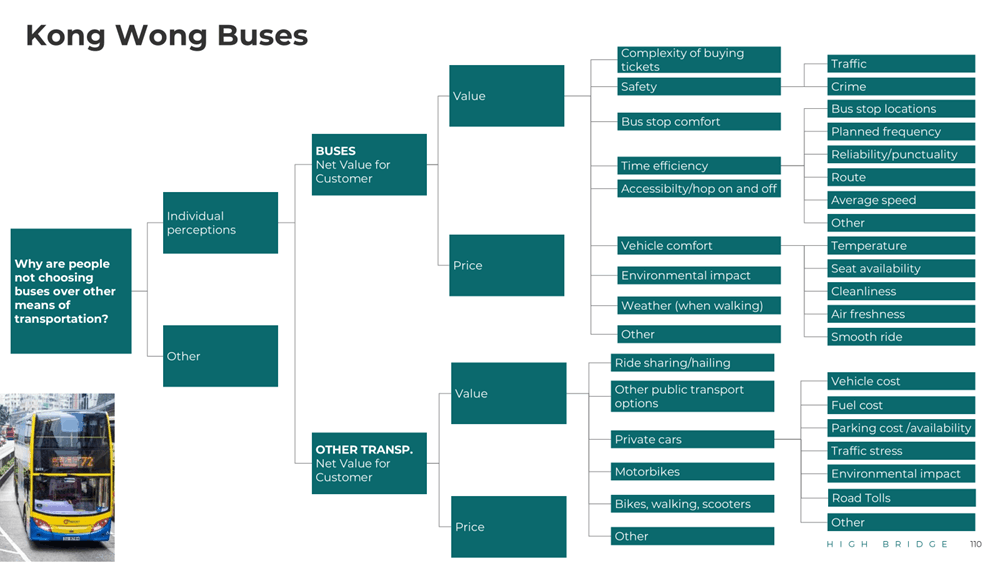
Illustration of MECE thinking using an issue tree framework to structure a business problem into mutually exclusive, collectively exhaustive categories.
Once your problem is defined, break it down using a MECE issue tree. MECE stands for Mutually Exclusive, Collectively Exhaustive — no overlaps, no gaps.
AI is fast at generating initial tree branches. Use this prompt: “Generate a MECE breakdown of the key drivers that could cause [problem statement]. Format as a structured list with top-level categories and sub-issues.” Review the output critically — AI structures can overlap or miss obvious branches.
Then use a second prompt to challenge it: “Are any of these branches overlapping? Are there important factors missing?” Treat the AI as a thinking partner, not a final authority.
Step 3: Generate and prioritize hypotheses
Once you have an issue tree, the next step is hypotheses. A hypothesis is a specific, testable answer to each branch — it moves you from “what might cause this” to “here’s what I believe and why.”
Use AI to generate hypotheses fast: “For each issue in this MECE tree, generate one hypothesis that would explain the problem if true.” Then score each on two dimensions: impact if true, and ease of testing.
This prioritization is where consultants spend most of their time. AI can generate ten hypotheses in thirty seconds. Deciding which ones to pursue first is still your call.
Step 4: Stress-test your structure
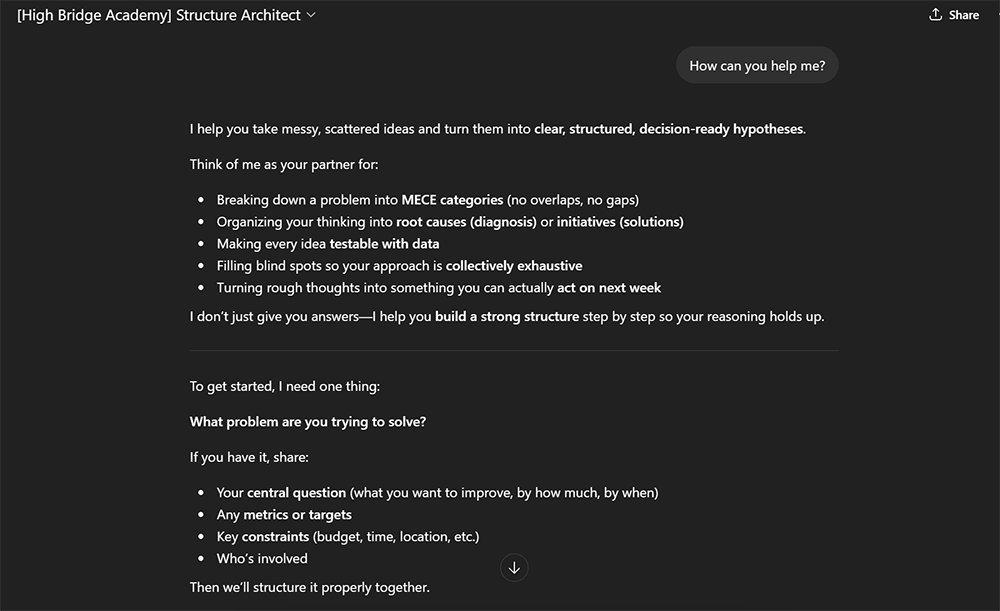
High Bridge Academy’s proprietary “Structure Architect” GPT helps users turn messy business challenges into clear, decision-ready hypotheses using consulting-grade logic, MECE structuring, and pressure-testing prompts.
Before committing to your analysis, use AI to pressure-test it. This step catches structural gaps before they become credibility problems in front of stakeholders. Five minutes here can save an hour of rework.
Try this: “Here is my problem structure and hypotheses: [paste]. What am I missing? What assumptions could be wrong? Where is my logic weakest?” Use the feedback to tighten the tree.
Don’t accept every critique. AI will sometimes flag things that are fine. The goal is to surface blind spots, not to accept every suggestion.
Step 5: Communicate findings top-down
A structured analysis means nothing if you can’t communicate it clearly. Top-down communication — conclusion first, then support — is how consultants present decisions to executives.
Use this prompt: “Here is my analysis: [paste]. Write a top-down executive summary using the Pyramid Principle — lead with the main recommendation, then provide supporting arguments in order of importance.” Edit the output for accuracy and tone.
Structure first, communication second. That’s how the best business professionals operate. AI accelerates both steps — but the framework has to come from you.
From process to practice
At High Bridge Academy, we approach problem-solving through a far deeper 8-step methodology we’ve developed to help professionals tackle complex business challenges with consulting-grade rigor. We’ve also built custom GPTs to accelerate and pressure-test key parts of the process. The five steps above are a simplified starting point — but they point you in the right direction when it comes to structured problem solving with AI.
Following these five steps will make you faster and sharper. But knowing a process and internalizing it are different things. The professionals who improve fastest are those who practice these frameworks in real situations, with real feedback.
That’s exactly what High Bridge Academy’s Business Excellence Bootcamp (BEB) is designed for. BEB teaches consulting-grade problem solving, executive communication, stakeholder management, and AI integration in one structured program. It’s built for professionals who want to work at a consulting level without joining a consulting firm.
Visit highbridgeacademy.com to learn more about the program and how it can accelerate your development.
FAQ
ChatGPT, Claude, and Gemini all work well for the steps above. The tool matters less than the prompts you use. Structure your inputs well and the output quality follows.
A basic understanding helps. MECE means no overlaps and no gaps in your issue tree. AI can help you check for both — but you need to understand the concept first.
Brainstorming with AI produces a list of ideas. Structured problem solving produces an organized, prioritized analysis. The difference shows up when you present your thinking to executives or stakeholders.
No. AI is a tool, not a methodology. Without understanding why MECE matters or how to build a hypothesis, you’ll produce well-formatted outputs that miss the real problem.
The prompts in this guide can be applied immediately. Building genuine fluency — where the structure comes naturally — takes weeks of deliberate practice. Programs that teach consulting frameworks alongside AI accelerate that process significantly.
The Pyramid Principle is a communication framework that says: lead with your conclusion, then support it with structured reasoning. It’s the final step in this process — once you’ve built and stress-tested your analysis, the Pyramid Principle tells you how to communicate it clearly.
Conclusion: Structure is the skill
AI is a multiplier for structured thinking — not a replacement for it. The professionals who use AI most effectively already know how to frame a problem and build a MECE tree. AI just makes each step faster.
If you want to build that foundation properly, start with the frameworks. High Bridge Academy’s Business Excellence Bootcamp teaches structured problem solving, communication, stakeholder management, and AI as one integrated program — built by 60+ former McKinsey, Bain, and BCG consultants. Ready to think and work at a consulting level? Explore highbridgeacademy.com to get started.