


If you’ve ever left a team meeting feeling like everyone talked a lot but nothing actually moved forward, Your team just finished a major analysis.
The data is solid. The recommendation is sound. But when they present it? Blank stares. Polite nods. No action.
Sound familiar?
I’ve watched this scene play out hundreds of times. Brilliant work dies in boring presentations. Great ideas get ignored because they’re buried in data dumps and bullet points that put stakeholders to sleep.
Here’s the uncomfortable truth: Your team’s ideas aren’t failing because they’re weak. They’re failing because they’re being presented incorrectly.
Facts don’t move people. Stories do.
In this blog, I’ll show you:
- Why storytelling isn’t optional anymore (the brain science proves it)
- Five story structures your team can use starting today
- Common mistakes that kill persuasion and how to fix them
Let me show you how to turn your team into storytellers who get results.
Why Business Storytelling Matters More Than Ever?
Let’s start with some irony. I’m about to use data to prove that data doesn’t work. Here’s what the research shows:
| What We Present? | What People Remember? |
| Raw statistics | 5-10% retention |
| Facts wrapped in stories | 65-70% retention |
| Stories with emotional hooks | Up to 22x more memorable |
A Stanford study found that after presentations, 63% of attendees could recall stories. Only 5% remembered specific statistics. Think about that. Your team spends hours perfecting their numbers. However, audiences tend to forget nearly all of them within minutes.
Meanwhile, 92% of business leaders say data storytelling is effective for presenting insights. And 93% believe decisions driven by good storytelling have the potential to increase revenue. The gap between what works and what most teams actually do is massive.
What’s Changed in Today’s Workplace?
The need for storytelling has never been more urgent.
- Attention spans are shrinking: Your team is competing with notifications, emails, and the constant pull of digital distractions. If they don’t hook their audience in the first 30 seconds, they’ve lost them.
- Remote work makes engagement harder: It’s tough to read the room when there is no room. Virtual presentations demand even more compelling narratives to keep people engaged through a screen.
- Information overload is the norm. According to Grammarly’s 2024 State of Business Communication report, miscommunication costs US businesses an estimated $1.2 trillion annually. When everyone is drowning in data, the teams that tell clear stories are the ones who get heard.
- Decisions happen faster. Executives don’t have time to wade through 50-slide decks. They need the point immediately, delivered in a way that sticks.
I once worked with a product team that was unable to secure budget approval for three consecutive quarters. Same solid data. Same logical arguments. Same rejection.
We changed nothing about their analysis. We only changed HOW they presented it. They got approved for the next quarter. The difference wasn’t what they said. It was how they structured the story.
The Brain Science Behind Persuasive Stories
This isn’t just communication theory. It’s neuroscience.
When someone hears a compelling story, something remarkable happens in their brain. Researchers at Princeton discovered that listeners’ brain activity begins to mirror the storyteller’s, a phenomenon called “neural coupling.”
It’s like a handshake between brains.
Here’s what stories trigger that data alone doesn’t:
- Multiple brain regions activate: Facts only light up language-processing areas. Stories engage the motor cortex, the sensory cortex, and the emotional centers simultaneously.
- Oxytocin releases: This “trust hormone” creates feelings of empathy and connection. It’s why we root for characters we’ve never met.
- Memory encoding strengthens: Emotional experiences create stronger neural pathways. That’s why you remember stories from childhood but forget what you read last week.
When your team presents data without a narrative, they’re only engaging a fraction of their audience’s brain. They’re leaving most of their persuasive power on the table.
Great stories trigger what some researchers call the “angel’s cocktail”, a mix of neurochemicals that make experiences memorable:
| Chemical | What It Does? | How Stories Trigger It? |
| Dopamine | Creates engagement and curiosity | Suspense, tension, unanswered questions |
| Oxytocin | Builds trust and empathy | Relatable characters, emotional stakes |
| Endorphins | Makes experiences memorable | Humor, surprise, satisfying resolution |
This is why you can remember the plot of a movie you saw years ago but can’t recall last quarter’s revenue figures. Stories don’t just inform. They transform how people feel about your idea. And feelings drive decisions.
Want to go deeper on how to structure presentations that leverage this science? Check out our guide on presentation storytelling techniques that ACTUALLY transform data into decisions.
The Core Elements of a Persuasive Business Story
Every effective business story follows a simple structure:
- Situation — Where are we now? What’s the context your audience needs to understand?
- Complication — What’s the problem, challenge, or opportunity? This creates tension.
- Resolution — What should we do about it? This is your recommendation and call to action.
This isn’t just storytelling theory. It’s how the human brain naturally processes information. We instinctively look for context, conflict, and resolution. When you structure your message this way, you’re working WITH your audience’s brain, not against it.
The Four Essential Ingredients of Persuasive Business Stories
Beyond structure, persuasive business stories contain four key ingredients:
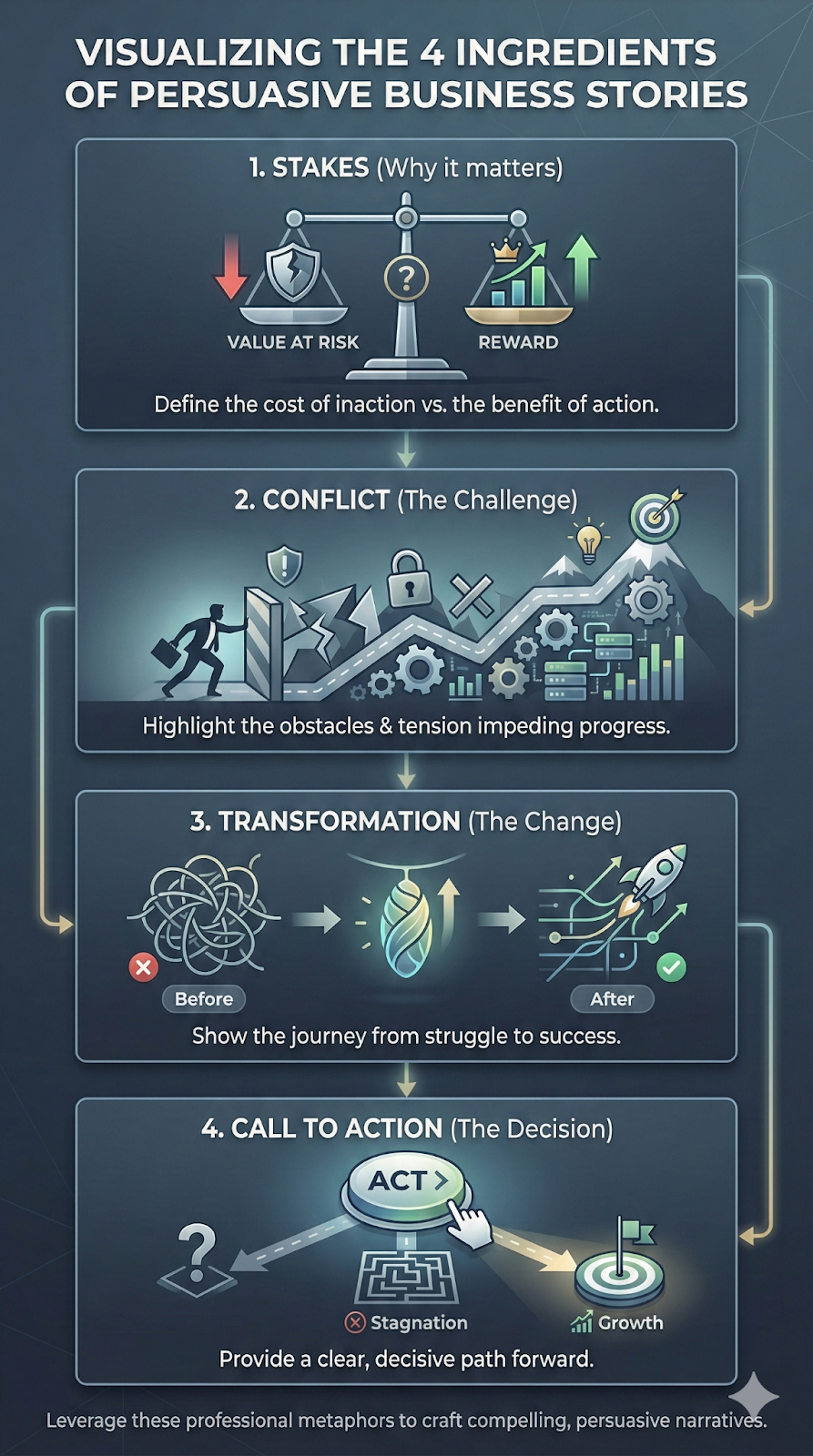
| Ingredient | What It Does? | Weak Example | Strong Example |
| Stakes | Makes people care | “This affects our department.” | “If we don’t act, we lose $2M and 15% market share.” |
| Conflict | Creates tension | “We have a challenge.” | “Our current system can’t handle demand, and competitors are closing in.” |
| Transformation | Shows change is possible | “Things improved”. | “After implementing X, customer satisfaction jumped 40% in 90 days.” |
| Call to Action | Drives decisions | “Let me know your thoughts.” | “I recommend we approve $50K by Friday to start Phase 1.” |
Missing any of these? Your story loses power.
One Thing Most People Miss: The “So What?”
Every data point needs a “so what.”
Numbers without meaning are just noise. I see this mistake constantly. Teams present impressive statistics but never connect them to what their audience actually cares about.
- Before: “Customer complaints increased 40%.”
- After: “Customer complaints increased 40%, which means we’re risking $2M in renewals next quarter if we don’t fix the support process.”
The data is identical. However, the second version explains to stakeholders WHY they should care. Train your team to ask themselves after every fact: “So what does this mean for my audience?”
For more on structuring messages that land, see our primer on Top-Down Communication.
Five Story Structures Your Team Should Master For Persuasion
Different situations call for different structures. Here are five structures your team can start using immediately.
1. The “What Is vs. What Could Be” Structure
This structure oscillates between the current state and a better future. It creates emotional tension that drives action.
How it works:
- Show the current reality (pain point)
- Paint the picture of what could be (possibility)
- Back to current problems
- Back to future benefits
- Build momentum until the call to action
Best for: Change initiatives, vision presentations, pitching new ideas
- Before: “Here’s our current process. Here’s the new process. Please approve.”
- After: “Right now, our team spends 10 hours weekly on manual reporting. Imagine if that time were spent on customer conversations instead. Currently, we’re losing deals because representatives are overwhelmed with administrative tasks. But with this solution, they could focus on what actually drives revenue. Today’s reality: frustrated reps and flat numbers. Tomorrow’s possibility: engaged teams and 20% more pipeline.”
2. The “Problem-Solution-Impact” Structure
Clean. Logical. Perfect for executive briefings.
How it works:
- State the problem clearly
- Present the solution
- Show the expected impact
Best for: Project proposals, budget requests, executive updates
- Before: “We’ve been looking at our customer support data, and there are some interesting findings I want to share with you about response times and how they relate to satisfaction scores, and we’ve been thinking about some changes…”
- After: “Support response times have increased 60%, driving satisfaction down 25 points. We recommend adding two specialists at $80K total investment. Expected result: response times cut in half, satisfaction restored, and $400K in retained revenue.”
3. The “Hero’s Journey” (Business Version)
Every great story has a hero who faces challenges and emerges transformed. In business, that hero is often your customer or your team.
How it works:
- Introduce the hero in their “ordinary world”
- Present the challenge that disrupts everything
- Show the struggle and obstacles
- Reveal the transformation and victory
Best for: Case studies, sales presentations, team recognition
- Before: “We implemented the software for Client X. They saw good results.”
- After: “Client X was losing $500K annually to inventory errors. Their team was demoralized, working overtime just to keep up with the demands. They tried three other solutions, which also failed. Then they found us. Six months later? Errors down 90%. Overtime eliminated. And their inventory manager just got promoted because of the turnaround she led.”
4. The “What, So What, Now What” Structure
Perfect for data-heavy presentations. This structure forces clarity.
How it works:
- What: Present the facts
- So What: Explain the implications
- Now What: Recommend actions
Best for: Quarterly reviews, analytical reports, research findings
- Before: “Sales were down 15%. Here are 47 charts showing the breakdown by region, product, and customer segment…”
- After: “Sales dropped 15% last quarter, that’s the what. So what? At this rate, we miss annual targets by $3M and trigger a hiring freeze. Now what? I recommend three actions: pause expansion in Region C, double down on our top 20 accounts, and reallocate $200K from brand marketing to sales enablement.”
5. The “In Medias Res” Opening
Start in the middle of the action. Grab attention immediately.
How it works:
- Open with a dramatic moment or surprising statement
- Then provide context
- Continue with your narrative
Best for: Keynotes, board presentations, any time you need to wake up the room
- Before: “Good morning. Today I’ll be presenting our Q3 results. Let me start with some background…”
- After: “At 2 AM last Tuesday, our servers crashed. 50,000 customers couldn’t access their accounts. Our support team handled 3,000 calls in four hours. And not a single customer churned. Let me tell you how that happened, and what it reveals about where we should invest next year.”
Here is a quick reference of when to use what:
| Your Situation | Best Structure |
| Proposing a change or a new initiative | What Is vs. What Could Be |
| Presenting data to executives | What, So What, Now What |
| Sharing customer success | Hero’s Journey |
| Quick executive update | Problem-Solution-Impact |
| Opening a big presentation | In Medias Res |
Pro tip: Master one structure at a time. Use it until it’s automatic. Then expand your repertoire.
For hands-on practice with these structures, explore our Logical Storytelling Workshop.
How to Coach Your Team on Persuasive Business Storytelling?
Most people think storytelling is “fluff.” Something for marketing, not serious business. Your first job is to reframe it.
Don’t call it storytelling.
- Call it structured persuasion.
- Call it strategic communication.
- Call it executive-ready messaging.
Show them concrete examples where the same content delivered differently got completely different results. When they see that storytelling is a strategy, not decoration, resistance melts away.
Step 1: Diagnose the Gap
Before you can coach, you need to understand where they struggle. Review their recent presentations and emails. Look for these red flags:
- Conclusions buried at the end
- Data without “so what” statements
- No clear call to action
- Background that goes on forever before getting to the point
- Missing stakes (why should anyone care?)
Ask them: “What did you want them to DO after reading this?” If they can’t answer clearly, that’s your starting point.
Step 2: Practice the Structure
Pick ONE structure (I recommend Problem-Solution-Impact for beginners). Apply it to a real upcoming presentation, not a hypothetical exercise. Real stakes create real learning.
Walk through it together:
- What’s the problem in one sentence?
- What’s your solution in one sentence?
- What’s the impact in one sentence?
If they can’t answer those questions crisply, they’re not ready to build slides.
Step 3: Build the Habit
One training session won’t create lasting change. You need repetition.
Build storytelling into your team rhythms:
- Start every team meeting by asking, “What’s the story?” rather than “What’s the update?”
- Before any presentation, require a one-sentence summary of the main point.
- Celebrate publicly when storytelling drives results.
The Feedback Framework
When reviewing your team’s stories, ask these questions:
- Is the main point clear in the first 30 seconds?
- Are the stakes obvious? (Why should the audience care?)
- Is there a clear, specific call to action?
- Would this make sense to someone outside the project?
- Is there anything you could cut without losing the point?
For more on developing these capabilities across your organization, see what is soft skills training.
Common Business Storytelling Mistakes (And How to Fix Them)
Even strong stories fail when a few predictable mistakes creep in.
Most teams don’t struggle because they lack insight; they struggle because their message is buried, unfocused, or framed for the wrong audience. Below are the most common business storytelling mistakes I see, along with suggestions on how to correct them without rewriting everything from scratch.
Mistake 1: Leading With Background Instead of the Point
Many presentations start with, “Let me give you some context first…”, followed by minutes of history before the real message appears. By then, attention is already gone.
Strong communicators flip the order. They lead with the recommendation, then use context and data to support it. This “top-down” approach respects time and ensures the core message lands even if the conversation gets cut short.
- Before: “So we’ve been analyzing customer data for several months, and there are some interesting patterns emerging that I want to walk you through, and then we’ll get to our recommendations…”
- After: “We should invest $200K in customer retention this quarter. Here’s why, and here’s the data that supports it.”
Mistake 2: Too Much Data, Not Enough Meaning
Charts, metrics, and numbers don’t persuade on their own. When teams present raw data without interpretation, audiences are left to do the thinking, and most won’t.
Every data point needs a takeaway. Every chart needs a headline that tells the story it supports. If removing a data point doesn’t change the conclusion, it shouldn’t be included in the presentation.
Instead of labeling a slide “Q3 Sales by Region,” frame it as: “Region C Drove 60% of Q3 Growth.”
Mistake 3: No Conflict = No Interest
Stories without tension feel flat.
When everything sounds smooth and neutral, there’s no reason for anyone to lean in. Conflict doesn’t mean drama; it means stakes. Even positive updates benefit from naming what was at risk, what could have gone wrong, or what pressure the team faced.
- Before: “Our new product launch went well.”
- After: “We had 72 hours to fix a critical bug or miss the holiday window. Here’s how the team pulled it off, and what we learned for next time.”
Mistake 4: Forgetting the Audience
A message that works for one audience can completely miss the mark with another. Presenting the same way to executives, peers, and frontline teams ignores what each group actually cares about.
The key question to ask before presenting is simple: “What does THIS audience need to care about?”
Finance leaders, technical leaders, and board members listen through different lenses. Adjusting your framing doesn’t weaken the story; it makes it land.
Mistake 5: The Never-Ending Story
Longer doesn’t mean clearer.
Rambling explanations, overloaded slides, and endless emails dilute the point and exhaust attention. Effective storytelling is disciplined. Every sentence should earn its place. If an idea can be expressed in ten words, fifty will only weaken it.
Shorter stories aren’t less persuasive; they’re usually more decisive.
| ⚠️ Warning: The Biggest Mistake I See |
| Teams think storytelling means “adding a customer anecdote” or “starting with a joke.” That’s not storytelling. That’s decoration.Real business storytelling is about structuring your ENTIRE message as a narrative, from the opening line to the call to action. The anecdote is just one tool. The structure is what makes it persuasive.Don’t sprinkle story elements on top of a data dump. Rebuild the entire message around a narrative arc. |
For more on communicating persuasively in challenging situations, check out our blog on How to Disagree Courageously: 7 Diplomatic Strategies.
Measuring Storytelling Improvement Within Your Team
How do you know if your team is actually getting better?
What to Track?
Quantitative signals:
- Presentation approval rates (before/after training)
- Email response rates and speed
- Meeting efficiency (fewer follow-up clarifications needed)
- Project approval cycle times
Qualitative signals:
- Stakeholder feedback quality
- Reduction in “I’m confused” or “Can you clarify?” responses
- More “Let’s move forward” and fewer “Let me think about it.”
Progress Checklist
Use this to assess where each team member stands:
- Can they articulate their main point in one sentence?
- Do their presentations start with conclusions, not background?
- Are data points consistently paired with “so what” statements?
- Can they adapt the same story for different audiences?
- Are their calls to action clear and specific?
- Do they use story structures intentionally (not accidentally)?
I coached a team that had a 30% project approval rate initially. Same quality of ideas, but poor presentation. After 90 days of focused storytelling practice:
- Approval rate jumped to 70%
- Average decision time dropped from 3 weeks to 5 days
- Their VP started requesting them for high-visibility presentations
The skills compounded. The more they practiced, the faster they improved.
If you’re serious about accelerating this transformation across your team, programs like High Bridge Academy’s Business Excellence Bootcamp offer structured training in logical storytelling and persuasive communication, with real practice and expert feedback.
How to Build a Storytelling Culture on Your Team?
Individual skills matter. But team habits multiply the impact.
Make It a Team Language
Create shared vocabulary around storytelling:
- “What’s the complication?” becomes a normal question
- “Where’s the so what?” becomes standard feedback
- “Lead with the point” becomes reflex, not effort
When everyone speaks the same language, quality rises across the board.
Create Practice Opportunities
Skills develop through repetition. Build practice into your team rhythms:
Weekly “pitch practice” (15 minutes):
- One team member presents a one-minute summary of their current project
- Others give feedback using the storytelling checklist
- Rotate weekly
Peer feedback circles:
- Before any big presentation, pair up team members to review each other’s stories
- Focus on structure first, slides second
“Story of the week” recognition:
- Call out examples of great storytelling in team meetings
- Celebrate when a well-told story drives results
Lead by Example
Your team watches how YOU communicate.
- Model storytelling in your own emails and presentations
- When you give feedback, tell a story about why it matters
- Share your own “before and after” journey
The compound effect is powerful. Teams that practice storytelling together improve faster than individuals working alone.
For practical exercises you can implement immediately, see our blog on Real-World Exercises to Improve Your Team’s Soft Skills.
Your 30-Day Team Storytelling Action Plan
Theory is useful. Action creates change. Here’s how to make this real.
Week 1: Foundation
- Monday: Share this article with your team. Discuss one concept that resonated.
- Wednesday: Identify one upcoming presentation to use as your practice case.
- Friday: As a team, choose ONE story structure to master first (I recommend Problem-Solution-Impact).
Week 2: Practice
- Monday-Wednesday: Apply the structure to your practice presentation. Draft and iterate.
- Thursday: Conduct a “story review” session. Use the feedback framework.
- Friday: Document before/after examples for future reference.
Week 3: Expand
- Monday: Introduce a second story structure.
- Wednesday: Practice adapting the same content for two different audiences.
- Friday: Start the “What’s the story?” habit in team meetings.
Week 4: Sustain
- Monday: Review results. What presentations got better responses?
- Wednesday: Celebrate wins publicly. Recognize team members who nailed it.
- Friday: Plan for ongoing practice. Make storytelling part of your culture, not a one-time initiative.
| 📅 Calendar Challenge |
| Block 30 minutes on your calendar this week: “Team Storytelling Kickoff.” Use that time to discuss ONE recent presentation that could have been more persuasive. Ask:What was the main point? (Was it clear?)Where were the stakes? (Why should the audience care?)What was the call to action? (Was it specific?)How would you restructure it as a story?That single conversation can spark a transformation. |
Your Team’s Next Chapter Starts Now
Let me leave you with the key principles:
- Facts inform, but stories persuade: Your team’s ideas deserve to be heard. Wrapping them in narrative makes that happen.
- Structure is more important than creativity: You don’t need to be a natural storyteller. You need a framework. Start with Situation-Complication-Resolution and build from there.
- Practice creates permanent change: One workshop won’t transform your team. But consistent practice over 30, 60, 90 days will. Every presentation is an opportunity to improve.
- The payoff is real: Faster decisions. More approvals. Bigger impact. Teams that tell good stories get resources. They get attention. They get results.
Building storytelling skills takes time. Your team won’t transform overnight. However, every presentation is an opportunity to practice. Every email is an opportunity to improve. Your next step is to pick one upcoming presentation. Apply one structure. Watch what happens.
To accelerate this transformation, consider introducing structured storytelling training to your team. High Bridge Academy’s Business Excellence Bootcamp features dedicated workshops on Logical Storytelling and Flawless Communication, taught by experienced professionals from McKinsey, Bain, and BCG. Book a free discovery call to learn more.
Your team has great ideas. It’s time the world heard them the way they deserve to be heard.