

MECE — Mutually Exclusive, Collectively Exhaustive — is the core framework consultants use to break down complex business problems. It is how McKinsey, BCG, and Bain structure everything: how they divide a problem, how they build an argument, and how they structure a recommendation. Learning it changes how you think, how you work, and how you communicate.
Most professionals never learn MECE in a formal way. They pick it up through observation, trial and error, or not at all. The result is analysis that overlaps, arguments with gaps, and presentations that bury the point. A structured program teaches you the framework properly — and more importantly, shows you how to apply it to real work.
This guide covers the top three training programs to learn MECE thinking and framework in 2026 — each evaluated on how deeply they teach MECE, what else they cover, and who they are best suited for.
What is MECE thinking and why does it matter?
MECE is a problem-structuring principle developed at McKinsey in the 1960s by Barbara Minto. It requires that any set of categories or arguments be:
- Mutually Exclusive — no overlap between items. Each element is distinct.
- Collectively Exhaustive — no gaps. Together, the items cover everything relevant.
When you apply MECE thinking, you avoid the two most common analytical errors: counting the same thing twice and missing something important. Every issue tree, every slide structure, every executive recommendation becomes cleaner and more defensible.
MECE matters because senior leaders and stakeholders have limited time and low tolerance for ambiguity. A MECE argument signals that you have thought through the problem completely. A non-MECE argument creates questions, delays decisions, and undermines your credibility.
Programs comparison table
| Strategy U | Firm Learning | High Bridge Academy (BEB) | |
|---|---|---|---|
| MECE framework | Yes — explicit module in Week 2 | Yes — applied in coaching | Yes — core curriculum |
| Issue trees | Yes | Yes | Yes |
| Hypothesis-driven thinking | Yes | Yes | Yes |
| Pyramid Principle | Yes | Partial | Yes |
| Executive communication | Yes | Partial | Yes |
| Stakeholder management | No | Partial | Yes |
| AI integration | Bonus only | No | Yes — core module |
| Format | Self-paced | Mentor-led coaching | Structured bootcamp |
| Live instruction | No | Yes | Yes |
| Price | $797 | Low-to-mid 4 figures (inquiry) | $500–$2,000 |
| Best for | Self-directed learners | Professionals wanting personal guidance | Mid-career professionals and teams |
1. Strategy U
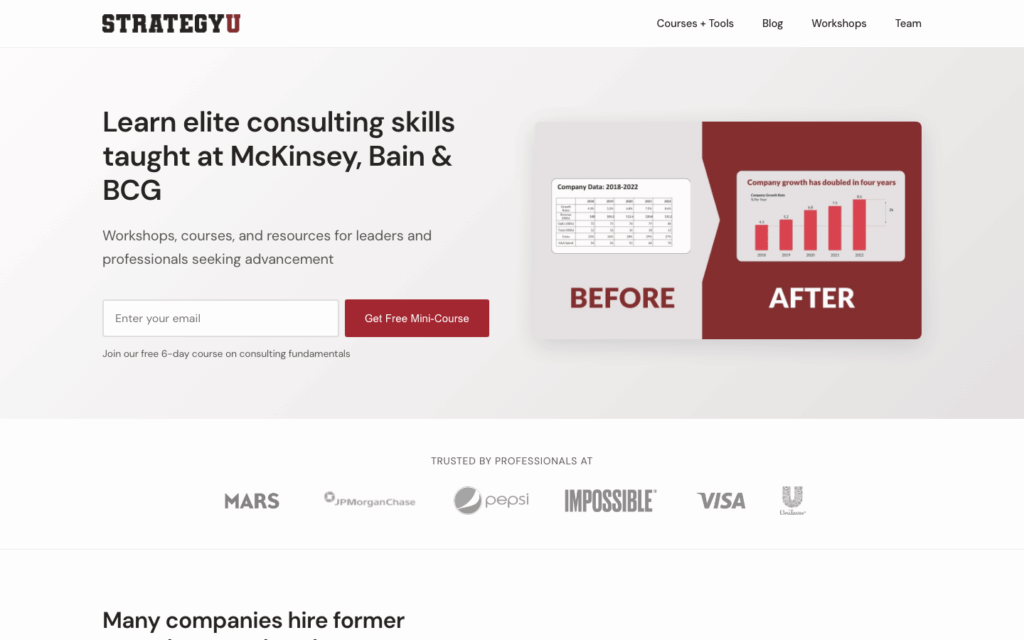
Strategy U is a self-paced online course built around the frameworks used at McKinsey, Bain, and BCG. It was founded in 2017 by Paul Millerd, who held knowledge and research roles at McKinsey and BCG and holds an MBA and M.S. in Systems Engineering from MIT. The flagship course — Think Like a Strategy Consultant — runs four weeks and 76 lessons, and is trusted by professionals at Mars, JPMorgan, PepsiCo, Visa, Unilever, and Impossible Foods.
MECE is the central framework in week two. You learn how to apply it to problem disaggregation, issue trees, and structured synthesis using the Label-Sort-Insight method. Week three extends this into hypothesis-driven problem solving — SCQA, issue trees, and hypothesis development — which builds directly on the MECE logic from the week before. This sequencing is what sets Strategy U apart from programs that teach MECE in isolation.
The course covers four weeks in total. Week one introduces the consulting mindset, top-down versus bottom-up workflows, and mental models. Week two covers MECE, the Pyramid Principle, and structured synthesis. Week three goes deeper on hypothesis-driven problem solving. Week four applies everything to PowerPoint and persuasion — slide design and top-down communication. Bonus materials include interviews with MBB consultants, 100+ slide templates, and AI guidance on presentations.
Key features
- MECE thinking — week two module: Problem disaggregation, structured categories, issue tree construction, and MECE testing of arguments
- Label-Sort-Insight: A practical method for organising MECE thinking into structured outputs
- Pyramid Principle: How to lead with the conclusion and structure supporting arguments top-down
- Hypothesis-driven problem solving: SCQA framework, hypothesis trees, and issue analysis — the week three extension of MECE logic
- Slide design and top-down communication: Applying structured thinking to PowerPoint construction and persuasion
- MBB consultant interviews: First-hand context on how top consulting firms apply these frameworks
- 100+ slide templates: Ready-to-use consulting-style templates
- Free 6-day email mini-course: An accessible entry point covering consulting fundamentals before purchasing
Pricing
| Format | Price |
|---|---|
| Self-paced course | $797 |
| Executive coaching add-on | $2,250+ |
| Corporate virtual workshop | $7,500 |
| Corporate in-person workshop | $12,000 |
| Customized cohort program | $25,000+ |
Pros & cons
Pros:
- One of the few self-paced courses that teaches MECE within a complete consulting framework — not as a standalone concept
- Strong Fortune 500 client proof: JPMorgan, Visa, PepsiCo, Unilever, Impossible Foods
- MECE sequenced logically into hypothesis-driven thinking in week three — good curriculum architecture
- 30-day money-back guarantee reduces purchase risk
- Free 6-day mini-course lets you assess fit before committing $797
Cons:
- No stakeholder management content — a significant gap for mid-senior professionals who need to apply MECE in complex organizational settings
- Founder’s MBB roles were knowledge and research positions, not client-facing engagement delivery
- AI is a bonus add-on, not embedded into the MECE or problem-solving curriculum
- Self-paced only at the individual tier — no live instruction, cohort, or accountability structure
- No feedback on your own work — you apply frameworks but receive no critique of your output
Customers
1,000+ students enrolled globally. Average rating: 4.9/5. Trusted by professionals at Mars, JPMorgan, PepsiCo, Visa, Unilever, and Impossible Foods. Corporate clients span finance, strategy, tech, and operations roles.
“The MECE module alone changed how I approach every analysis I run. I can’t unsee it once you learn it properly.”
2. Firm Learning
Firm Learning is a mentor-led coaching and training program based in Munich, Germany. It was founded by Heinrich Rusche, who spent more than six years at McKinsey before moving through several C-suite positions. The program is co-led by Managing Director Johannes Sommer, who has more than six years of strategy consulting experience with a focus on private equity and value creation. Together, they have trained 5,000+ professionals across 200+ teams and 500+ training sessions globally.
MECE is taught through Firm Learning’s Professional Program as part of a structured problem-solving curriculum. Unlike self-paced courses, Firm Learning applies MECE coaching directly to your real work — your actual deliverables, presentations, and business problems. This makes the learning contextual in a way that generic case study content cannot replicate. Professionals learn to apply MECE not in a simulated environment but in the situations they face every day.
The program is selective. You apply through a free initial consultation, then move through a strategy call before being accepted. Programmes typically run three to twelve months depending on your starting point and goals. Firm Learning also teaches structured problem solving, communication, slide writing, and leadership skills — making it broader than a standalone MECE course, if narrower than a full bootcamp.
Key features
- MECE applied to your real work: Coaching applies structured problem solving to your actual business context, not abstract case studies
- Structured problem solving curriculum: Issue trees, hypothesis-driven analysis, and MECE testing integrated into professional output coaching
- Communication and slide writing: Clarity frameworks and slide writing principles taught alongside structured thinking
- Personal mentor: Each client is assigned a personal mentor who provides regular check-ins and progress accountability
- Online academy access: A library of online classes, tools, and templates available throughout the program
- Practical exercises with feedback: Exercises designed around real work situations with direct feedback from experienced mentors
- Live classes and consultation hours: Almost daily live calls for questions, practice, and direct coaching access
- Global community: A professional network across 25+ nationalities for peer learning and discussion
Pricing
| Format | Price |
|---|---|
| Coaching programs (Candidate, Professional, Leadership) | Low-to-mid four figures — by inquiry after initial consultation |
| Corporate team training | By inquiry |
Pricing is discussed during the free initial consultation. Firm Learning states professionals should expect pricing “in the low to medium four figures.”
Pros & cons
Pros:
- MECE applied to your own real work — not generic examples — which accelerates practical skill transfer
- Credible founding team: Heinrich Rusche with 6+ years at McKinsey; Johannes Sommer with 6+ years in strategy consulting
- Personal mentor creates accountability that self-paced courses cannot offer
- 200+ corporate teams trained; 500+ training sessions delivered; strong track record
- 95% of coaching clients achieve their stated goals within six months
Cons:
- No public pricing — requires an initial consultation before you know the cost
- Selective application process — not accessible on demand
- No explicit AI integration in the curriculum
- Stakeholder management is taught partially but is not as deep as a full consulting toolkit program
- Geographic concentration in Europe; less brand recognition in North America
Customers
5,000+ professionals trained across 25+ nationalities. 200+ teams supported. 300,000+ social media followers. Clients include professionals from McKinsey, Capgemini, Porsche, E.ON, and other major firms. NPS score above 70; satisfaction rate above 95%.
“I still use the MECE frameworks from the coaching every week. It changed how I structure everything — emails, analyses, presentations.”
3. High Bridge Academy — Business Excellence Bootcamp (BEB)
High Bridge Academy is our program. We’re including it here because it’s directly relevant — but you should weigh that context accordingly.
High Bridge Academy’s Business Excellence Bootcamp teaches MECE as a foundational module inside a complete consulting skill set. The program was developed by former consultants from top strategy firms. It is designed for professionals with two to ten years of experience who want to operate at a consulting level — not just learn one framework.
What separates BEB from the other two programs on this list is what sits around the MECE training. Most programs teach you how to structure a problem. BEB teaches you what to do with that structure — how to turn a MECE analysis into an executive communication, how to present it to stakeholders who disagree, and how to use AI to work faster throughout the process. MECE is not an isolated module; it is woven through problem solving, communication, and stakeholder management as a consistent thread.
BEB is also the only program on this list that combines all four pillars consultants actually use: structured problem solving (including MECE and hypothesis-driven thinking), executive communication (Pyramid Principle, top-down communication, business storytelling), stakeholder management (influence, alignment, managing up), and AI integration (AI tools embedded into professional workflows as a core skill, not a bonus). This integration is what makes it the strongest option for mid-career professionals who want to apply MECE in real organizational contexts — not just in analytical exercises.
Key features
- MECE and structured problem solving: Issue trees, MECE framework, hypothesis-driven thinking, and decision frameworks — taught as an integrated system, not isolated concepts
- Executive communication: Top-down communication, Pyramid Principle, business storytelling, and slide communication — connecting MECE structure directly to how you communicate it
- Stakeholder management and influence: How to align stakeholders around MECE-structured analysis, manage objections, and drive decisions — a skill no other program on this list teaches at depth
- AI integration — core module: AI tools built into the professional workflow throughout the program; not a bonus add-on
- Practitioner-led instruction: Taught by former strategy consultants with real client delivery experience — not knowledge or research roles
- Immediate workplace application: Every module is designed to apply directly to your real work, not simulated cases
- Individual and corporate formats: Available for individual professionals and for corporate teams building shared methodology across functions
Pricing
| Format | Price |
|---|---|
| Entry workshops | ~$500 |
| Full Bootcamp | ~$2,000 |
| Corporate team programs | By inquiry |
Full pricing at highbridgeacademy.com/beb-pricing.
Pros & cons
Pros:
- Only program that teaches MECE within a complete consulting toolkit — problem solving, communication, stakeholder management, and AI in one course
- Taught by former strategy consultants with genuine client delivery experience
- Stakeholder management depth — the most neglected skill in this category — taught as a core module
- AI embedded throughout as a core professional skill, not an afterthought
- Available for individual professionals and corporate team deployments
Cons:
- Higher price point than single-skill alternatives
- Smaller public student count and review volume than more established platforms
- Full bootcamp pricing requires direct inquiry — less transparent upfront than self-paced competitors
Customers
Business professionals in strategy, operations, finance, product management, and consulting-adjacent roles. Corporate clients span consulting, tech, finance, and startups. Designed for professionals with 2–10 years of experience.
“BEB changed how our team structures every problem and every client presentation. The MECE framework finally clicked when we applied it to a real project with real stakes.”
How they compare
| Strategy U | Firm Learning | High Bridge Academy (BEB) | |
|---|---|---|---|
| MECE framework | Yes — explicit Week 2 module | Yes — applied in coaching | Yes — core curriculum |
| Issue trees | Yes | Yes | Yes |
| Hypothesis-driven thinking | Yes | Yes | Yes |
| Pyramid Principle | Yes | Partial | Yes |
| Executive communication | Yes | Partial | Yes |
| Stakeholder management | No | Partial | Yes |
| AI integration | Bonus only | No | Yes — core module |
| Live instruction | No | Yes | Yes |
| Personal feedback on your work | No | Yes | Yes |
| Format | Self-paced | Mentor-led | Structured bootcamp |
| Price | $797 | Low-to-mid 4 figures | $500–$2,000 |
FAQ
MECE stands for Mutually Exclusive, Collectively Exhaustive. It is a problem-structuring principle developed at McKinsey. Mutually exclusive means your categories do not overlap — each item is distinct. Collectively exhaustive means your categories cover everything relevant — there are no gaps. Together, these two properties ensure your analysis is complete and clean.
MECE was developed at McKinsey in the 1960s by Barbara Minto, who later codified it in The Pyramid Principle. It became the standard for how McKinsey and other top consulting firms structure problems, arguments, and recommendations. It has since spread across strategy, finance, product management, and other fields where structured thinking is valued.
You apply MECE thinking any time you need to break a problem or argument into parts. Start by defining what you are trying to understand or decide. Then identify all the possible categories or drivers — and check that they do not overlap (mutually exclusive) and together cover everything relevant (collectively exhaustive). Issue trees and logic trees are the most common tools for making this visual and testable.
The concept is straightforward — most professionals understand it within minutes. The hard part is applying it consistently under pressure, especially when problems are ambiguous and stakeholders are involved. This is why practice on real work — not just case studies — is the fastest way to build the skill. Programs that apply MECE to your actual deliverables, like Firm Learning and BEB, accelerate this faster than self-paced courses alone.
No. MECE is a general problem-structuring tool that applies to any professional context — strategy, operations, finance, product, communications. Most professionals who learn it have never worked in consulting. The programs on this list are specifically designed to teach consulting frameworks to people who work outside consulting firms.
MECE and the Pyramid Principle are related but distinct. MECE is a principle for structuring your thinking — ensuring your categories or arguments are clean and complete. The Pyramid Principle, developed by Barbara Minto, is a communication framework that tells you how to present your thinking — starting with the conclusion and supporting it with MECE-structured arguments beneath. MECE is how you build the analysis; the Pyramid Principle is how you communicate it.
If you have prior consulting exposure, Strategy U’s self-paced format may feel too foundational. Firm Learning is better for applying MECE coaching to specific career situations. High Bridge Academy’s BEB is the strongest option if you want to reinforce MECE within a complete framework that also covers stakeholder management and AI — skills that become more critical as you advance.
Yes. All three programs offer some form of corporate or team engagement. Strategy U offers corporate virtual workshops from $7,500 and customized cohort programs from $25,000+. Firm Learning works with corporate teams by inquiry. High Bridge Academy’s BEB is specifically designed for both individual professionals and corporate team deployments, with shared methodology as a key outcome.
You can understand MECE conceptually in a few hours. Applying it consistently — to your own work, under real conditions — takes weeks to months of practice with feedback. Self-paced courses give you the framework quickly; mentor-led and bootcamp formats give you the application repetitions that build lasting habit.
Conclusion
MECE thinking is one of the highest-leverage skills a professional can develop. It changes how you approach every problem, every analysis, and every communication. The question is not whether to learn it — it is which program teaches it in the context that best fits where you are and what you need next.
If you want a self-paced course that sequences MECE into a broader consulting framework, Strategy U is a strong option. If you want personal coaching that applies MECE to your real work, Firm Learning is worth exploring. If you want to learn MECE inside a complete consulting toolkit — with executive communication, stakeholder management, and AI built in — High Bridge Academy’s Business Excellence Bootcamp is the most comprehensive program available for mid-career professionals.
Ready to build MECE thinking and consulting-grade problem solving? Explore High Bridge Academy’s Business Excellence Bootcamp — taught by former strategy consultants, built for working professionals.