


Ever sat through a 20-minute update that could have been two sentences?
I have.
Too many times!
After training hundreds of professionals across consulting, finance, and corporate strategy teams, I’ve seen one pattern repeat itself: smart people bury their point. They build up context. They share a background. And by the time they get to the answer, their audience has already checked out.
This is the communication gap that costs companies millions of dollars. And fixing it requires more than a one-off workshop. It requires building a habit.
In this blog, I’ll walk you through:
- Why top-down communication (Pyramid Principle) is the #1 skill executives look for
- A proven 5-step process to train your team on this approach
- Practical exercises you can implement starting this week
Let’s get into it.
Why Top-Down Communication Matters More Than Ever?
Here’s a number that should concern every manager: 86% of employees and executives cite ineffective communication for workplace failures.
That’s not a minor issue. That’s a systemic breakdown.
According to the 2024 Grammarly State of Business Communication Report, poor communication costs U.S. businesses an estimated $1.2 trillion annually. And the biggest culprit? Messages that bury the point.
The problem isn’t that employees lack intelligence. It’s that they haven’t been trained to structure their thinking in a way that respects the audience’s time.
This is where top-down communication becomes essential.
Top-down communication (Pyramid Principle) means leading with your conclusion first, then supporting it with key arguments and evidence. It’s the opposite of how most people naturally communicate, which is to build up to a point.
Here’s why this matters for your team:
- Executives are time-starved. They need to grasp your message in seconds, not minutes.
- Decisions move faster. When the answer is upfront, stakeholders can immediately engage or push back.
- Credibility increases. Clear, structured communication signals competence and confidence.
The companies that train their teams on this approach consistently outperform those that don’t. And the gap is widening.
What The Pyramid Principle Actually Looks Like?
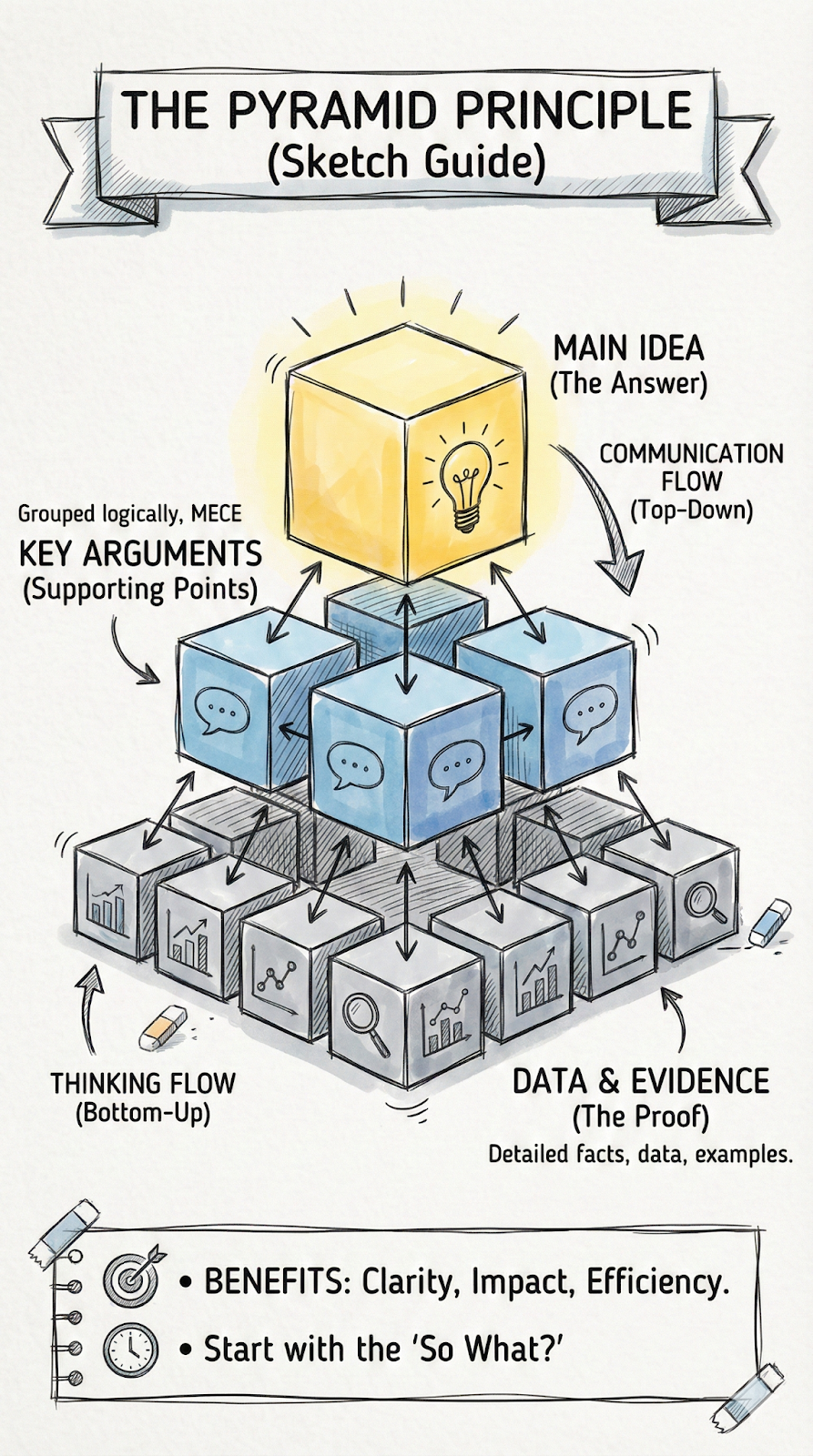
Let me show you the difference with a real example.
Imagine an analyst updating their manager on a market research project. Here’s how most people communicate:
❌ Before (Bottom-Up Approach):
“So I looked at the competitor data from Q3, and I also reviewed some customer feedback we got last month. The pricing analysis took longer than expected because the data was messy. I had to clean it up first. Anyway, I noticed some interesting patterns in the European market, and I think there might be an opportunity there. But I’m still waiting on a few more data points before I can confirm anything. I should have the final numbers by Thursday.”
What’s the point? The manager has to work hard to extract it.
✅ After (Top-Down Approach):
“We’ve identified a pricing opportunity in Europe that could increase margins by 8%. Here’s what we found: European competitors are pricing 15% higher than our current rates. Customer feedback confirms willingness to pay more for premium features. I’ll have final recommendations by Thursday.”
Same information. Entirely different impact.
Here’s the structure breakdown:
| Element | Bottom-Up Version | Top-Down Version |
| Opening | Process details | Key conclusion |
| Middle | Scattered observations | Supporting arguments |
| Closing | Vague next step | Clear action item |
| Audience Experience | Confused, impatient | Engaged, informed |
Notice what changed?
The top-down version respects the audience’s time by delivering the most important information first. The supporting details follow in logical order.
This is the core principle: start with the answer, then explain how you got there.
Why Teams Struggle With This (And It’s Not Their Fault)?
If top-down communication is so effective, why don’t more people do it naturally?
Simple: we’re trained to think bottom-up, but we need to present top-down.
Barbara Minto, the former McKinsey consultant who developed this communication method, put it perfectly: “You think from the bottom up, but you present from the top down.”
Most education systems reward building to a conclusion. We learn to show our work. We’re taught that context comes first. This conditioning is hard to break.
Here are the four biggest barriers I see when training teams:
- Fear of sounding presumptuous: Some people worry that leading with the answer feels arrogant. It doesn’t. It shows respect for your audience’s time.
- Attachment to the process: Employees want credit for their hard work. So they describe every step. But stakeholders care about outcomes, not process.
- Lack of practice: Top-down communication feels unnatural at first. Without deliberate practice, people default to old habits under pressure.
- No feedback loops: If no one corrects scattered communication, it becomes normalized. Teams need consistent reinforcement.
| 💡 Pro Tip: The next time someone gives you a long-winded update, don’t just tolerate it. Ask, “What’s the bottom line?” This trains people to lead with the answer. |
I once worked with a strategy team that spent 45 minutes on weekly updates. After training them on top-down communication, updates dropped to 15 minutes.
Same content but better structure.
The 5-Step Training Roadmap for Pyramid Principle at Work
Building this habit requires more than a single workshop. You need a systematic approach that combines learning, practice, and reinforcement.
Here’s the exact process I use when training teams:
Step 1: Establish the “Why” First
Before teaching the technique, help your team understand why it matters.
Share examples of communication failures. Show the data. Make it personal. I typically start training sessions with a simple exercise: I ask participants to recall the last time they felt frustrated by a rambling presentation. Everyone has a story.
This creates buy-in. Without it, the training feels like just another corporate initiative.
Step 2: Teach the Core Structure
The structure is straightforward:
- Lead with the answer: State your conclusion, recommendation, or key takeaway first.
- Provide supporting arguments: Group your key points logically (aim for 2-4).
- Back up with evidence: Add data, examples, or details only where needed.
This is sometimes called the “answer-first” method. McKinsey, BCG, and Bain all train their consultants on this approach.
I always emphasize: your first sentence should be your most important sentence.
If someone interrupted you 10 seconds into your message, would they know the main point? If not, you’re burying the lead.
Step 3: Practice With Real Scenarios
Theory without practice is useless.
I have teams practice on actual work scenarios:
- Summarizing a project status in two sentences
- Sending an email requesting a decision
- Presenting findings to a senior stakeholder
The key is immediate feedback. After each practice round, the team reviews what worked and what didn’t.
For more on how I teach analysts to think clearly, check out my detailed breakdown.
Step 4: Create Feedback Rituals
One workshop isn’t enough. You need ongoing reinforcement.
Effective teams build feedback into their culture:
- Meeting check-ins. At the start of meetings, ask everyone to state their key message in one sentence.
- Email reviews. Periodically review team emails together. Discuss what could be restructured.
- Peer coaching. Pair team members to give each other feedback on presentations.
The goal is to establish structured communication as a team norm, rather than an individual skill.
Step 5: Recognize and Reward Improvement
What gets celebrated gets repeated.
Publicly recognize when someone delivers a clear, structured message. Call out great examples in team meetings. This creates positive reinforcement.
At High Bridge Academy, our Business Excellence Bootcamp dedicates multiple sessions to structured communication because we’ve seen how transformative it is for professional growth.
Practical Exercises for Immediate Application of The Pyramid Principle
Let me give you three exercises you can run with your team this week.
Exercise 1: The “Headline Test”
Time: 10 minutes
Ask each team member to write a one-sentence summary of their current project status. The sentence must answer: What’s the most important thing the reader needs to know? Then, read the headlines aloud. Discuss which ones are clear and which ones bury the point.
Why it works: It forces people to distill their message. Most people will struggle the first time. That’s the point.
Exercise 2: Before-and-After Rewrite
Time: 20 minutes
Collect 3-4 real emails or updates from your team (anonymize if needed). As a group, rewrite them using a top-down structure. Compare the originals to the rewrites. Notice how much shorter and clearer the rewrites become.
Why it works: Working with real examples makes the training stick. People see the immediate value.
Exercise 3: The 30-Second Update
Time: 15 minutes
Each person gives a 30-second verbal update on their current work. They must follow this format:
- State the key takeaway (5 seconds)
- Provide 2 supporting points (20 seconds)
- State the next step (5 seconds)
The time constraint forces discipline. Most people will initially go over. That’s feedback in itself.
| 🔥 Activity Challenge: Run one of these exercises in your next team meeting. Track how communication clarity improves over 4 weeks. |
If you want more structured exercises, our guide on real-world exercises to improve your team’s soft skills has additional ideas.
How to Reinforce the Habit Long-Term
Training is just the start. Sustainability is the real challenge.
Here’s what I’ve seen work:
Create Visual Reminders
Post the structure somewhere visible in your workspace. A simple poster with “Answer First. Key Points. Evidence.” works wonders. Visual cues trigger the right behavior at the right moment. Keep the habit top of mind without extra effort.
Standardize Meeting Formats
Require that all project updates follow the top-down structure. When every team member uses the same communication approach, it becomes the norm rather than the exception. Consistency across meetings reinforces the skill faster than individual practice alone.
Build It Into Performance Reviews
Explicitly evaluate communication clarity during formal reviews. Include specific criteria, such as “leads with key message” and “structures updates logically.” What gets measured gets improved. People prioritize skills that affect their evaluations.
Schedule Quarterly Refreshers
A 30-minute session every few months keeps the skill sharp. Review examples, practice new scenarios, and troubleshoot challenges to enhance your skills. Skills decay without practice. Regular touchpoints prevent backsliding into old habits.
Lead by Example
Managers must model the behavior they expect from others. If leaders ramble in meetings and bury their points in emails, teams will mirror that approach. Demonstrate structured communication in every interaction. Your team watches how you communicate more than what you say about communication.
| ⚠️ Warning: Avoid one-and-done training. Studies show that without reinforcement, people forget 75% of what they learned within a week. Build in repetition. |
Also, consider how presentation storytelling techniques complement structured communication. They work hand in hand.
Common Mistakes to Avoid
I’ve seen these pitfalls derail communication training many times:
Mistake 1: Overloading With Theory
People don’t need a 50-page manual on communication principles. They need simple rules and lots of practice. Lengthy explanations bore participants and reduce retention. Keep training sessions practical, interactive, and focused on doing rather than learning.
Mistake 2: No Immediate Application
If training doesn’t connect to real work, it won’t transfer. Generic examples feel disconnected from daily responsibilities. Always use actual team scenarios, real emails, and genuine project updates. Relevance drives retention and behavior change.
Mistake 3: Expecting Overnight Change
Habits take time. Expect awkwardness and stumbles in the first few weeks. That’s completely normal. Team members will initially forget, revert, and struggle. Celebrate small wins and progress rather than demanding perfection immediately.
Mistake 4: Skipping the Feedback Loop
Without regular feedback, people drift back to old patterns within weeks. Good intentions fade when nobody holds the team accountable. Build in structured moments for review. Weekly check-ins or peer feedback sessions keep the skill active and improving.
Mistake 5: Ignoring Written Communication
Many teams focus only on verbal presentations and meetings. But emails, Slack messages, and reports need the same structure. Written communication often gets overlooked in training. In fact, how action titles transform business presentations applies to all forms of business writing.
Measuring Success: How to Know If The Pyramid Principle is Working?
You can’t improve what you don’t measure.
Here are the metrics I track when evaluating communication training:
| Metric | How to Measure? | Target Improvement |
| Meeting length | Compare the average duration before/after | 20-30% reduction |
| Email response time | Track how quickly decisions get made | Faster turnaround |
| Stakeholder feedback | Survey executives on clarity | Improved ratings |
| Employee confidence | Self-assessment surveys | Higher scores |
| Repeat clarifications | Count “can you explain that again?” moments | 50% reduction |
Did you know that 40% of HR leaders cite communication training as their top L&D priority for 2025? This is a skill that directly impacts business outcomes.
Let’s Train Your Team!
Top-down communication isn’t a luxury skill. It’s a necessity.
The teams that communicate clearly save time, build credibility, and make faster and more informed decisions. The teams that don’t? They waste hours in meetings, frustrate stakeholders, and lose momentum.
The good news: this is a trainable skill.
With the right structure and consistent practice, any team can build this habit. Start with the 5-step roadmap. Run one exercise this week. Create feedback rituals. And reinforce consistently.
If you want to accelerate this process, consider our Business Excellence Bootcamp, where we train professionals on structured problem-solving, top-down communication, and executive presence.
Your team’s communication will define their impact. Make it count!.