

BCG and Bain didn’t build their reputations on smart people. They built them on a specific way of thinking — structured, hypothesis-driven, and ruthlessly clear.
That thinking has a method. Consultants learn to define problems precisely, structure them in MECE trees, form hypotheses before gathering data, and communicate conclusions top-down. It’s a discipline, and it’s teachable.
This guide covers the best courses for learning BCG-style and Bain-style thinking in 2026. Each program takes a different approach — from full consulting bootcamps to cohort-based marketplaces and broad self-paced platforms. The right fit depends on how deep you want to go and what you need the skill for.
What are the best courses to learn BCG-style and Bain-style thinking?
High Bridge Academy’s Business Excellence Bootcamp (BEB) teaches the full consulting thinking methodology — structured problem solving, hypothesis-driven analysis, MECE frameworks, and executive communication — with AI integrated throughout. Maven hosts cohort-based courses from practitioners who teach consulting thinking and structured communication.
The Analyst Academy covers the communication and presentation layer of consulting thinking — slide design, data visualization, and the Pyramid Principle. Coursera offers individual courses on strategic thinking and business problem solving. LinkedIn Learning provides short-form professional skills content for foundational exposure.
| Platform | Starting Price | Best For | Key Differentiator | Free Trial |
|---|---|---|---|---|
| High Bridge Academy (BEB) | ~$500 | Professionals wanting the full BCG/Bain consulting thinking toolkit | Combines structured problem solving, communication, stakeholder management, and AI in one program | No |
| Maven | $300–$2,000+ per course | Professionals who want cohort-based instruction from practitioners | Curated cohort format with live sessions and peer interaction | Varies by course |
| The Analyst Academy | $197–$497 | Professionals focused on consulting-style slides and presentation structure | Pyramid Principle applied to slide decks | No |
| Coursera | Free–$79/month | Professionals wanting low-cost exposure to strategic thinking topics | University-backed certificates from Yale, Michigan, and Google | Yes (free audit) |
| LinkedIn Learning | ~$30/month | Professionals who want broad introductory coverage | Integrated with LinkedIn Premium; certificates visible on LinkedIn | Yes (free trial) |
1. High Bridge Academy (BEB): The full BCG/Bain thinking toolkit for professionals
Disclosure: High Bridge Academy is our own product. We’ve included it because we believe it genuinely belongs on this list, but you should know we’re not a neutral party.
High Bridge Academy’s Business Excellence Bootcamp teaches the thinking methods behind BCG and Bain. It applies them directly to your job. The program is built around structured problem solving, hypothesis-driven analysis, MECE frameworks, and executive communication. These aren’t survey-level introductions. They’re the same frameworks taught inside top strategy firms, now structured for professionals working outside consulting.
What separates BEB from standalone courses is integration. Structured thinking is taught alongside executive communication, stakeholder management, and AI tools. You don’t just learn how to build an issue tree. You learn how to communicate the output, align stakeholders around it, and use AI to move faster.
Unlike most programs that focus on a single skill, BEB was built to mirror how consulting teams operate in real business environments.
The program is designed and delivered by 60+ former McKinsey, Bain, and BCG consultants with real client-facing experience across strategy, operations, transformation, and executive communication projects. Pricing starts at ~$500 for entry workshops, up to ~$2,000 for the full bootcamp.
Key features
- Structured problem solving: Learn to define, disaggregate, and analyze business problems the way BCG and Bain consultants do.
- Hypothesis-driven thinking: Form and test hypotheses before gathering data — not after.
- MECE frameworks: Structure problems and arguments with no overlaps and no gaps.
- Executive communication: Communicate conclusions top-down to senior stakeholders.
- Delivered by 60+ ex-MBB consultants: Learn directly from former McKinsey, Bain, and BCG practitioners who have applied these frameworks with real clients and business leaders.
- AI integration: Use AI tools embedded into consulting-grade workflows to work faster and communicate better.
Pricing
- Entry workshops: ~$500 USD
- Full Bootcamp: up to ~$2,000 USD
- Full pricing: highbridgeacademy.com/beb-pricing/
Pros & cons
Pros:
- Consulting thinking taught as a complete, integrated curriculum — not isolated modules
- Covers problem solving, communication, stakeholder management, and AI in one program
- Taught by former strategy consultants with real client delivery experience
- Transparent, accessible pricing from ~$500
Cons:
- No free trial before committing to the program
Customers
High Bridge Academy serves professionals in strategy, operations, finance, product management, and corporate leadership. Typical participants have 2–10 years of experience. Corporate teams across consulting, technology, finance, and other professional services environments use BEB to develop structured problem solving, executive communication, and decision-making capabilities at scale.
Expert Perspective: The Hidden Skill Behind Top Consultants
“When people observe great consultants, they often focus on the frameworks, slide decks, or analytical models. But those are outputs. The underlying skill is the ability to create structure where none exists. Whether you’re entering a new market, improving performance, or making a strategic decision, the challenge is rarely the lack of information. The challenge is determining what matters, what doesn’t, and what should happen next. That’s the capability consulting firms systematically develop.”
— Flavio Soriano, ex-McKinsey, Founder of High Bridge Academy
2. Maven: Cohort-based courses from consulting practitioners
Maven is a two-sided marketplace where subject matter experts create and run their own cohort-based courses. The platform hosts courses on consulting thinking, structured communication, and the Pyramid Principle. Some are led by practitioners with real MBB backgrounds.
The cohort format is Maven’s main advantage. You’re not watching passive video content. You learn alongside a peer group through live sessions, structured exercises, and direct instructor access. For professionals who want accountability and interaction, the format delivers more than self-paced alternatives.
The trade-off is variability. Instructor quality, curriculum rigor, and depth differ significantly across courses. You need to evaluate each course individually — the platform doesn’t guarantee a consulting-grade experience by default. Course pricing typically runs $300–$2,000+ depending on the instructor and format.
Key features
- Cohort-based delivery: Live sessions with structured exercises and peer interaction across a defined program timeline.
- Practitioner instructors: Courses led by practitioners across consulting, technology, and other professional fields.
- Consulting thinking courses: Programs on structured communication, the Pyramid Principle, and consulting-style problem solving.
- Lightning Lessons: Free short-form sessions as an entry point to paid cohorts.
- Flexible enrollment: Multiple cohorts available across the calendar — enroll when timing fits.
Pricing
- Individual courses: $300–$2,000+ (varies by course and instructor)
- Lightning Lessons: Free
- No platform-wide subscription — each course is purchased separately
Pros & cons
Pros:
- Cohort format creates live accountability and peer learning vs. passive video
- Instructors include genuine practitioners from top organizations
- Wide range of topics including structured communication and consulting thinking
- Lightning Lessons offer a free entry point before committing to paid courses
Cons:
- Marketplace model means quality varies widely by instructor
- No integrated curriculum — you assemble your own learning path across multiple courses
- No single program that combines problem solving, communication, stakeholder management, and AI together
Customers
Maven hosts courses from practitioners across consulting, technology, and other professional domains. Course quality and participant experience vary by instructor and cohort. The platform has strong credibility among tech and product professionals seeking cohort-based professional development.
3. The Analyst Academy: Consulting-style slides and Pyramid Principle communication
The Analyst Academy was founded by Paul Moss, a Wharton MBA and former management consultant. The platform focuses on the communication execution layer of consulting work — slide design, data visualization, and Pyramid Principle storytelling.
BCG and Bain consultants communicate in a specific way. Slides carry a single message in the headline, arguments flow top-down, and data supports conclusions rather than leading to them. The Analyst Academy teaches exactly that — applied to PowerPoint, not just theory.
This is not a full consulting thinking program. You won’t learn structured problem solving or hypothesis-driven analysis here. But if your gap is slide structure and visual communication, the Analyst Academy is a practical option at $197–$297.
Key features
- Presentation Storytelling course: Pyramid Principle applied to slide decks and executive presentations.
- Advanced PowerPoint for Consultants: Consulting-grade slide design and formatting.
- Data Visualization for Consultants: Chart selection and data visualization standards from top consulting firms.
- Message-first headlines: How to write top-down headlines that carry the argument at a glance.
- Complete Presentations Bundle: All three core courses combined.
Pricing
- Advanced PowerPoint course: $197
- Presentation Storytelling course: $297
- Complete Presentations Bundle: $497
- Corporate team license: $197/user (3-year access, all three courses)
- Live team training: By inquiry
Pros & cons
Pros:
- Courses focused on consulting-style communication and presentation development.
- Low entry price at $197–$297 with lifetime access
- Focused specifically on the communication execution layer used at BCG and Bain
- Corporate team licensing available at $197/user
Cons:
- Limited to slides and visual communication — no problem solving, hypothesis-driven thinking, stakeholder management, or AI
- No live interaction or feedback in the core self-paced courses
Customers
The Analyst Academy serves professionals looking to improve presentation storytelling and consulting-style communication. Presentation Storytelling is one of the platform’s flagship communication courses. The platform is commonly referenced by professionals working on presentations and communication.
4. Coursera: University-backed courses on strategic thinking
Coursera is a large online learning platform offering thousands of courses from universities and organizations around the world. Relevant courses cover business communication, strategic thinking, structured problem solving, and AI for business. Universities like Yale, Michigan, and Duke contribute courses in this space.
For professionals who want low-cost exposure to strategic thinking concepts, Coursera is an accessible starting point. Courses can be audited free. Paid certificates cost $49–$79/month, and Coursera Plus gives access to the full catalog for $399+/year.
The limitation is depth and methodology. Coursera courses on strategic thinking are taught by academic instructors, not former BCG or Bain consultants. The content introduces concepts but doesn’t build the integrated consulting thinking methodology that defines how MBB firms actually work.
Key features
- Strategic thinking courses: University-backed content on business problem solving and analytical frameworks.
- Business communication specializations: Courses on structured writing, presentation, and executive communication.
- AI for business: Certificates and specializations on applying AI in professional contexts.
- Coursera Plus: All-access annual subscription covering thousands of courses and certificates.
- Coursera for Business: Corporate subscription for team learning and credentialing.
Pricing
- Free audit: Available on most courses
- Individual certificates: ~$49–$79/month
- Coursera Plus: $399+/year (all-access)
- Coursera for Business: By inquiry
Pros & cons
Pros:
- University-backed credentials from Yale, Michigan, Google, and IBM
- Free audit option reduces the barrier to entry
- Broad topic coverage at low cost
- Strong enterprise option through Coursera for Business
Cons:
- Academic instruction, not practitioner-led — most instructors are professors, not former strategy consultants
- No integrated consulting methodology — courses teach individual topics in isolation
- Completion rates on self-paced MOOCs are notoriously low
- BCG/Bain-style thinking requires applied practice, not just concept exposure
Customers
Coursera has 148M+ registered learners and partnerships with 700+ universities and companies. Corporate clients use Coursera for Business for team-wide upskilling. Certificates from top university partners carry recognition in the market for foundational skills.
5. LinkedIn Learning: Short-form professional skills content
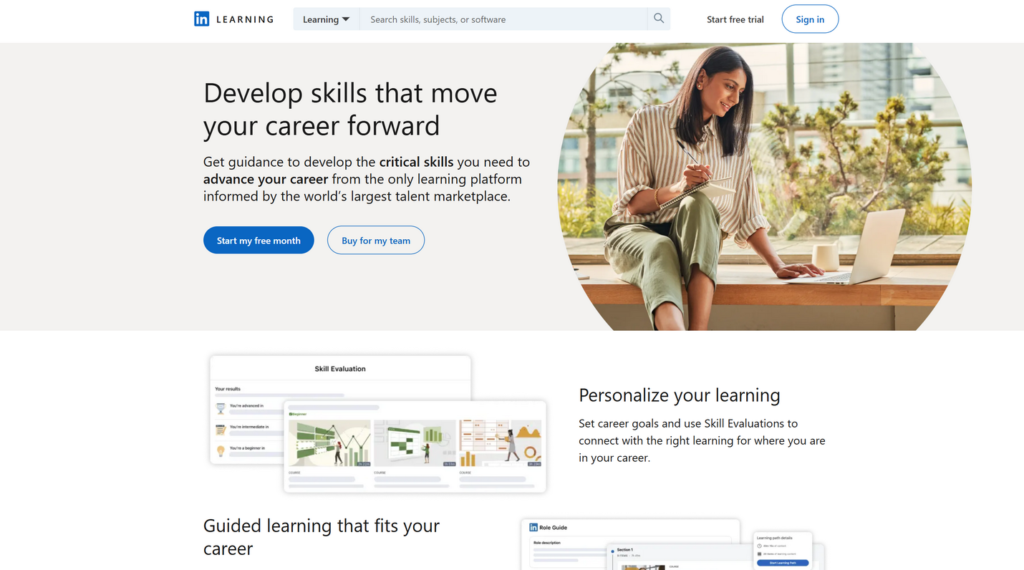
LinkedIn Learning is Microsoft’s professional skills library, integrated directly with the LinkedIn platform. It offers 22,000+ courses, available to all LinkedIn Premium subscribers. Relevant courses cover communication, business analysis, leadership, structured thinking, and AI tools.
The main advantage is access. If you already have LinkedIn Premium, LinkedIn Learning is included at no extra cost. Certificates display directly on your LinkedIn profile — a minor but visible signal for recruiters. Short courses typically run 1–3 hours, making them easy to fit around a busy schedule.
The limitation is the same as most passive video libraries. LinkedIn Learning builds awareness, not capability. Watching a 90-minute course on “consulting problem solving” doesn’t produce the applied skill — especially without structured exercises, feedback, or cohort accountability.
Key features
- Structured thinking courses: Short-form courses on logical thinking, problem solving, and analytical frameworks.
- Business communication: Content on presentation skills, executive communication, and stakeholder management basics.
- AI tools for professionals: Courses on using AI in professional workflows, productivity, and communication.
- LinkedIn profile integration: Completed certificates appear on your LinkedIn profile automatically.
- LinkedIn Learning for Business: Corporate subscription for team-wide access and reporting.
Pricing
- Included with LinkedIn Premium (~$39.99/month)
- Standalone subscription: ~$29.99/month
- LinkedIn Learning for Business: By inquiry
Pros & cons
Pros:
- Included with LinkedIn Premium — low incremental cost for existing subscribers
- Certificates visible on LinkedIn profile
- Broad topic coverage across communication, problem solving, and AI
- High production quality on many courses
Cons:
- No consulting-grade depth — content is broad and introductory
- No structured methodology or progressive curriculum
- Purely passive format with no exercises, feedback, or cohort accountability
- LinkedIn Learning certificates carry limited market signal compared to practitioner-led programs
Customers
LinkedIn Learning is available to all LinkedIn Premium subscribers globally. Corporate clients use LinkedIn Learning for Business for team access and reporting. The platform is widely used for introductory professional skills content across industries.
Frequently asked questions
BCG-style and Bain-style thinking refers to the structured problem-solving methodology used inside top strategy consulting firms. It includes defining problems precisely, structuring them in MECE issue trees, forming hypotheses before gathering data, and communicating conclusions top-down. It’s a discipline taught inside those firms — and increasingly available to professionals outside consulting.
They overlap significantly. All three firms — McKinsey, BCG, and Bain — use hypothesis-driven problem solving, MECE structuring, and top-down communication. Minor differences exist in emphasis and vocabulary, but the core methodology is shared. Courses that teach “consulting thinking” generally teach methods common to all three firms.
High Bridge Academy’s BEB is the only option on this list that combines structured problem solving, executive communication, stakeholder management, and AI in a single program. If you want the full toolkit — not just one element of it — BEB is the right fit.
You can get exposure to the concepts through free audits on Coursera or free Lightning Lessons on Maven. But BCG and Bain-style thinking requires applied practice, not just concept awareness. The frameworks only become a real skill through structured exercises, feedback, and repetition — which free content rarely provides.
Foundational exposure takes days. Applied proficiency — where you can use the frameworks fluently in your actual work — typically takes weeks of structured practice. Programs like BEB and Maven cohorts are designed to accelerate that timeline through structured application, not just passive learning.
No. These courses are specifically designed for professionals who didn’t come up through a consulting firm. The goal is to bring the thinking methods of BCG and Bain to professionals working in corporate, finance, product, and strategy roles — regardless of background.
Conclusion: Match the course to your actual gap
If your gap is specifically the communication and slides layer, The Analyst Academy is a practical and affordable option. The Presentation Storytelling course applies Pyramid Principle concepts directly to slide decks and executive presentations.
If you want cohort-based instruction with live sessions, Maven is worth evaluating. The platform hosts courses from genuine practitioners, and the format creates more accountability than passive video. Vet individual courses carefully before enrolling.
For foundational exposure at low cost, Coursera and LinkedIn Learning both work as starting points. Neither produces consulting-grade proficiency on its own, but they’re accessible entry points for professionals early in the learning curve.
If you want the full BCG/Bain thinking toolkit, High Bridge Academy’s BEB is the right fit. It’s the only program here that combines structured problem solving, communication, stakeholder management, and AI in one curriculum. It’s taught by former strategy consultants with real client delivery experience. Visit highbridgeacademy.com to see the current program and pricing.