

Most professionals struggle to communicate with executives. Not because they lack knowledge. Because they communicate in a way executives don’t respond to.
Executives are time-constrained and outcome-focused. They want the answer first — context second. Most professionals do the opposite, which loses the executive before the point lands.
This guide covers the frameworks that fix that mismatch. It also covers the courses where you can build these skills with structure and expert guidance.
Why executive communication breaks down
Executives operate at a higher level of abstraction than their teams. They make decisions quickly and move between topics fast. They need your conclusion upfront — not a path that builds toward it.
Most professionals were trained to explain their reasoning step by step. That approach works with peers who want to follow your process. It fails with executives who want your point.
The gap isn’t intelligence or effort. It’s communication structure.
Expert Perspective: Why Executive Communication Matters More Than Ever
“One of the biggest misconceptions professionals have is that executive communication is mainly about confidence or presentation skills. In reality, senior leaders care far more about clarity, structure, and decision usefulness. The professionals who advance fastest are usually the ones who can simplify complexity, communicate recommendations clearly, and help executives make decisions faster.”
— Flavio Soriano, ex-McKinsey, Founder of High Bridge Academy
What executives want from every communication
Executives want three things from any communication. They want to know what you’re recommending, why it’s the right call, and what they need to do next. If your message doesn’t deliver those things clearly and quickly, you lose the room.
They’ll interrupt, ask for a summary, or disengage entirely. Understanding this changes how you prepare every email, meeting update, and presentation.
The frameworks that work
1. Top-down communication
Top-down communication means leading with your conclusion. You state the answer or recommendation first. Then you provide the supporting rationale.
This is how strategy consultants communicate with senior executives. It’s the direct opposite of how most professionals write and speak. Switching to this structure is the highest-impact communication change you can make.
The Pyramid Principle — developed by Barbara Minto at McKinsey — is the formal version of this approach. It organizes any message as a hierarchy: answer at the top, grouped supporting arguments below, evidence at the base. Mastering it changes how you write emails, build slides, and run meetings.
2. SCQA: Situation, Complication, Question, Answer
SCQA is a framework for opening any communication with executives. It orients the listener quickly and without wasted context. Each letter maps to one element of a tight, logical opening.
- Situation: What is already true and agreed upon
- Complication: What has changed or created a problem
- Question: What decision or action does this require
- Answer: Your recommendation or conclusion
An SCQA opening for a budget conversation might go: “We’re on track for Q3 revenue targets (Situation), but one customer segment is declining faster than projected (Complication). The question is whether we should reallocate budget now (Question). Our recommendation is yes — here’s the three-part case (Answer).”
This structure eliminates vague setups. It positions you as someone who thinks before they communicate.
3. MECE thinking
MECE stands for Mutually Exclusive, Collectively Exhaustive. It’s a principle for organizing any analysis or set of recommendations.
Mutually exclusive means no overlap between your categories. Collectively exhaustive means nothing is left out. When your structure is MECE, executives can see the full picture immediately.
They don’t have to wonder what’s missing or where two points overlap. Use it when breaking down options, presenting a problem, or structuring a recommendation.
It signals rigorous thinking — and executives notice.
4. Stakeholder-aware messaging
Not all executives are the same. A CFO cares about financial impact. A COO cares about execution risk.
Effective executive communication means knowing your audience. You adapt the framing, not the underlying logic. The core message stays consistent — the emphasis shifts to what that executive values most.
This is stakeholder management at the communication level. Most professionals never develop it explicitly. But it’s the difference between a message that lands and one that gets redirected.
Common mistakes that undermine executive communication
Burying the point. You open with background, then build to the recommendation. Executives read this as unclear thinking — not thoroughness.
Over-explaining. You provide more detail than the decision requires. Executives want just enough to act, not everything you know.
Topics instead of points. “Update on Project X” is a topic. “Project X is on track — three risks to flag” is a point. Subject lines, email openers, and meeting intros should lead with the point, not the topic.
Asking instead of recommending. Executives prefer “We recommend X” over “What do you think about X?” If you have a recommendation, lead with it. Save the question for when you genuinely need input.
No clear ask. Every communication should close with a specific next step or decision request. Ending without one leaves the executive without direction — and signals you haven’t thought through what you need.
Putting the frameworks into practice
Learning a framework is the easy part. Using it under pressure — in a live meeting, in a board update, in a message to a skeptical CFO — requires repetition. Most professionals understand top-down communication conceptually and still revert to bottom-up when stakes are high.
The gap between knowing and doing closes through deliberate practice in real situations.
Start with emails. Rewrite your next project update so the key point appears in the first sentence. Then check whether anything important is still buried further down. Move it up before you send.
Apply SCQA to your next meeting opening. Write out all four elements before you walk in. Two minutes of preparation changes how the executive experiences the first 60 seconds of the conversation.
Run your next analysis through MECE. Ask whether your categories overlap. Ask whether anything is missing. Fix the structure before the meeting — not during it.
Practice stakeholder tailoring deliberately. Write one version of a key message, then rewrite the opening paragraph for a different executive audience. Notice what changes between the CFO version and the COO version. That awareness builds into a reliable instinct over time.
The fastest way to accelerate this is feedback. A structured course where practitioners review your work — not just explain the theory — compresses months of trial and error into weeks.
Courses to develop executive communication skills
Reading about frameworks helps. Applying them under expert guidance is what changes how you actually work. These are the programs worth considering if you want to build executive communication as a real professional skill.
| Platform | Starting Price | Best For | Covers Communication + Problem Solving + AI? |
|---|---|---|---|
| High Bridge Academy (BEB) | ~$500 | Professionals wanting the full consulting toolkit | Yes — all three |
| Clarity First Program | $1,490 | Senior professionals writing board papers | Communication only |
| Strategy U | $797 | Self-paced learners building consulting thinking | Communication + problem solving; no AI |
| The Analyst Academy | $297 | Professionals focused on slides and storytelling | Communication only |
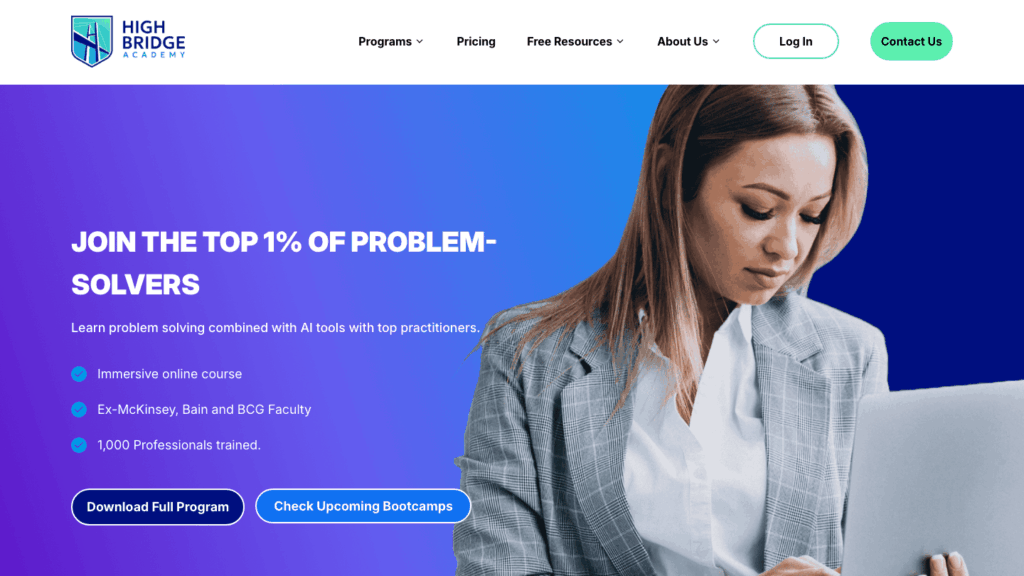
High Bridge Academy — Business Excellence Bootcamp (BEB)
Disclosure: High Bridge Academy is our own product. We’ve included it because we believe it genuinely belongs on this list, but you should know we’re not a neutral party.
BEB teaches executive communication as part of a full consulting-grade curriculum. Top-down communication, business storytelling, and stakeholder management are core modules — not optional add-ons. The program is taught by former strategy consultants with real client delivery experience.
What sets BEB apart is scope. You learn to structure problems, communicate them clearly, and influence stakeholders — all in one program. AI tools are embedded throughout, so you practice with the tools professionals actually use.
Pricing starts at ~$500 for entry workshops, up to ~$2,000 for the full bootcamp. Full pricing at highbridgeacademy.com/beb-pricing/.
Clarity First Program
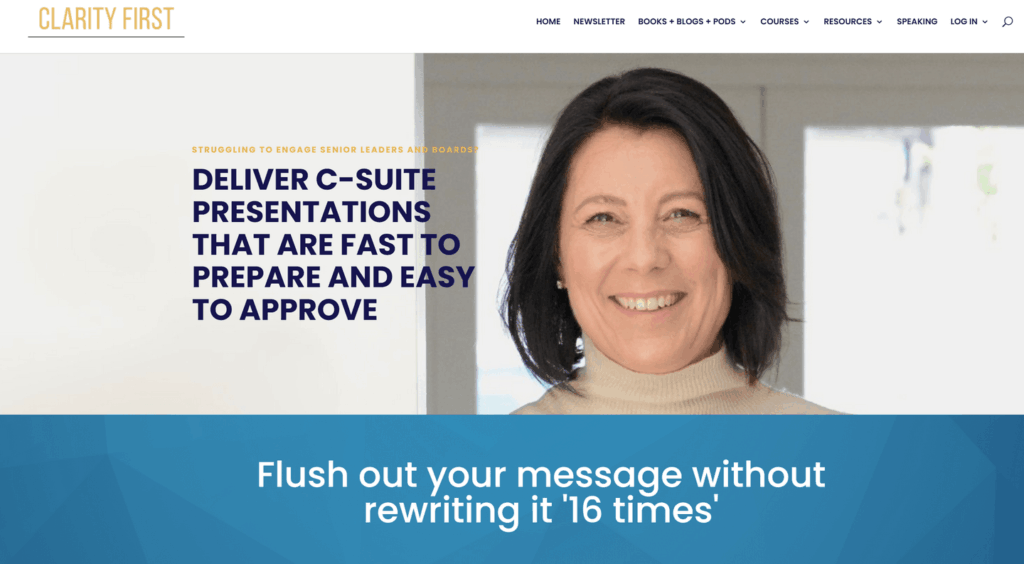
Clarity First was founded by Davina Stanley, a communication specialist with 25+ years of experience. The program has strong roots in Pyramid Principle teaching and focuses heavily on structured executive writing. The flagship program is the Board Paper Bootcamp — a two-week cohort priced at $1,490 USD.
This program is built for senior professionals who regularly write board papers and executive documents. It goes deep on structured writing. It does not cover structured problem solving, stakeholder management, or AI.
Strategy U — Think Like a Strategy Consultant
Strategy U’s flagship course is a four-week self-paced program covering consulting mindset, MECE thinking, the Pyramid Principle, and slide design. It’s priced at $797 and includes a 30-day money-back guarantee. It’s a self-directed option for professionals interested in learning consulting-style frameworks.
The program does not include stakeholder management or meaningful AI integration. The founder’s MBB roles were in knowledge and research, not client-facing delivery. An optional executive coaching add-on is available at $2,250+.
The Analyst Academy
The Analyst Academy focuses on slide design, data visualization, and presentation storytelling. Its Presentation Storytelling course ($297) applies the Pyramid Principle to slide decks and visual communication. Courses are self-paced and focused heavily on presentation storytelling and visual communication.
The scope is narrow — communication execution only. There is no structured problem solving, stakeholder management, or AI integration. It works well as a complement to a broader program, not as a standalone executive communication solution.

Frequently asked questions
Lead with your conclusion. Most professionals bury the point at the end of an email, presentation, or meeting update. Switching to a top-down structure — answer first, rationale second — has more immediate impact than any other adjustment.
The Pyramid Principle is a communication framework developed at McKinsey by Barbara Minto. It organizes any message with the key insight at the top, grouped supporting arguments below, and evidence at the base. Applying it creates clarity in emails, presentations, and spoken communication.
SCQA stands for Situation, Complication, Question, Answer. Use it to open any communication that needs context before the recommendation. It orients the executive quickly and frames your recommendation as the logical response to a real problem.
Most professionals see measurable improvement within weeks of applying a framework like SCQA or top-down communication. Deeper skills — structured storytelling and stakeholder-aware framing — take months of deliberate practice. A structured course with feedback from practitioners accelerates the timeline significantly.
Bottom-up builds to a conclusion — context and analysis come before the point. Top-down leads with the conclusion and supports it afterward. Executives respond to top-down because it matches how they make decisions and manage their time.
Yes — but it’s slow. Without a framework, most professionals repeat the same habits and get the same mixed results. A structured course gives you the pattern first, so your on-the-job practice accelerates instead of stalls.
High Bridge Academy’s Business Excellence Bootcamp covers executive communication alongside structured problem solving, stakeholder management, and AI integration. It’s the only single program that combines all four as a consulting-grade professional toolkit.
Conclusion: Build the skill, not just the awareness
Understanding these frameworks isn’t the same as using them under pressure. Most professionals can describe top-down communication and still revert to bottom-up when it matters. The gap closes through structured practice with real feedback.
A course that requires you to apply frameworks — and gives you feedback from practitioners — produces lasting change. Knowing the concept doesn’t.
High Bridge Academy’s Business Excellence Bootcamp is the place to start. It combines communication, problem solving, stakeholder management, and AI in one structured program. It’s taught by former strategy consultants with real client delivery experience — not academics.