

Most professionals solve problems the same way. They brainstorm ideas, group them loosely, and move forward. The result is messy, incomplete, and hard to communicate clearly.
There’s a better way. MECE — Mutually Exclusive, Collectively Exhaustive — is the framework that separates structured thinkers from everyone else. It’s the foundation of how top strategy consultants structure every problem they touch.
If you’ve wondered why some people think more clearly under pressure, MECE is part of the answer. This post explains what MECE means, how to use it at work, and why it’s worth learning properly.
What does MECE mean?
MECE stands for Mutually Exclusive, Collectively Exhaustive — meaning each category is distinct, and together the categories cover the full problem. The term originated at McKinsey, where it became a core standard for structuring analysis. Today, it’s used across strategy, finance, operations, and product roles worldwide.
Mutually exclusive means each item in your structure belongs to exactly one category. No overlap. If you’re segmenting customers into groups, each customer fits in one group only.
Collectively exhaustive means your categories cover every possible option. Nothing is left out. Together, your categories account for the full problem space.
Top consulting firms like McKinsey, Bain, and BCG use MECE to break down complex business problems into clear, manageable parts.
Here’s a quick test. Ask: can any item belong to two of your categories at once? If yes, they aren’t mutually exclusive. Then ask: is there any item that doesn’t fit any category? If yes, they aren’t collectively exhaustive.
Why MECE matters in business
Without MECE, your analysis has gaps or overlaps. Gaps mean you’re missing something important. Overlaps mean you’re double-counting or creating confusion in your argument.
That sounds simple. In practice, most unstructured thinking violates MECE without the person realizing it. Categories feel logical but don’t hold up when you test them carefully.
MECE matters because your audience needs to trust your structure. Strong structured analysis reduces confusion, eliminates overlap, and makes your recommendations easier to defend. If a senior stakeholder spots a gap or an overlap, your credibility takes a hit. Clean MECE structures prevent that.
MECE thinking is useful in three core business situations: problem structuring, decision-making, and communication. In each case, the goal is the same — no gaps, no overlaps, no ambiguity.
MECE in problem structuring: issue trees
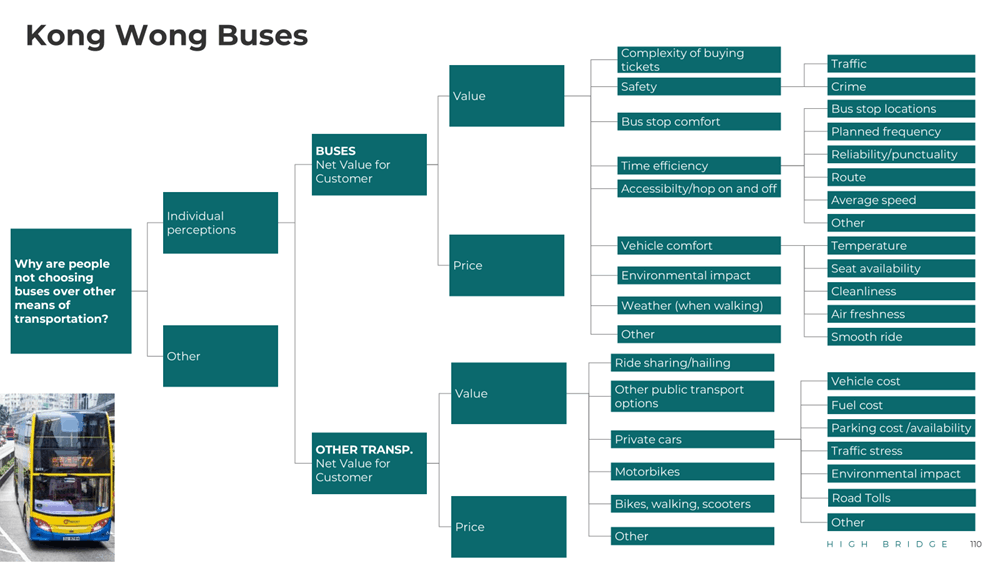
Illustration of MECE thinking using an issue tree framework to structure a business problem into mutually exclusive, collectively exhaustive categories
The most common MECE application is building an issue tree. An issue tree breaks a central question into sub-questions that are MECE. Each branch is mutually exclusive, and together the branches cover the full problem.
Take a simple example. A company’s revenue is declining. You can split that into two MECE branches: volume (fewer units sold) or price (lower revenue per unit). Those two don’t overlap, and together they account for every possible revenue decline.
From there, you go deeper. Volume splits into new customer acquisition and existing customer retention. Price splits into rate (the actual price charged) and mix (which products are selling). Each level of the tree is MECE.
Issue trees are used by strategy consultants on every major engagement. They make complex problems manageable. They also make it obvious where your data gaps are.
Before you finalize any analysis, run a quick check. Ask whether any categories overlap, and whether any possibility is unaccounted for. If the answer to either question is yes, your structure isn’t MECE yet.
MECE in decision-making
MECE helps you make better decisions by ensuring you’ve considered all relevant options. If your list of options isn’t MECE, you’re either missing alternatives or counting the same option twice under different labels.
Imagine you’re evaluating how to enter a new market. Your three options are: build, buy, or partner. Those are mutually exclusive — each is a distinct strategic path. Together, they’re collectively exhaustive — every market entry approach fits one of them.
That’s MECE. Now try a poorly structured version: “organic growth, acquisition, joint venture, licensing.” Joint venture and licensing both fall under partnership. The structure has overlap — and it creates confusion when you try to evaluate the options.
Good decisions start with good option structures. MECE forces you to be explicit about what you’re choosing between — and why. That discipline makes evaluation faster and recommendations easier to defend.
MECE in communication
MECE is the backbone of clear executive communication. Whether you’re presenting to leadership, writing a board memo, or structuring a strategy presentation, MECE helps ensure your message is complete, logical, and easy to follow.
The Pyramid Principle — Barbara Minto’s framework for top-down communication — relies on MECE as a core requirement. Your supporting points must be MECE for the pyramid to hold. If they overlap or leave gaps, the logic collapses.
When you present to senior stakeholders, clarity matters more than volume. A MECE structure signals that you’ve done rigorous thinking. It also makes your message easier to absorb and remember.
Non-MECE communication forces your audience to do the work. They have to figure out how your points relate to each other. MECE communication does that work for them upfront.
Common MECE mistakes
Most professionals make the same few errors when applying MECE for the first time. Knowing them in advance shortens the learning curve.
Overlapping categories. This is the most common mistake. Categories seem distinct but share members. “Domestic clients” and “enterprise clients” can overlap if your enterprise segment includes domestic firms. Test every category pair.
Missing the residual case. If your categories don’t cover every possibility, you need a catch-all. “Other” is often necessary but easy to forget. Just make sure “other” is still mutually exclusive from your named categories.
Mixing levels of abstraction. Don’t list “marketing,” “digital marketing,” and “social media” as siblings — they’re nested. Marketing contains digital marketing, which contains social media. Keep each level of your tree at the same altitude.
MECE by label, not logic. Categories can sound MECE without actually being so. “People problems” and “process problems” seem distinct. In practice, a broken process is often caused by a people decision. Pressure-test the logic — not just the labels.
Forcing a familiar framework onto an unfamiliar problem. A common trap is reaching for a standard 2×2 matrix or known consulting framework without checking if it fits. Start with the problem, then build the structure — not the other way around.
Expert Perspective: Most MECE Structures Only Look Logical
“Bad MECE structures can sound logical at first glance.
That’s what makes them dangerous.
People create categories that feel clean on a slide, but break down the moment you test them against real decisions, real data, or real stakeholder questions.
Good MECE is not about making frameworks look organized. It’s about building structures that survive pressure.”
— Flavio Soriano, ex-McKinsey, Founder of High Bridge Academy
MECE and the Pyramid Principle
MECE and the Pyramid Principle are often mentioned together — and for good reason. They’re complementary frameworks for structured thinking and communication.
These consulting frameworks are designed to solve two problems at once: how to think clearly, and how to communicate that thinking clearly to others. That’s why MECE and the Pyramid Principle remain foundational tools across consulting, strategy, and leadership roles.
The Pyramid Principle says: lead with your conclusion, then support it with MECE reasons. Each reason is supported by MECE evidence below it. The whole structure forms a pyramid with one governing message at the top.
MECE is what makes the pyramid structurally sound. Without it at each level, the pyramid has holes. With it, every question your audience might ask is answered somewhere in the structure.
Together, these two frameworks form the foundation of consulting communication. McKinsey, BCG, and Bain all use variations of them. Learning both — and practicing them together — is a high-leverage professional investment.
MECE vs. exhaustive lists
There’s an important distinction between a MECE structure and a long list. A long list might feel thorough, but it’s not the same thing.
A long list can have duplicates, overlaps, and gaps without anyone noticing. A MECE structure forces you to identify every category explicitly and verify no overlap exists. That verification step is where structured thinking actually happens.
Long lists also create communication problems. Your audience has to do the work of grouping the items themselves. A MECE structure does that work upfront and makes the logic immediately clear.
When you feel the urge to write a list, replace it with a MECE structure instead. The discipline forces you to think more precisely about what you actually mean.
How to start applying MECE today
You don’t need a formal program to start. Here are three immediate applications.
Apply it to your next presentation. Before you finalize your slides, check whether your supporting points are MECE. Do any of them overlap? Have you left something out? Fix the structure before you build the content.
Use it on your next complex problem. Draw a simple issue tree. Break the problem into two or three MECE branches. Then go one level deeper on each. You don’t need software — pen and paper work fine.
Audit a recent document. Take a recent deck or memo and look at your section headers. Ask: are these MECE? Most aren’t. Identifying the gap is the first step to changing the habit.
These three habits compound over time. The more you check for MECE, the faster you’ll spot violations — and the cleaner your thinking will get.
How to test whether a structure is truly MECE
Before finalizing a structure, run through this simple checklist:
- Can any item fit into two categories at once?
- Is any important category missing?
- Are all categories operating at the same level of abstraction?
- Does each category answer the same question?
- Would a senior stakeholder immediately understand the logic?
- Does the structure reduce confusion or create more of it?
If the answer to any of these raises doubt, the structure likely is not fully MECE yet.
Why MECE is hard to develop on your own
Most professionals have never been taught structured problem solving in a formal setting. They know what MECE stands for after a quick search. But applying it correctly — building clean issue trees, structuring decisions, organizing presentations under pressure — requires deliberate practice.
At top consulting firms like McKinsey, Bain, and BCG, consultants spend years refining structured problem solving through repeated feedback from senior leaders. That level of coaching is one reason consulting-grade thinking often feels noticeably sharper, clearer, and more rigorous than typical corporate communication.
Consultants develop MECE fluency on the job. They get corrected by senior colleagues repeatedly before it becomes instinctive. Professionals outside consulting rarely get that kind of structured, ongoing feedback on their thinking.
That’s the gap High Bridge Academy was built to close. The Business Excellence Bootcamp teaches MECE as a core skill — not a definition to memorize. You practice applying it to real business problems with feedback from former strategy consultants who used it every day on client engagements.
Frequently asked questions
MECE stands for Mutually Exclusive, Collectively Exhaustive. It’s a framework for structuring problems so categories don’t overlap and nothing is missing. The term originated at McKinsey and is now standard across consulting, strategy, and finance.
MECE was developed at McKinsey as a standard for structuring client analysis. It became foundational to the consulting profession and spread widely from there. Today it’s used in strategy, operations, finance, product management, and beyond.
MECE is used to structure problems, organize arguments, and build decision frameworks. Issue trees, presentation structures, and segmentation models all rely on MECE logic. Any time you need to break a complex question into parts, MECE applies.
They’re related but distinct. The Pyramid Principle is a communication framework for structuring arguments top-down. MECE is a property those arguments must have — the Pyramid Principle relies on it as a core requirement.
Yes. MECE applies wherever you need to structure a problem or organize information clearly. It’s useful in strategy, finance, product management, operations, and any role that requires clear thinking. The framework is industry-agnostic.
Reading about MECE is a start — applying it to real problems is what builds fluency. The fastest path is structured practice with feedback from people who use it daily. Programs taught by former consultants can accelerate that learning curve significantly.
Segmenting customers by company size is MECE: small, medium, and large. Each customer fits exactly one tier, and every customer is covered. Non-MECE would be: “small businesses, large enterprises, and B2B clients” — a B2B client could be small or large, so the categories overlap.
Conclusion: Stop reading about MECE and start applying it
MECE is not complicated to explain. It is hard to apply well — and most professionals never learn to use it correctly. The gap isn’t knowledge. It’s the absence of deliberate, feedback-driven practice.
If you work in strategy, finance, operations, or any role requiring clear thinking, MECE is worth mastering properly. High Bridge Academy’s Business Excellence Bootcamp teaches it as part of a full consulting-grade curriculum — alongside structured problem solving, executive communication, and stakeholder management. You’ll build the skill with real practitioner feedback, not just read about it. Visit highbridgeacademy.com to see the current program and pricing.