

Can soft skills really be trained, or do people either have them or they don’t?
I hear this question often from managers and L&D leaders who have seen too many workshops create energy in the room but very little change afterward.
In my experience, soft skills can be trained when they are treated as workplace behaviors. People improve when they practice the exact moments that happen at work: giving feedback, listening under pressure, asking better questions, managing tension, explaining decisions, and working with people who think differently.
The World Economic Forum’s Future of Jobs Report 2025 also points in this direction. Skills such as leadership, social influence, resilience, flexibility, agility, empathy, and active listening now sit alongside analytical and technical skills as important workplace capabilities.
In this blog, we will cover:
- Why most soft skills training fails
- 9 soft skills training strategies that work in real teams
- How to build and measure a soft skills training program
Let’s start with the reason so many programs look good in the workshop but disappear in the workplace.
Why Most Soft Skills Training Fails to Change Real Workplace Behavior
Most soft skills training fails because it explains the skill without changing the behavior.
I have seen this many times. A team attends a communication or leadership workshop, agrees with the ideas, enjoys the discussion, then returns to the same unclear updates, weak feedback conversations, long meetings, and cross-functional tension.
The training created awareness, but the behavior stayed the same.
The usual reasons are simple:
- The training covers too many soft skills at once.
- The examples feel generic.
- People practice once and never repeat the behavior.
- Managers do not reinforce the skill after the workshop.
- The program measures attendance or satisfaction instead of workplace change.
Soft skills need practice, feedback, repetition, and real application. If the goal is better communication, people need to practice clearer updates. If the goal is stronger feedback, managers need to practice difficult conversations. If the goal is better collaboration, teams need to practice handoffs, ownership, and disagreement.
The rule I use is simple: define the behavior before designing the training.
Instead of training “better communication,” train people to summarize decisions, owners, and next steps at the end of meetings. Instead of training “empathy,” train people to check the other person’s concern before responding.
That is how soft skills training moves from theory to behavior.
9 Soft Skills Training Strategies That Work in Real Teams
The best soft skills training strategies make people practice real workplace moments in a safe, structured way.
Effective training depends on realistic scenarios, useful feedback, and repetition. Here are the nine strategies I recommend.
1. Use Reverse Role-Play to Build Empathy Across Levels and Teams
Reverse role-play helps people experience how their behavior lands on others.
In a normal role-play, a manager practices giving feedback to an employee. In reverse role-play, the manager becomes the employee receiving unclear feedback. A senior leader becomes the frontline team member trying to follow a policy. A team lead becomes the junior analyst trying to ask a question without sounding unprepared.
I once worked with a leader who believed his instructions were clear. He was experienced, sharp, and used to moving quickly. During a reverse role-play, he had to act as the person receiving his own style of direction. Within ten minutes, he saw the problem.
The person expected to execute the instruction found it confusing because the necessary context was missing.
Use reverse role-play for empathy, listening, leadership communication, stakeholder awareness, feedback delivery, and conflict awareness. It also helps managers build the soft skills every manager needs because they see how their decisions and messages feel from the other side.
2. Create Failure-Safe Simulations for Difficult Workplace Conversations
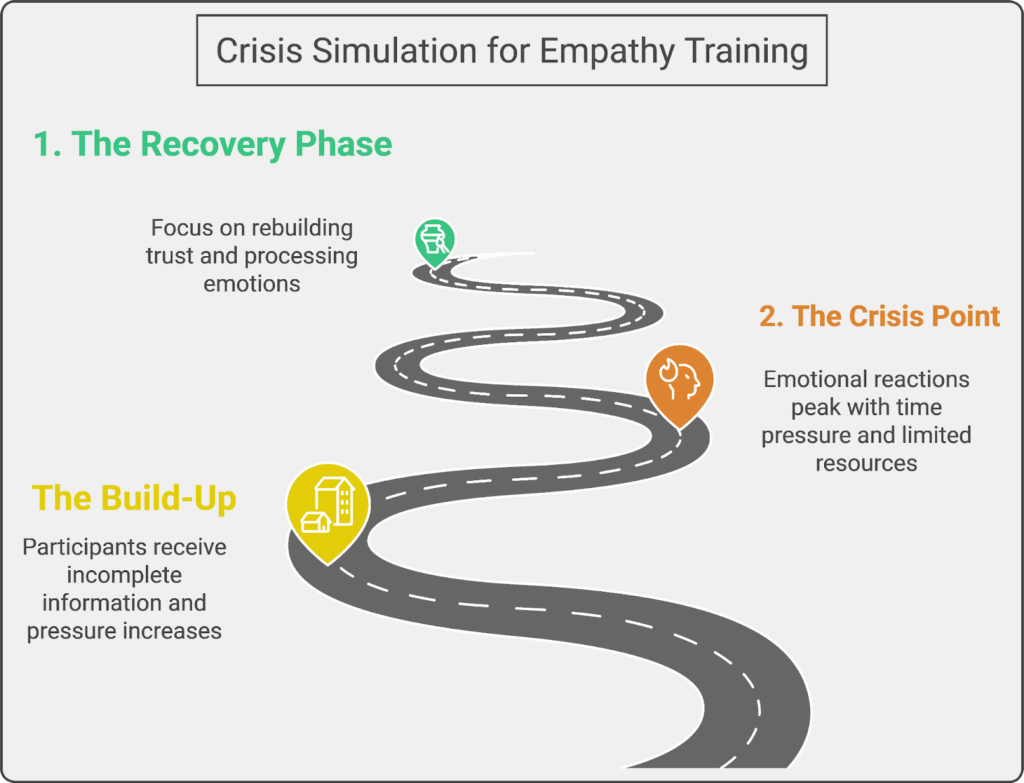
Soft skills improve when people practice moments that do not go perfectly.
That is why failure-safe simulations work so well. They give people a controlled place to make mistakes, recover, receive feedback, and try again before the real conversation happens.
In one training session, I gave managers a simple task: give feedback to a team member who had missed two deadlines. The first round sounded polite but vague. The employee in the scenario could leave the room without understanding what needed to change.
So we paused. I asked the managers to name the behavior, the business impact, and the next expectation. Then they practiced again, and eventually the second round became clearer, calmer, and more useful.
Good simulation scenarios include:
- A feedback conversation becomes defensive.
- A stakeholder challenges a recommendation.
- A team member misunderstands an instruction.
- A customer reacts emotionally.
- A meeting loses focus.
- A team member stays silent instead of raising a blocker.
The difficult moment is the training. Participants learn how to stay clear when the conversation becomes uncomfortable.
3. Use Microlearning Drills to Train One Soft Skill Behavior at a Time
Soft skills become easier to train when you make them smaller.
“Communication” is too broad for one session. It includes listening, summarizing, questioning, writing, presenting, disagreeing, explaining, aligning, escalating, and following up. A broad topic creates broad advice, and a specific behavior creates practice.
One of my favorite drills is the one-sentence update. Participants must explain progress, blocker, and next step in one clean sentence. At first, people give long background explanations. Then we practice tightening the message.
A strong version sounds like this:
“The customer research is complete, the main blocker is missing pricing data, and I need Finance input by Thursday to finalize the recommendation.”
That sentence gives the room status, problem, and action. It also follows the logic of top-down communication: lead with the point, then add the context people need.
Use microlearning drills for active listening, clearer updates, feedback, meeting summaries, written communication, and disagreement. Short practice done repeatedly creates more progress than one overloaded workshop.
4. Use Cross-Functional Shadowing to Improve Collaboration Between Teams
Many soft skills problems are actually visibility problems.
Sales sees cautious delivery timelines and calls Operations slow. Operations sees early client promises and calls Sales unrealistic. Product sees edge cases from Customer Success, while Customer Success sees repeated user pain that Product needs to understand. Finance focuses on budget control, while HR sees the people impact behind those numbers.
Everyone has a version of the truth, and cross-functional shadowing helps teams see the pressure, constraints, and decisions behind another team’s work.
Use shadowing where teams depend on each other:
| Team Pairing | What It Helps People Understand |
| Sales and Operations | Promises, delivery limits, and expectation setting |
| Marketing and Product | Customer language, roadmap trade-offs, and prioritization |
| Finance and HR | Budget decisions, people impact, and policy communication |
| Customer Success and Product | User pain, feedback loops, and product decisions |
| Leadership and Frontline Teams | Policy impact, communication clarity, and operational reality |
End the shadowing with one question: “What assumption changed after seeing the other team’s work?”
5. Use Trade-Off Exercises to Train Judgment in Messy Situations
Some workplace situations do not have a perfect answer. That is exactly why they are useful for soft skills training.
Business trade-offs often show up in ordinary moments. A customer asks for something the team cannot deliver, a top performer creates tension, a late project forces an uncomfortable choice, or two departments disagree on what matters most. Even a simple feedback conversation becomes harder when the manager likes and respects the person receiving it.
These are the moments where soft skills matter.
Trade-off exercises train people to name the tension, explain the decision, acknowledge the impact on others, and keep the work moving. This is especially useful for managers, team leads, and high-potential employees who need to communicate through complexity.
Use scenarios that force people to explain a trade-off clearly:
- A leader needs to reduce scope after the team has already worked hard.
- A manager must divide limited resources between two important projects.
- A new process improves control but slows delivery.
- A stakeholder wants a faster launch, but the team sees quality risks.
- A policy looks fair on paper but creates pressure for frontline employees.
This is also where teams can practice how to disagree courageously. The goal is to challenge ideas clearly while protecting trust.
6. Use Silent Observation Exercises to Build Emotional Intelligence
Emotional intelligence starts with noticing more.
People often miss the signal before the problem. A quiet pause, a change in tone, a person who stops contributing, or a stakeholder who agrees too quickly can reveal more than the words being spoken. So can the team member who says “fine” while clearly feeling the opposite.
Silent observation exercises train people to slow down and pay attention. The exercise is simple: remove speech for a short period and ask participants to observe what is happening. The silence makes people notice body language, facial expressions, hesitation, eye contact, posture, and energy in the room.
I have seen confident speakers struggle with this exercise. They are used to leading with words. Once words are removed, they have to listen with more than their ears.
A simple version works like this:
- Show a short meeting clip with the sound removed.
- Ask participants to write down only what they observe.
- Separate facts from assumptions.
- Discuss which signals were missed.
- Connect the learning to feedback, meetings, and conflict.
This exercise builds active listening, emotional awareness, patience, nonverbal communication, meeting awareness, and empathy.
7. Add Pressure Practice to Train Communication Under Stress
Soft skills often break down under pressure.
A person communicates clearly when the situation is calm. Then a deadline moves, a stakeholder pushes back, a customer becomes unhappy, or a senior leader asks for an answer sooner than expected. Suddenly the message becomes rushed, defensive, vague, or overly complicated.
Pressure practice helps people stay clear in those moments.
The key is control. The training environment should challenge people without embarrassing them. Add a shorter time limit, stakeholder pushback, incomplete information, changing priorities, or a difficult follow-up question. Then debrief the behavior, not the person.
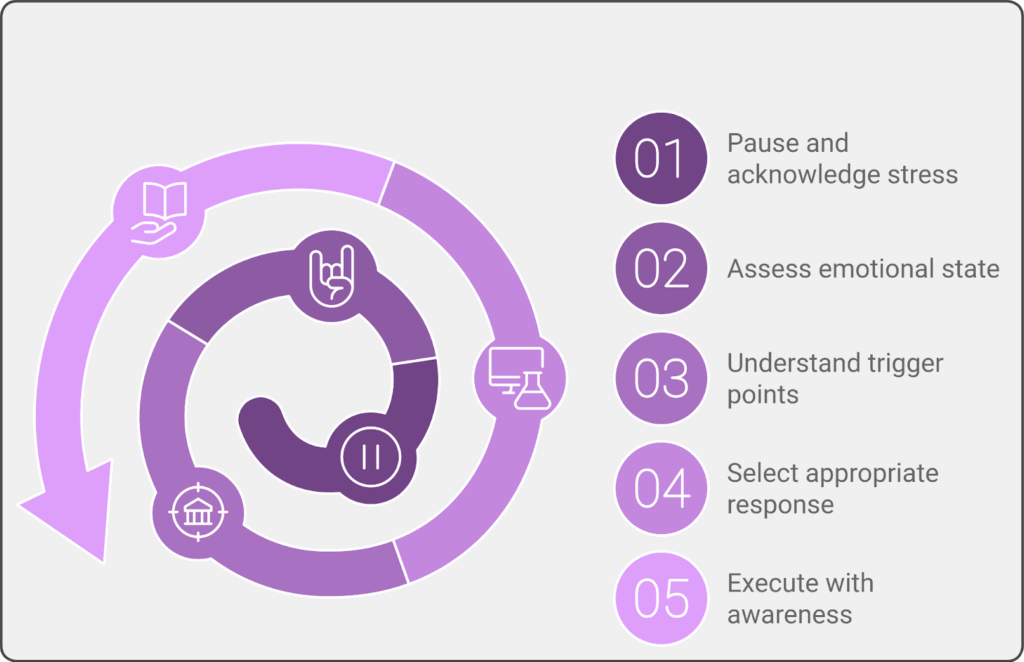
A useful framework is:
Pressure Practice Framework
- Pause.
- Name the issue.
- Clarify the priority.
- Choose the next action.
- Communicate the decision.
For example:
“We have two issues: the deadline moved, and the data is incomplete. The priority is to give leadership a directional answer today. I will share the current recommendation, name the assumptions, and confirm what we will validate by Friday.”
That kind of response creates calm because people see the thinking behind the action.
8. Use Communication Style Labs for Diverse and Distributed Teams
Diverse teams bring different communication habits into the same workplace.
One person values direct feedback, while another reads the same message as harsh. One team wants fast decisions, while another needs more alignment before moving forward. In global or distributed teams, hierarchy, challenge, written clarity, and live discussion all shape how people interpret the same conversation.
These differences create hidden friction.
A communication style lab should bring those expectations into the open. Discuss:
- Decision-making preferences
- Feedback preferences
- Meeting behavior
- Conflict style
- Time expectations
- Escalation norms
- Written communication habits
- Expectations around hierarchy
The trainer should avoid broad stereotypes. The point is to help people agree on working norms so difference does not become unnecessary friction.
9. Use Real-Work Application Projects to Make Soft Skills Stick
A workshop should create momentum. Real work should turn that momentum into behavior change.
This is where many soft skills programs lose impact. The session may create temporary inspiration followed by little application, manager follow-up, or visible behavior change.
Real-work application projects fix that gap.
Near the end of a session, I like asking participants this question:
“What is one conversation, meeting, update, or handoff this week where you will use this skill?”
That question makes the skill concrete by tying it to a real moment already on the calendar. A manager prepares for a difficult one-on-one, a team lead plans how to close the next meeting with clearer owners and next steps, a junior employee decides to ask for help at work before a blocker grows, and a cross-functional partner clarifies ownership before the next handoff.
Examples of application projects include:
- Run a clearer weekly team update.
- Give one piece of structured feedback.
- Rewrite a confusing handoff document.
- Facilitate a meeting with clearer decision rules.
- Summarize a stakeholder conversation more clearly.
Many of these behaviors connect naturally to better work documentation, because decisions, expectations, and next steps become easier to repeat when they are captured clearly.
How to Build a Soft Skills Training Program (Step by Step)
A soft skills training program works best when it starts with a real workplace problem.
I always look for the friction first. Where are meetings getting stuck? Where are managers losing the team? Where are clients asking the same questions again and again? Where does work slow down because ownership, communication, or decision-making is unclear?
Once you find that pattern, the training becomes much easier to design.
Step 1: Identify the Skill Gap
Start by understanding what is actually happening at work.
A company may say, “Our people need communication training,” but that can mean many different things.
Are updates unclear? Are meetings too long? Are managers avoiding difficult feedback? Are teams missing handoffs? Are senior leaders asking for sharper recommendations?
Use a few sources before deciding:
- Manager interviews
- Performance feedback
- 360-degree surveys
- Meeting observations
- Presentation reviews
- Team project debriefs
This is where soft skills gap analysis becomes useful. The goal is to identify the behavior creating friction, then train that behavior directly.
| Quick Exercise: Run a 30-minute Skill Gap Audit |
| Choose one recent project that slowed down. Ask:Where did the work get stuck?What behavior caused the delay?Which soft skill would have improved the situation?This gives you a practical starting point. |
Step 2: Choose the Right Soft Skills to Train
Once the gap is clear, choose the skills that match the business problem.
A sales team needs active listening, negotiation, and objection handling. A strategy team needs structured problem-solving and executive communication. A new manager group needs feedback, delegation, prioritization, and conflict resolution.
Trying to train every soft skill at once makes the program too broad. Choose the few behaviors that will make the biggest difference in daily work.
For example:
- If meetings end without decisions, focus on communication and facilitation.
- If projects slow down between teams, focus on collaboration and ownership.
- If managers avoid hard conversations, focus on feedback and emotional intelligence.
- If recommendations feel unclear, focus on structured problem-solving and presentation skills.
The clearer the skill choice, the stronger the training.
Step 3: Set Behavior-Based Training Objectives
Good training objectives describe what people should do differently after the program.
“Improve leadership” sounds good, but it does not tell anyone what to practice. A stronger objective would be:
“Managers will run weekly team check-ins with clear priorities, blockers, owners, and next steps.”
That is observable. You can see whether it happens.
Behavior-based objectives work better because they connect training to real work. Instead of saying “improve communication,” define the behavior:
“Employees will write stakeholder updates that explain what changed, why it matters, and what decision is needed.”
Now the trainer knows what to teach, the manager knows what to observe, and the employee knows what to practice.
Step 4: Pick the Right Training Format
Different soft skills need different training formats.
Live practice works well for difficult conversations. Coaching helps with personal communication habits. Business cases are stronger for problem-solving and decision-making, while short digital modules can introduce a concept before people apply it in a real workplace exercise.
Use the format based on the behavior you want to build.
| Skill | Best Format | Why It Works |
| Feedback and difficult conversations | Role-play and coaching | People practice the exact words they need in uncomfortable moments |
| Structured problem-solving | Business cases and team exercises | Participants learn how to break down messy problems and present a recommendation |
| Executive communication | Live workshops and presentation practice | Employees practice leading with the main point and defending their logic clearly |
| Collaboration | Team projects and peer practice | People learn how ownership, context, and follow-through affect the group |
| Adaptability | Simulations and scenario-based training | Participants practice responding when priorities, information, or constraints change |
| Time management | Microlearning and manager check-ins | Short routines help people prioritize, plan, and communicate trade-offs |
The format matters because soft skills are built through use. A lecture can introduce a concept. Practice turns that concept into behavior.
Step 5: Build Practice Into Daily Work
Soft skills training becomes stronger when people apply it to work they already do.
After a communication workshop, every participant can rewrite one stakeholder update using the framework taught in the session. After a leadership workshop, managers can apply the new check-in structure in their next team meeting.
This keeps the training practical. It also helps employees see the value quickly because they are improving something already on their desk.
| Try This: The One-Meeting Practice Sprint |
| Choose one soft skill for the week, such as active listening, clearer updates, or better follow-up. Apply it in a real meeting. After the meeting, write down:What did I try?What changed in the conversation?What will I adjust next time?This turns daily work into a training ground. |
Step 6: Reinforce the Skill After Training
Soft skills fade when the workplace stops reinforcing them.
That is why managers play such an important role after training. They help the behavior stay active in meetings, reviews, project discussions, and feedback conversations.
Useful reinforcement methods include:
- Manager check-ins
- Peer feedback
- Monthly refreshers
- Short practice challenges
- Team reviews
- Before-and-after presentation reviews
A manager can ask one simple question during a check-in:
“Where did you apply the skill this week?”
That question keeps the learning alive. It also signals that soft skills remain relevant to real performance after the training session.
How to Measure Soft Skills Training Effectiveness
Soft skills training should lead to visible changes in how people work.
Completion rates show attendance. A complete evaluation should also examine feedback quality, meeting clarity, and confidence in stakeholder conversations.
The Kirkpatrick Model gives L&D teams a practical way to think about training evaluation through reaction, learning, behavior, and results. For soft skills training, I would translate those levels into four workplace questions:
- Measure participant reaction: Did people find the training relevant, practical, and connected to their work? A soft skills session should feel close to the conversations, meetings, and decisions participants already face.
- Measure learning: Can participants explain the skill, recognize strong examples, and identify what needs improvement? For example, after feedback training, they should be able to tell the difference between vague feedback and useful feedback.
- Measure behavior change: Are managers seeing clearer updates, better feedback, stronger handoffs, or better collaboration? This is the most important level because soft skills only matter when they show up at work.
- Measure business impact: Are meetings clearer, decisions faster, escalations lower, and stakeholder conversations better? The strongest programs connect training to business signals alongside participant satisfaction.
A simple 30, 60, and 90-day review works well.
- At 30 days, check whether people remember and use the framework.
- At 60 days, review whether the behavior appears in real meetings or projects.
- At 90 days, look for business impact: clearer decisions, better collaboration, stronger presentations, fewer repeated issues, or higher stakeholder confidence.
That gives soft skills training a stronger measurement story.
Regular practice with these techniques helps participants develop resilience and maintain soft skills Most Common Soft Skills Training Mistakes to Avoid
Soft skills training sounds simple until you try to make the learning stick across a real team.
People bring different habits, confidence levels, communication styles, and workplace pressures into the room. A training session can be well designed, but the results depend on how closely it connects to daily work.
Here are the mistakes I see most often.
Mistake 1: Training Too Many Skills at Once
A full-day workshop covering communication, feedback, leadership, empathy, conflict, resilience, and collaboration can leave participants with too many ideas and limited practice. Focused practice on one behavior gives participants a clearer way to apply the learning.
Mistake 2: Using Generic Scenarios
A finance team, a sales team, and a group of new managers will not respond to the same examples in the same way. Their pressure points, conversations, and stakeholders are all different. The closer the training feels to daily work, the more seriously people take it.
Mistake 3: Skipping Useful Feedback
Repeated practice can reinforce weak behavior when feedback is missing. Useful feedback explains what helped, what created confusion, and what the participant should try next.
Mistake 4: Treating Soft Skills Like Personality Traits
Labels such as “natural communicator” or “not a people person” are too vague to train. Focus on behavior. How does the person ask questions, explain decisions, respond to disagreement, and handle pressure?
Mistake 5: Ending the Training at the Workshop
The workshop should start the behavior change process. The real test happens later, during a meeting, feedback conversation, stakeholder update, handoff, or conflict. Build in application, manager check-ins, peer feedback, and repeated practice.
Which Soft Skills Should Companies Train First?
The best soft skill to train first is the one creating the most visible friction.
For some teams, that is communication. For others, it is feedback, collaboration, conflict management, leadership, or adaptability. The final choice should come from the team’s actual work instead of a generic skills list.
Here is a practical way to choose.
| Soft Skill | Best Training Method | Workplace Behavior to Practice |
| Communication | Microlearning drills | Summarizing decisions clearly |
| Feedback | Failure-safe simulations | Giving specific and useful feedback |
| Emotional intelligence | Silent observation exercises | Noticing emotion before responding |
| Leadership | Reverse role-play | Understanding how decisions affect others |
| Collaboration | Cross-functional shadowing | Improving handoffs between teams |
| Conflict management | Trade-off exercises | Disagreeing without escalation |
| Adaptability | Pressure practice | Responding clearly when priorities change |
| Empathy | Role reversal and reflection | Understanding another person’s reality before advising |
- If unclear updates are slowing decisions, start with communication.
- If people avoid difficult conversations, start with feedback or conflict management.
- If teams misunderstand each other, start with collaboration.
- If managers struggle during change, start with leadership communication and pressure practice.
The best program meets the team where the friction is.
Train Soft Skills Like Behaviors People Can Practice
Soft skills training earns its value when people use the skill in real work: a sharper meeting update, a calmer feedback conversation, a cleaner recommendation, or a faster decision.
That level of change comes from repeated practice, direct feedback, manager reinforcement, and measurement tied to observable behavior.
At High Bridge Academy, this is the kind of practical behavior change we focus on inside the Business Excellence Bootcamp. The program helps professionals and teams strengthen communication, structured thinking, stakeholder management, and leadership behaviors through realistic business cases, drills, and direct feedback.
If your team needs stronger communication, clearer thinking, and more confident execution, explore the Business Excellence Bootcamp and choose the training path that fits your team’s goals.
FAQs About Soft Skills Training Strategies
Yes. Soft skills can be trained when the program focuses on specific workplace behaviors, realistic practice, useful feedback, and repeated application. The key is to move beyond awareness and help people practice the moments they face at work.
The best way to train soft skills is to combine short practice drills, realistic simulations, manager feedback, and real-work application. People improve faster when they practice one behavior at a time and use it in actual meetings, conversations, and team situations.
A single session can build awareness, but behavior change takes repeated practice over several weeks. The timeline depends on the skill, the role, the quality of feedback, and how quickly participants apply the behavior at work.
Companies should start with the soft skill causing the most visible friction. Common starting points include communication, feedback, listening, collaboration, conflict management, leadership communication, and adaptability under pressure.
Soft skills training programs fail when they rely on lectures, generic examples, one-time workshops, vague goals, or weak follow-up. They work better when people practice specific behaviors in realistic workplace situations and receive feedback after the session.