

McKinsey consultants are trained to think differently. They structure problems before solving them. They communicate conclusions first, not last. They use issue trees to break complexity into manageable parts, and MECE thinking to ensure nothing overlaps or gets missed.
These skills are not intuitive. They are learned — systematically, inside consulting firms that have decades of methodology behind them. Professionals outside consulting rarely get access to the same training.
That’s changing. A handful of programs now teach the same frameworks to professionals who didn’t come up through McKinsey, BCG, or Bain. This guide covers the 5 best online courses to think like a McKinsey strategic consultant in 2026.
What are the best courses to think like a McKinsey consultant?
The top 5 courses are Strategy U, High Bridge Academy (BEB), The Analyst Academy, Firm Learning, and Clarity First Program.
Strategy U is a strong self-paced curriculum for McKinsey-style thinking. It covers hypothesis-driven problem solving, MECE analysis, the Pyramid Principle, and slide communication in one 4-week program. High Bridge Academy’s Business Excellence Bootcamp (BEB) goes further — covering the same consulting thinking foundations alongside stakeholder management and AI integration, taught by former strategy consultants with real client delivery experience.
The Analyst Academy focuses on the output layer: how McKinsey consultants build slides, visualize data, and communicate structured findings. Firm Learning teaches communication and clarity frameworks derived from McKinsey practice, built by a former McKinsey Project Lead. Clarity First Program is the deepest option for the Pyramid Principle specifically — the structured communication method created at McKinsey and still used as the firm’s internal standard.
Best McKinsey thinking courses — Comparison table
| Course | Starting Price | Core Focus | Format | Instructor Background | Free Trial |
|---|---|---|---|---|---|
| Strategy U | $797 | MECE, hypothesis-driven thinking, Pyramid Principle, slides | Self-paced (4 weeks) | Former McKinsey / BCG knowledge roles | 30-day money-back |
| High Bridge Academy (BEB) | ~$500 | Full consulting toolkit: problem solving, communication, stakeholder management, AI | Bootcamp (practitioner-led) | Former top strategy firm consultants (client delivery) | By inquiry |
| The Analyst Academy | $197 | Consulting slide design, data visualization, presentation storytelling | Self-paced (4–5 hrs) | Former management consultant and Wharton MBA | No |
| Firm Learning | $397 | Consulting communication, clarity frameworks, slide writing | Self-paced (12-month access) | Former McKinsey Project Lead (6 years) | No |
| Clarity First Program | $1,490 | Pyramid Principle, structured executive writing, board papers | Live cohort (2 weeks) | Only Barbara Minto-approved instructor outside McKinsey | No |
1. Strategy U: Best self-paced course for McKinsey-style thinking
Strategy U is the most directly positioned program for this topic. The flagship course is called Think Like a Strategy Consultant — and that’s exactly what it delivers. It covers the mental models, structured problem-solving frameworks, and communication methods consultants use in practice.
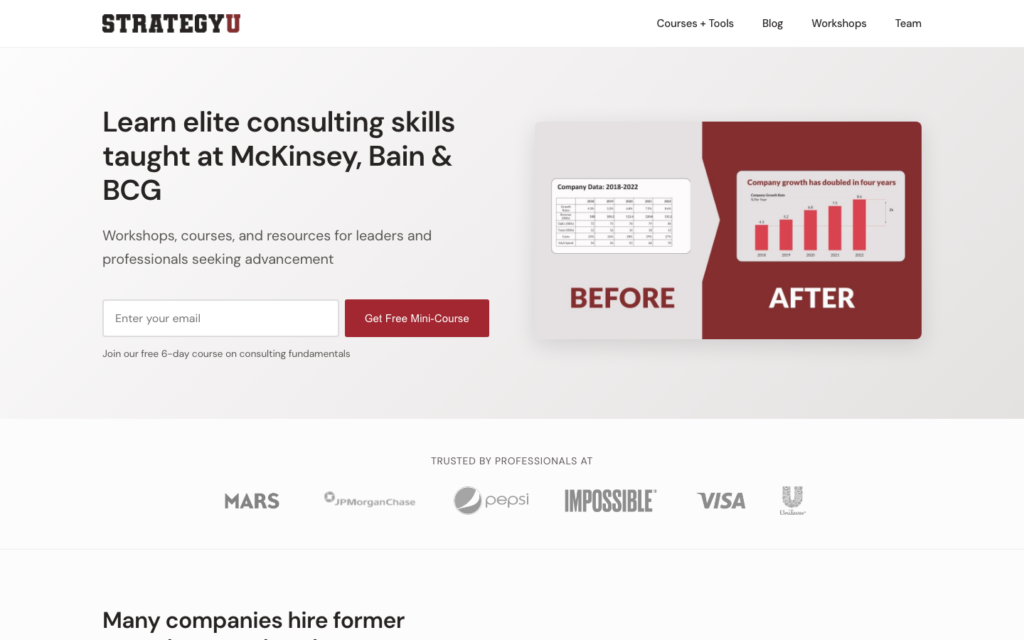
The 4-week, 76-lesson curriculum moves from consulting mindset through MECE thinking, hypothesis-driven analysis, issue trees, and top-down communication. Week 4 covers PowerPoint and persuasion — how to build a McKinsey-quality slide. Fortune 500 clients include JPMorgan, Visa, PepsiCo, and Unilever.
The gap is stakeholder management. Strategy U teaches how to think and communicate clearly — not how to influence senior stakeholders or navigate organizational dynamics. AI is present as a bonus module, not a core skill embedded in the curriculum.
Key features
- MECE thinking: Mutually exclusive, collectively exhaustive problem decomposition — the foundational McKinsey framework
- Hypothesis-driven problem solving: Start with a hypothesis, structure analysis around proving or disproving it — the way McKinsey teams actually work
- SCQA framework: Situation, Complication, Question, Answer — the McKinsey storyline structure
- Issue trees: Break a complex problem into its component parts before beginning analysis
- Pyramid Principle: Structure communication so the key message comes first, supported by grouped arguments underneath
- Top-down PowerPoint: McKinsey-style slide construction where every slide starts with its conclusion
- MBB consultant interviews: Context from practitioners on how consulting firms approach real problems
- 100+ slide templates: Consulting-quality templates ready to use immediately
Pricing
| Format | Price |
|---|---|
| Self-paced course | $797 |
| Executive coaching add-on | $2,250+ |
| Corporate virtual workshop | $7,500 |
| Corporate in-person workshop | $12,000 |
| Customized cohort program | $25,000+ |
Pros & cons
Pros:
- A strong self-paced curriculum specifically designed around McKinsey thinking frameworks
- Fortune 500 social proof (JPMorgan, Visa, PepsiCo, Unilever)
- 30-day money-back guarantee reduces commitment risk
- Covers all four consulting thinking pillars: mindset, problem solving, communication, and slides
Cons:
- No stakeholder management — a critical gap for professionals managing complex organizations
- Founder’s MBB roles were knowledge/research, not client-facing engagement delivery
- AI is a bonus add-on, not integrated throughout the curriculum
- No live cohort or peer accountability at the base price
Customers
1,200+ students globally. Clients include JPMorgan, Visa, PepsiCo, Unilever, and Impossible Foods. Rated 4.9/5.
“The clearest explanation of how McKinsey actually thinks that I’ve found outside the firm itself. Applied it on a live project the week after completing the course.”
2. High Bridge Academy (BEB): Best full consulting toolkit including McKinsey methods
High Bridge Academy is our platform. We’re including it here because it’s directly relevant — but you should weigh that context accordingly.
McKinsey consultants don’t just structure problems. They communicate them clearly, manage the stakeholders around them, and use every tool available — including AI — to do it faster. High Bridge Academy’s Business Excellence Bootcamp (BEB) is the only program that teaches all of this together in one structured curriculum.
BEB is taught by former consultants from top strategy firms — people with real client delivery experience, not knowledge or research roles. The curriculum moves through structured problem solving, executive communication, stakeholder management, and AI integration. Every module applies immediately to real work situations.
Where Strategy U teaches you to think like a consultant, BEB trains you to work like one. The distinction matters at mid-senior levels, where the challenge isn’t just clear thinking — it’s influencing stakeholders who don’t report to you and making decisions in ambiguous, high-pressure environments.
“BEB gave me the frameworks I’d been missing for 10 years. I finally understand why consultants communicate the way they do — and now I do too.”
Key features
- Structured business problem solving: MECE frameworks, issue trees, and hypothesis-driven analysis — the same methods McKinsey uses internally
- Executive communication and business storytelling: Pyramid Principle, top-down communication, and narrative structure for executive audiences
- Stakeholder management and influence: How to align and influence people who don’t report to you — a skill McKinsey consultants use constantly
- Decision-making frameworks: Consulting-style structured frameworks for business decisions under ambiguity
- AI integration as a core skill: AI tools embedded throughout — not a bonus module
- Former strategy consultant instructors: Taught by practitioners with real McKinsey, BCG, or Bain client delivery experience
- Immediate workplace application: Every framework applied to real problems, not hypothetical cases
Pricing
| Format | Price |
|---|---|
| Entry workshops | ~$500 |
| Full Bootcamp | ~$2,000 |
| Corporate team programs | By inquiry |
Full pricing at highbridgeacademy.com/beb-pricing.
Pros & cons
Pros:
- Only program combining McKinsey-style thinking with stakeholder management and AI in one curriculum
- Instructors have genuine client delivery experience at top strategy firms
- Covers the full consulting operating model — not just problem structuring
- Available for both individuals and corporate teams
Cons:
- Higher price than single-skill alternatives
- Less transparent public pricing than self-paced competitors
- Smaller public review volume than more established platforms
Customers
Professionals in strategy, operations, finance, and product management. Corporate clients span consulting, tech, finance, and startups.
3. The Analyst Academy: Best course for McKinsey-quality slides and presentations
McKinsey is as well known for its slides as its thinking. The structured, data-driven, visually clean presentation style is a signature of the firm — and a skill that takes deliberate practice to develop. The Analyst Academy teaches exactly that.
Founded by Paul Moss — a former management consultant with an MBA from Wharton — The Analyst Academy has reached 35,000+ professionals in 100+ countries. Its three core courses cover PowerPoint construction, data visualization, and presentation storytelling using the Pyramid Principle applied to slide decks.
Each course is self-paced, tightly scoped, and rated 4.9/5. This is the right program for professionals who already understand consulting frameworks but want their output — the slides and visualizations — to match the standard.
Key features
- Advanced PowerPoint for Consultants: McKinsey-standard slide construction, layout, and formatting
- Data Visualization for Consultants: Chart selection, visual hierarchy, and data storytelling principles
- Presentation Storytelling: Applying the Pyramid Principle to structure a slide deck from message to supporting evidence
- Consulting templates: Pre-built slide templates matching consulting firm standards
- Corporate team licensing: $197/user for 3-year access to all three core courses
- High production quality: All courses rated 4.9/5 across 11,000+ enrolled students
Pricing
| Format | Price |
|---|---|
| Individual course | $197 |
| Complete Bundle (3 courses) | $497 |
| Corporate team license | $197/user (3-year access) |
| Live team training | By inquiry |
Pros & cons
Pros:
- Most targeted program for the slide and visual communication skills McKinsey is known for
- Consistently rated 4.9/5 — among the highest-rated programs in this category
- Very low entry price ($197) reduces commitment friction
- Wharton-credentialed founder with real consulting background
Cons:
- No problem solving, hypothesis-driven thinking, or MECE frameworks — only the output layer
- No stakeholder management or AI content
- Self-paced only; no live cohort or accountability structure
- Completing this course produces better slides, not consulting thinking
Customers
35,000+ professionals across 100+ countries. Used in consulting, finance, tech, and corporate strategy.
“My slides went from competent to McKinsey-quality. The gap was smaller than I thought — but I needed someone to show me exactly where it was.”
4. Firm Learning: Best budget course for McKinsey communication frameworks
Firm Learning is built by Heinrich Rusche — a former McKinsey Project Lead with 6 years at the firm. The flagship program, Communications & Slide Writing Academy, teaches how to communicate with the clarity and structure McKinsey is known for. It is one of the most affordable structured programs in this space at $397.
The program covers clarity frameworks, problem articulation, and slide writing principles. Heinrich has a large YouTube following and has delivered 100+ corporate training sessions alongside the self-paced product. The community access and template library add accountability beyond passive video watching.
The limitation is scope. Firm Learning covers McKinsey-style communication — not the problem-solving methodology that precedes it. It is the right starting point for professionals who want to improve their clarity and written communication without yet committing to a full consulting curriculum.
Key features
- Clarity frameworks: Structuring and simplifying complex ideas the way McKinsey consultants do
- Slide writing principles: The written logic behind McKinsey-quality slides — not just formatting
- Problem articulation: How to define and frame a business problem before communicating it
- Templates and blueprints: Slide and document frameworks based on McKinsey communication standards
- Community access: Peer learning community for 12 months
- 1:1 coaching: Available separately; 95% of clients achieve stated goals
Pricing
| Format | Price |
|---|---|
| Communications & Slide Writing Academy | $397 (12-month access) |
| Corporate team training | By inquiry |
| 1:1 coaching | By inquiry |
Pros & cons
Pros:
- Genuine McKinsey Project Lead credentials — 6 years at the firm, not a knowledge or support role
- Most accessible price among the structured programs ($397)
- Large community and YouTube presence creates additional free learning alongside the course
- Combines templates, frameworks, and community into one purchase
Cons:
- Scope limited to communication and slides — no structured problem solving, stakeholder management, or AI
- Oriented primarily toward early-career professionals; may be too introductory for senior roles
- 12-month access (not lifetime) at $397 creates a time constraint
- Solo instructor — entirely dependent on one person
Customers
40,000+ professionals enrolled. 100+ corporate training sessions. Global audience with strong representation in Europe and North America.
“Heinrich’s McKinsey background is evident throughout. The communication frameworks are directly applicable — I used them in a board presentation the week after finishing the course.”
5. Clarity First Program: Best course for the Pyramid Principle — McKinsey’s core communication method
The Pyramid Principle is McKinsey’s internal standard for written communication. It was created by Barbara Minto, a McKinsey consultant, and is still the foundation of how the firm structures its documents, presentations, and client deliverables. Davina Stanley is the only instructor outside McKinsey personally approved by Barbara Minto to teach it.
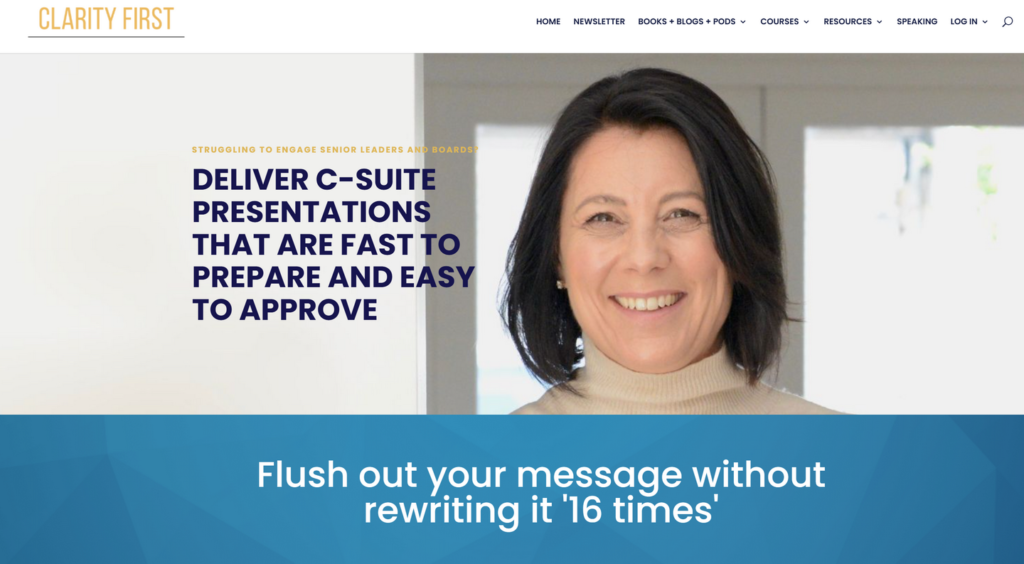
The flagship product — the Board Paper Bootcamp — is a 2-week live cohort covering the SCORE framework, MECE testing, and 24 board paper case studies. It includes 1:1 feedback from Davina and 6 months of Clarity Hub access. Reported outcomes include a 30% reduction in major document review cycles.
This program is best for senior professionals who write board papers, C-suite briefings, or complex organizational documents. It is the deepest available program for the Pyramid Principle specifically — deeper than any other program on this list for that one skill.
Key features
- Minto Pyramid Principle (official): The only program outside McKinsey with Barbara Minto’s personal approval to teach her method
- SCORE framework: Clarity First’s structured approach to board-level written communication
- MECE testing: Applying the McKinsey MECE standard to document structure and argument design
- Board Paper Bootcamp: 2-week live cohort; 11 hours total; 24 real cases; certificate on completion
- 1:1 feedback from Davina: Direct coaching on your written work — not just peer review
- Books: Engage and Elevate extend the methodology beyond the bootcamp
Pricing
| Format | Price |
|---|---|
| Board Paper Bootcamp | $1,490 USD |
| Extreme Clarity Workshop | Not publicly listed |
| Private / bespoke programs | By inquiry |
Pros & cons
Pros:
- Unique and defensible credential — only Barbara Minto-approved instructor outside McKinsey
- The deepest available program for the Pyramid Principle specifically
- Live cohort with 1:1 feedback from a 25-year communication coaching veteran
- Strong outcomes data: 30% reduction in document review cycles
Cons:
- Extremely narrow scope — structured writing only; no problem solving, stakeholder management, or AI
- $1,490 for a single communication skill is expensive relative to broader programs
- Best suited to senior executives; not relevant to early-to-mid career professionals
- Geographic concentration in Australia limits accessibility and brand recognition elsewhere
Customers
Senior executives, company secretaries, chiefs of staff, finance leaders, and government directors across Australia and English-speaking professional markets.
“The Pyramid Principle finally clicked after years of trying to learn it from Minto’s book. Davina’s teaching is what makes it stick.”
FAQ
What is McKinsey-style thinking?
McKinsey-style thinking is a structured approach to business problems. It starts by defining the problem clearly, then breaking it into MECE components using an issue tree. Analysis is hypothesis-driven — you form a view early and test it, rather than gathering data and seeing what emerges. Conclusions are communicated top-down: the answer first, then the supporting logic. This methodology is taught inside McKinsey and the other major strategy firms, and is now available through several external programs.
What is MECE thinking and why does McKinsey use it?
MECE stands for Mutually Exclusive, Collectively Exhaustive. It means that the components of a problem or argument don’t overlap with each other (mutually exclusive) and together they cover everything relevant (collectively exhaustive). McKinsey uses MECE to structure issue trees, slide logic, and argument design. It forces clarity at every level — you can’t move forward if your categories overlap or leave gaps.
What is the Pyramid Principle?
The Pyramid Principle is a communication framework created by Barbara Minto at McKinsey. It holds that every communication should start with a single governing idea — the answer — followed by grouped supporting arguments, each of which is supported by data or analysis below it. McKinsey consultants use it for documents, slides, emails, and verbal communication. It is the reason McKinsey deliverables always start with “the answer is…” rather than building up to a conclusion.
Do I need to be a consultant to benefit from these courses?
No. These programs are specifically designed for professionals who work outside consulting but want to apply the same thinking methods. The value is in bringing consulting-grade problem solving and communication to corporate, tech, finance, and strategy roles. No consulting background is required.
Which course is best for structured problem solving specifically?
Strategy U is a strong self-paced option for structured problem solving. It covers issue trees, MECE thinking, hypothesis-driven analysis, and SCQA in one curriculum. High Bridge Academy’s BEB covers the same foundations but pairs them with stakeholder management and AI in a bootcamp format taught by former strategy consultants.
Which course is best for communication in the McKinsey style?
Clarity First is the deepest option for the Pyramid Principle and structured written communication. The Analyst Academy is the best for McKinsey-style slides and data visualization. Firm Learning is the most accessible option for clarity frameworks and slide writing on a budget. All three teach different layers of McKinsey communication — they are more complementary than competitive.
Are these courses worth it for corporate teams?
Yes, particularly for teams in strategy, operations, finance, or consulting-adjacent roles. McKinsey-style thinking creates a common language for problem framing, decision-making, and communication that pays off in faster alignment and cleaner stakeholder interactions. Programs with corporate formats — BEB, Strategy U’s custom cohorts, and The Analyst Academy’s team licensing — are designed specifically for team deployment.
Conclusion
McKinsey’s competitive advantage is a methodology, not a secret. Structured problem solving, hypothesis-driven analysis, MECE thinking, and top-down communication are learnable skills. The best programs make them accessible to professionals who didn’t go through a strategy firm.
Strategy U is a strong self-paced curriculum for the thinking frameworks specifically. High Bridge Academy’s BEB is the right choice for professionals who want the full operating model — thinking, communication, stakeholder influence, and AI — in one program taught by former strategy consultants.
For focused skill development: The Analyst Academy for McKinsey-quality slides, Firm Learning for communication frameworks on a budget, Clarity First for the Pyramid Principle at depth. Each program addresses a specific layer of how McKinsey consultants actually work.
The question isn’t whether you can learn to think like a McKinsey consultant. The question is which layer matters most for where you are right now.
Ready to build consulting-grade thinking skills? Explore High Bridge Academy’s Business Excellence Bootcamp — the full consulting toolkit, taught by former strategy consultants.