

Firm Learning teaches communication and slide writing skills from consulting. It is a practical starting point for early-career professionals. But for managers, it has two clear limits: the scope stops at communication, and it is built for people entering the field — not leading teams.
If you manage people, projects, or stakeholders, you need more than clearer slides. You need to structure complex problems, align people who disagree, and communicate decisions that stick. These are the gaps Firm Learning does not fill.
Here are five alternatives worth considering in 2026.
Comparison table
| Firm Learning | Reforge | Coursera | LinkedIn Learning | Maven | High Bridge Academy (BEB) | |
|---|---|---|---|---|---|---|
| Executive communication | Yes | No | Partial | Partial | Varies | Yes |
| Structured problem solving | Partial | No | Partial | No | Varies | Yes |
| Stakeholder management | No | No | Partial | Partial | Varies | Yes |
| AI integration | No | Partial (tech-focused) | Partial | Partial | Varies | Yes — core module |
| Live sessions | No | Yes | No | No | Yes | Yes |
| Practitioner-led | Yes | Yes | No (academic) | Partial | Yes (varies) | Yes |
| Target audience | Early-career | Senior tech/product | Broad | Broad | Varies | Mid-career managers |
| Price | $397 | ~$2,000/yr | Free–$399/yr | ~$30/mo | $300–$2,000+ | $500–$2,000 |
1. Reforge
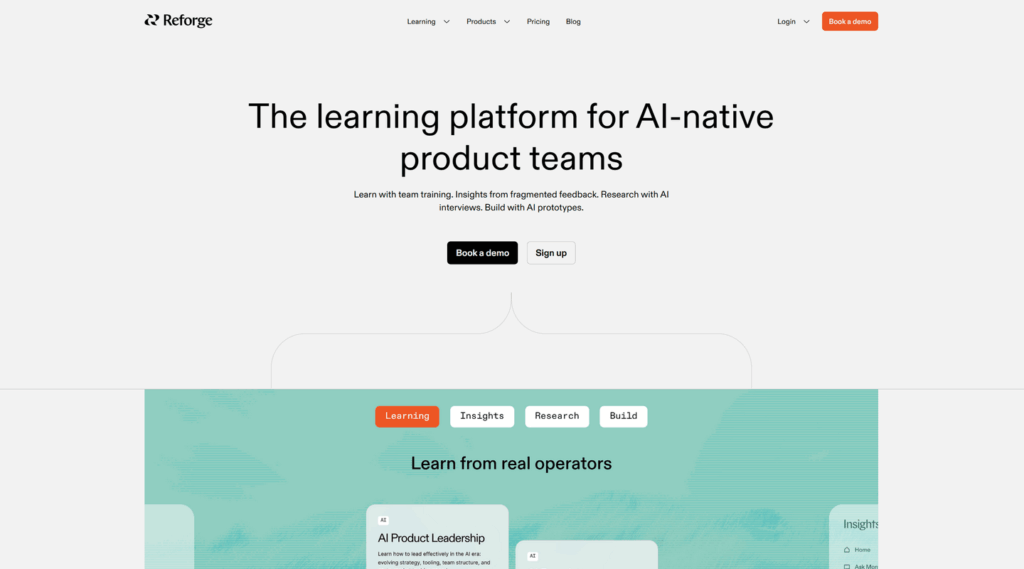
Reforge is a practitioner-led learning platform for senior product, growth, and marketing professionals. It was founded by Brian Balfour and Andrew Chen and has grown to 100,000+ alumni. In March 2026, Reforge was acquired by Miro — the Learning division continues to operate independently at reforge.com.
Programs run in cohorts with live sessions led by senior practitioners from companies like Airbnb, Stripe, Google, and Meta. Topics include product strategy, growth, AI, data, and leadership. The annual membership gives access to the full program library.
Reforge is a strong option for managers in tech or product roles who want practitioner-led learning from operators at top companies. It does not teach consulting frameworks, structured problem solving, or stakeholder management at depth. It is heavily skewed toward tech and product — not industry-agnostic.
Key features
- Cohort-based programs: Live sessions with 200–500 peers from leading tech companies
- Practitioner instructors: Senior operators from Airbnb, Stripe, Google, Shopify, and Meta
- Program library: Product strategy, growth, AI, retention, monetization, leadership, and more
- Alumni community: 100,000+ alumni across top tech companies
- Annual membership: One fee unlocks access to all programs and archived content
Pricing
| Format | Price |
|---|---|
| Individual membership | ~$1,995–$2,495/year (verify current pricing at reforge.com — changed post-Miro acquisition) |
| Team / corporate plans | By inquiry |
Pros & cons
Pros:
- High-caliber practitioner instructors with verifiable track records at top tech companies
- Cohort model creates peer networking with professionals from Airbnb, Stripe, Google, and similar
- 100,000+ alumni community is genuinely valuable for senior tech and product managers
- Broad program library at a single annual membership price
Cons:
- Heavily skewed toward tech and product roles — not relevant for managers outside these functions
- No consulting frameworks, structured problem solving, or MECE thinking
- No stakeholder management or executive communication at depth
- Membership model means no clear beginning and end to a learning journey
- Post-Miro acquisition, the product roadmap and pricing are in transition
Format: Cohort-based programs (live sessions + async); annual membership
Price: ~$1,995–$2,495/year
Best for: Senior managers in tech or product roles who want practitioner-led learning from top operators
2. Coursera
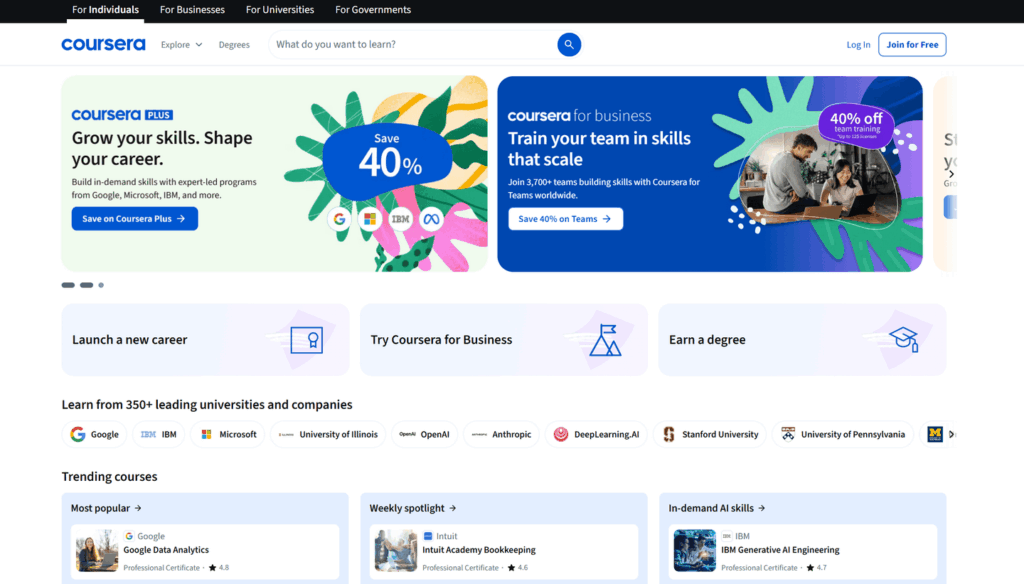
Coursera is the world’s largest online learning platform. It was founded in 2012 by Stanford AI professors Andrew Ng and Daphne Koller. It has 148M+ registered learners, 7,000+ courses, and partnerships with 700+ universities and companies including Yale, Michigan, Google, and IBM.
For managers, Coursera offers courses on communication, leadership, strategic thinking, data analysis, and AI for business. You can audit most courses for free. Coursera Plus gives access to the full catalog for ~$399 per year. Coursera for Business offers corporate subscription options for teams.
Coursera is a low-cost option for managers who want to explore specific skill areas without committing to a structured program. The limitation is depth — courses teach topics in isolation with no integrated consulting methodology. Most instructors are academics, not practitioners.
Key features
- Broad course library: 7,000+ courses covering communication, leadership, strategy, data, and AI for business
- University-backed credentials: Certificates from Yale, Michigan, Google, IBM, and other recognized institutions
- Free audit: Most courses can be started for free without a certificate
- Coursera Plus: ~$399/year for unlimited access to the full catalog
- Coursera for Business: Corporate subscription for teams and organizations
- Self-paced flexibility: No fixed schedule; learn on your own timeline
Pricing
| Format | Price |
|---|---|
| Free audit | $0 |
| Individual certificate | ~$49–$79/month |
| Coursera Plus (annual) | ~$399/year |
| Coursera for Business | By inquiry |
Pros & cons
Pros:
- Lowest cost entry point — free audit available on most courses
- University-backed credentials add credibility on a LinkedIn profile
- Enormous library covers virtually any skill topic
- Coursera for Business makes it easy to deploy across a team
Cons:
- No integrated consulting methodology — courses teach topics in isolation
- Most instructors are academics, not practitioners with real business experience
- No curated curriculum that builds from problem solving through communication to stakeholder management
- Completion rates on self-paced MOOCs are notoriously low
- Certificates carry limited market signal compared to practitioner-led programs
Format: Self-paced
Price: Free–$399/year
Best for: Managers who want to explore specific skill areas at low cost before committing to a structured program
3. LinkedIn Learning

LinkedIn Learning is Microsoft’s professional skills library, available to all LinkedIn Premium subscribers. It has 22,000+ courses covering communication, leadership, business analysis, stakeholder management, presentation skills, and AI tools. Certificates appear directly on your LinkedIn profile.
For managers, LinkedIn Learning is low-friction — many already have access through LinkedIn Premium. It covers relevant topics at a surface level. LinkedIn Learning for Business gives organizations centralized access and reporting on team learning activity.
LinkedIn Learning is a practical option for managers who want quick exposure to a topic rather than a structured program. The content is broad and introductory — not practitioner-level. There are no live sessions, no cohort, and no feedback on your work.
Key features
- 22,000+ courses: Communication, leadership, stakeholder management, presentation skills, and AI tools
- LinkedIn integration: Certificates display directly on your LinkedIn profile
- Included with Premium: No additional cost for existing LinkedIn Premium subscribers
- LinkedIn Learning for Business: Centralized team access with learning analytics and reporting
- High production quality: Well-known instructors in some categories; consistent video quality
Pricing
| Format | Price |
|---|---|
| LinkedIn Premium (includes Learning) | ~$39.99/month |
| LinkedIn Learning standalone | ~$29.99/month |
| LinkedIn Learning for Business | By inquiry |
Pros & cons
Pros:
- Already included in LinkedIn Premium — zero additional cost for many managers
- Certificates visible on LinkedIn profile add a small credibility signal
- Covers most professional skill topics at an accessible level
- LinkedIn Learning for Business makes team deployment straightforward
Cons:
- No consulting-grade depth — content is introductory and broad, not practitioner-level
- No structured methodology — courses are isolated with no common framework thread
- Purely passive learning — no live sessions, no cohort, no feedback on your own work
- Certificates carry low market signal relative to practitioner-led programs
- Content designed for awareness, not transformation — watching a course on stakeholder management is not the same as practicing it
Format: Self-paced, short-form video (1–3 hours per course)
Price: ~$30–$40/month (or included with LinkedIn Premium)
Best for: Managers who want low-friction exposure to professional skill topics they already have access to
4. Maven
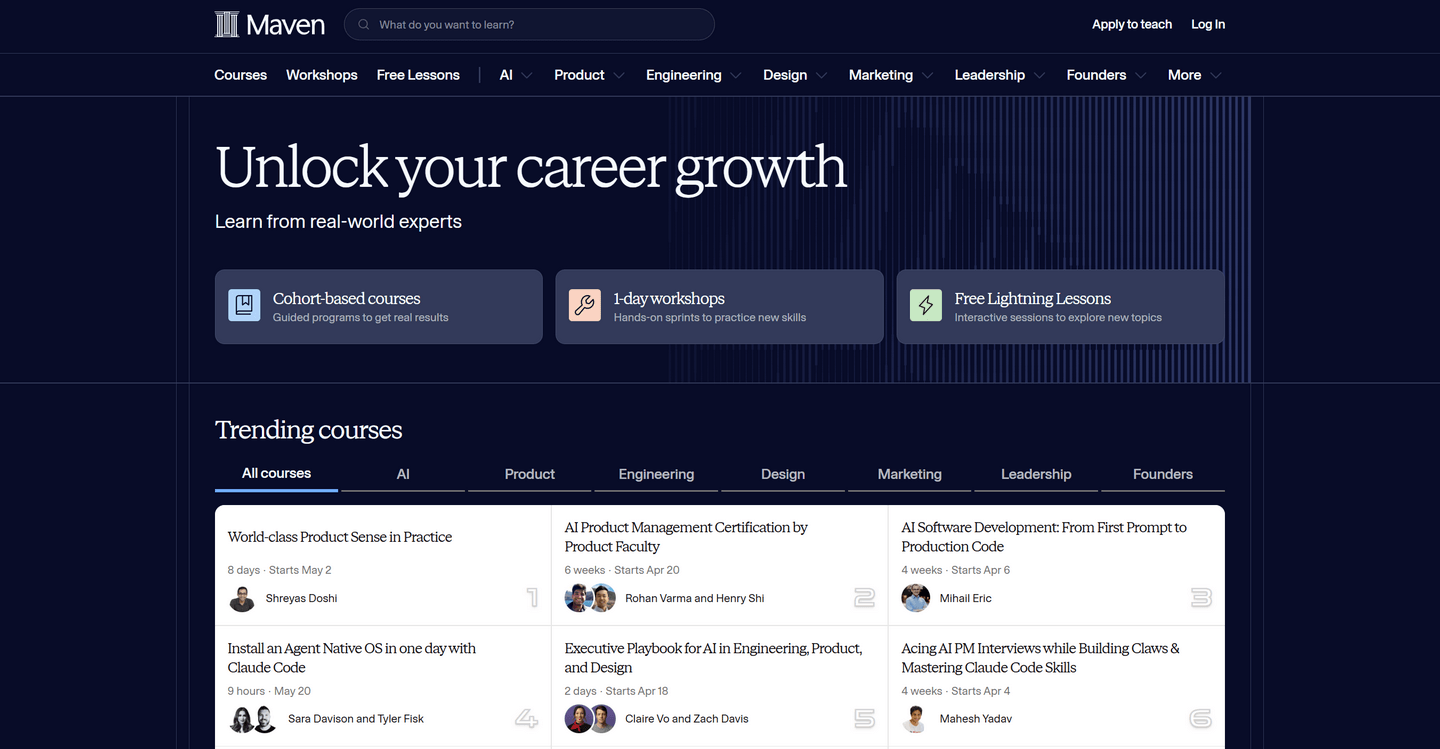
Maven is a marketplace of cohort-based courses taught by independent practitioners. You can find courses on communication, leadership, structured thinking, and management across a wide range of instructors. Some are taught by practitioners from Google, Meta, OpenAI, and consulting firms.
For managers, Maven offers flexibility. You pick courses that match your specific gaps rather than committing to a fixed curriculum. Shorter workshops are available for lower commitment and cost — a good way to test a topic or instructor before committing to a full course.
Maven is a practical option if you want to select specific courses rather than follow a fixed program. Quality varies significantly by instructor. There is no single integrated curriculum across the platform.
Key features
- Wide course library: Communication, leadership, structured thinking, management, AI, and more
- Practitioner instructors: Courses from operators at leading tech firms and consulting firms
- Cohort format: Live sessions with peers create accountability vs. passive video
- Short-form workshops: Lower-cost entry points before committing to a full course
- Flexible enrollment: Browse and enroll in scheduled cohorts across a wide range of topics
Pricing
| Format | Price |
|---|---|
| Individual courses | $300–$2,000+ depending on instructor |
| Workshops | Varies — some not publicly listed |
Pros & cons
Pros:
- Flexibility to pick courses that match specific gaps
- Cohort format creates peer interaction and accountability
- Wide range of topics and practitioner instructors
- Short-form workshops allow low-cost sampling before committing to a full course
Cons:
- No integrated curriculum — you curate your own learning path
- Quality varies significantly by instructor
- No consulting-grade methodology as a consistent thread across courses
- Not designed for corporate team deployment with a shared framework
Format: Cohort-based courses (instructor-led); formats vary
Price: $300–$2,000+ per course
Best for: Managers who want flexibility to select specific courses rather than a fixed program
5. High Bridge Academy — Business Excellence Bootcamp (BEB)
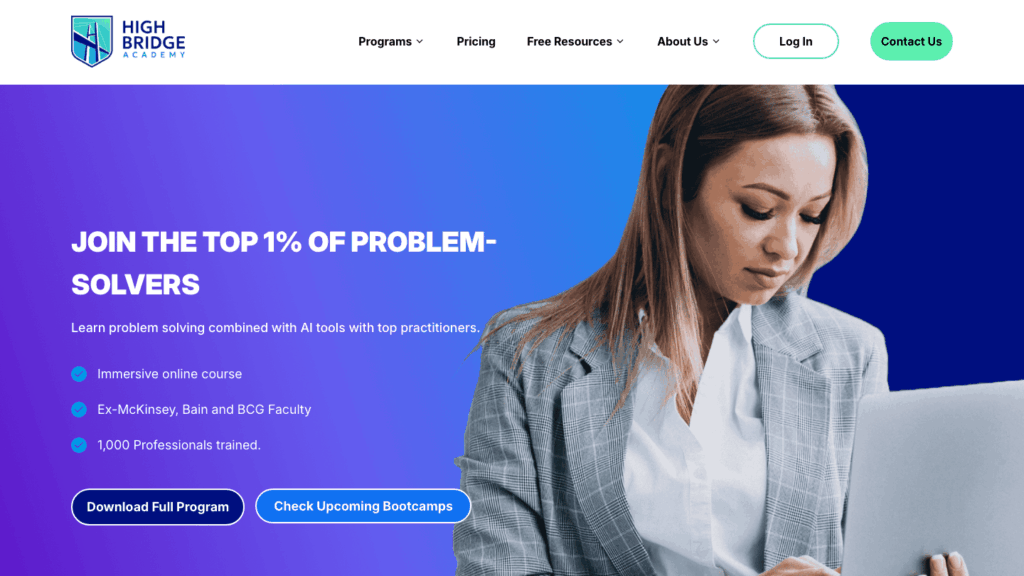
High Bridge Academy is our program. We’re including it here because it’s directly relevant — but you should weigh that context accordingly.
High Bridge Academy’s Business Excellence Bootcamp is built for the challenges managers face. It teaches structured problem solving, executive communication, stakeholder management, and AI integration in one program. It was developed by former consultants from top strategy firms.
Where Firm Learning focuses on communication and slides for early-career professionals, BEB is built for managers operating at a higher level. You learn how to structure complex problems, communicate decisions clearly to leadership, manage stakeholders who disagree, and use AI to work faster. These are the skills that separate managers who advance from those who plateau.
BEB is the only program on this list that combines all four pillars in one structured course. No other program here teaches consulting-grade thinking, executive communication, stakeholder management, and AI together. For managers who want to close the gap between where they are and how senior leaders operate, this is the most complete option available.
Key features
- Structured problem solving: MECE framework, issue trees, hypothesis-driven thinking, and decision frameworks
- Executive communication: Top-down communication, Pyramid Principle, business storytelling, and slide communication
- Stakeholder management: How to align, influence, and manage complex stakeholders — a skill no other program on this list teaches at depth
- AI integration — core module: AI tools built into the professional workflow throughout; not a bonus add-on
- Practitioner-led instruction: Taught by former strategy consultants with real client delivery experience
- Individual and corporate formats: Available for individual professionals and corporate team deployments
Pricing
| Format | Price |
|---|---|
| Entry workshops | ~$500 |
| Full Bootcamp | ~$2,000 |
| Corporate team programs | By inquiry |
Full pricing at highbridgeacademy.com/beb-pricing.
Pros & cons
Pros:
- Only program combining all four pillars: problem solving, communication, stakeholder management, and AI
- Taught by former strategy consultants with genuine client delivery experience
- Stakeholder management taught as a core module — the most neglected skill for managers
- Available for both individual professionals and corporate team deployments
Cons:
- Higher price point than single-skill alternatives
- Smaller public review volume than more established platforms
- Full bootcamp pricing requires direct inquiry
Format: Structured bootcamp — practitioner-led, online
Price: ~$500 (entry workshops) to ~$2,000 (full bootcamp)
Best for: Managers and corporate teams who want a complete consulting skill set, not just communication training
FAQ
Firm Learning teaches communication and slide writing well. But managers need more than that. You need to structure complex problems, influence stakeholders, and make decisions under pressure. Firm Learning does not cover structured problem solving, stakeholder management, or AI — the three areas where managers most often struggle as they move into senior roles.
Communication is important, but it is downstream of other skills. You need to structure the problem before you communicate it. You need to align stakeholders before you present to them. And increasingly, you need to use AI to work faster and more effectively. The best programs for managers teach communication within a broader consulting skill set — not in isolation.
Reforge is built for senior professionals in product, growth, and marketing at tech companies. If you work in finance, operations, strategy, or a non-tech industry, Reforge is not designed for you. The instructors, the peer network, and the program content all assume a tech and product context.
LinkedIn Learning is useful for quick exposure to a topic — especially if you already have LinkedIn Premium. It is not a substitute for a structured program. The content is introductory, the learning is passive, and the certificates carry limited signal. It works best as a supplement to other learning, not as a primary investment.
Coursera is a low-cost way to explore topics before committing to a more structured program. The university-backed certificates add some credibility. The limitation is that courses teach topics in isolation with no integrated methodology — which means you can complete several Coursera courses and still struggle to apply the skills consistently in real work.
For mid-level managers, High Bridge Academy’s BEB is the strongest option. It covers the full range of skills managers need — structured thinking, executive communication, stakeholder management, and AI — in one program. If you want a lower-cost entry point first, Maven gives you access to individual practitioner-led courses without a large upfront commitment.
Yes. Coursera for Business and LinkedIn Learning for Business both offer team subscriptions with reporting. Maven offers team discounts on individual courses. High Bridge Academy’s BEB is specifically designed for corporate team deployment — building shared methodology across a function. Reforge offers team and corporate plans by inquiry.
LinkedIn Learning courses run one to three hours each. Coursera courses vary — most take a few weeks self-paced. Reforge cohorts run four to six weeks with live sessions. Maven courses vary by instructor. High Bridge Academy’s BEB is a structured bootcamp — length depends on the cohort schedule.
Conclusion
Firm Learning is a practical starting point for communication and slide writing. But if you are a manager who needs to do more — structure complex problems, influence stakeholders, and use AI effectively — it does not go far enough.
Reforge is a strong option for managers in tech and product roles. Coursera and LinkedIn Learning are useful for low-cost topic exploration. Maven gives you flexibility to pick practitioner-led courses without committing to a fixed curriculum.
If you want one program that covers everything managers need — consulting-grade thinking, executive communication, stakeholder management, and AI — High Bridge Academy’s Business Excellence Bootcamp is the most complete option available.
Learn more about the Business Excellence Bootcamp at highbridgeacademy.com.