



Is AI about to replace consultants completely?
I get this question at least three times a week from consultants I coach.
The panic is real. You’ve spent years building expertise, and now it feels like everything’s shifting under your feet.
Here’s the uncomfortable truth: AI isn’t replacing consultants, but it is fundamentally changing how you work, what clients expect, and where your value comes from.
Over the past decade, I’ve coached hundreds of consultants through major industry shifts, and here’s what I’m seeing right now. The consultants who are thriving aren’t fighting AI or ignoring it. They’re using it to do better work, faster, while focusing on the skills that actually set them apart.
In this blog, you’ll learn:
- What’s actually changing in consulting workflows (and what’s just hype)
- Which AI capabilities matter most for your daily work
- How to protect and grow your value in an AI-enhanced world
No fluff, no speculation. Just practical strategies you can start using this week.
What’s Actually Changing in Consulting (And What’s Just Noise)?
Is AI really transforming consulting, or is this just another tech trend that’ll fade in 18 months?
I’ve been coaching consultants for over a decade, and I can tell you this feels different. The consultants who contact me aren’t worried about hypothetical futures anymore. They’re dealing with actual changes right now. So what’s really happening beyond the headlines?
Here are the three changes that are actually real:
Change #1: Your Time Is Shifting (And That’s Good News)
The consultants I’ve worked with report 30 to 40% time savings on research-heavy tasks.
One strategy consultant I coached used to spend 12 to 15 hours per week gathering industry reports and market analysis. Now, she spends about 5 hours. She moved from data gathering to insight synthesis.
Think about your last project. How much time did you spend finding information versus interpreting what it means?
That ratio is flipping.
Further reading: How to Convince Consulting Firms You’re Genuinely Motivated to Join Them?
Change #2: Client Expectations Just Went Up
Your clients have access to the same AI tools you do, so they’re expecting faster turnarounds and deeper insights.
The bar for “good enough” moved higher.
According to research from McKinsey Global Institute, generative AI could automate up to 45% of current work activities, pushing professionals toward higher-value strategic work.
What used to take two weeks?
Now it needs to happen in three days with strategic recommendations that clients haven’t thought of yet.
Change #3: The Skills That Actually Matter Are Shifting
Less about processing information. More about knowing what to do with it.
I’m watching this with every consultant I coach at High Bridge Academy. The ones thriving aren’t the most technical anymore. They’re the ones with the sharpest judgment, best questions, and the ability to synthesize across domains.
Human skills are becoming MORE valuable, not less.
Why?
Because AI can analyze a dataset in seconds, but it can’t tell you which analysis matters to a CEO making a market entry decision. It can’t read the room or sense when a client hesitates for reasons they haven’t articulated. This shift mirrors what I’ve seen across industries.
What AI Still Can’t Do?
Let’s be clear about what’s NOT changing:
- Build genuine client trust through years of reliable partnership.
- Handle truly ambiguous problems where the question itself isn’t clear yet.
- Make nuanced judgment calls, balancing competing priorities.
- Sell challenging recommendations to skeptical executives.
If your value comes from these areas, you’re not just safe. You’re more valuable than ever.
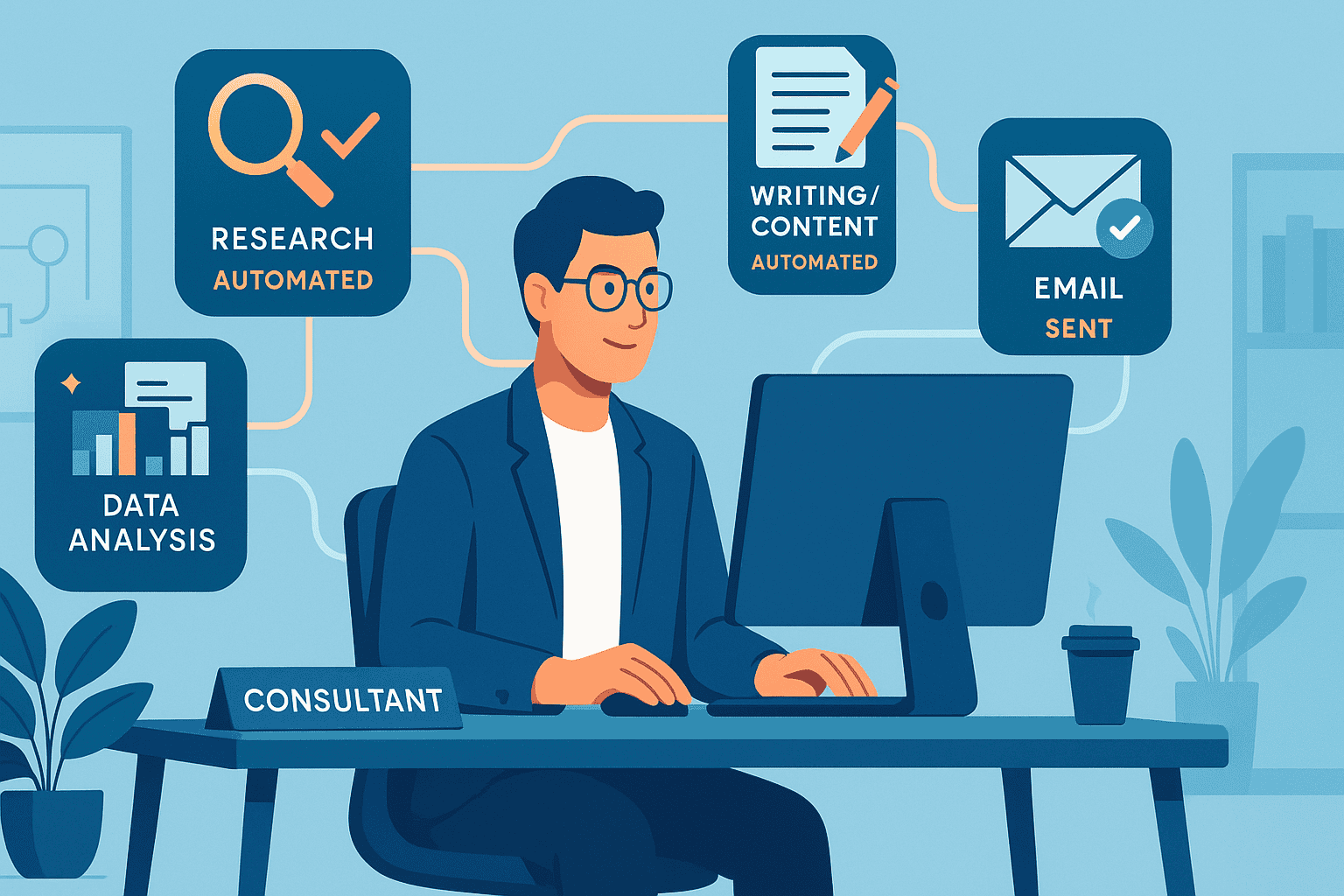
The AI Tools Consultants Are Actually Using (Skip the Rest)
Here’s what I tell consultants I coach: you don’t need 20 AI tools cluttering your workflow.
You need four capabilities that actually move the needle. I care about what the tool helps you DO, not what it’s called or how impressive it sounds.
Here’s what’s working right now:
| Tool Category | Best For | Top Tools |
| Research & Information | Gathering data, synthesizing sources, and fact-checking | Perplexity AI, ChatGPT, Claude, Consensus (academic research) |
| Analysis & Pattern Recognition | Processing datasets, identifying trends, and visualizing data | ChatGPT (Advanced Data Analysis), Claude, Julius AI, Microsoft Copilot |
| Content Creation | First drafts, structure, formatting, presentations | ChatGPT, Claude, Gamma (presentations), Jasper |
| Meeting Enhancement | Transcription, summaries, action tracking | Otter.ai, Fireflies.ai, Fathom, Microsoft Copilot (Teams integration) |
Now let’s talk about what each category actually does for your work.
Category #1: Research and Information Processing
I work with consultants who use these capabilities to cut research time by 35 to 50%. They do not skip research, but they let AI handle initial aggregation while they validate and interpret.
Here’s how it works in practice:
- Start your project by feeding AI your research questions.
- It pulls together initial findings from multiple sources.
- You spend time validating accuracy and connecting dots that the AI missed.
One consultant used this on a market entry analysis. Three days of desk research became six hours of AI-assisted work plus four hours of deep validation.
The catch?
AI confidently presents wrong information sometimes. Always validate critical facts against primary sources.
Category #2: Analysis and Pattern Recognition
I’ve seen consultants analyze five years of sales data in 20 minutes instead of two days.
The AI spots patterns, flags anomalies, and generates initial hypotheses you can test. Upload your dataset and ask specific questions like “What patterns exist in customer churn across regions?”
But remember this.
Context matters more than the analysis itself. AI finds correlations but doesn’t understand causation or your client’s specific situation. That’s where you add value.
The best consultants I work with approach this like defining problems correctly before solving them. AI gives you speed on analysis, but you need clarity on which problems actually matter.
That’s the human judgment clients pay for.
Category #3: Content Creation and Drafting
A consultant I coached cut slide deck creation time by 60%. AI handles structure and first-pass content. She focuses on strategic narrative and client-specific insights.
Feed the AI your analysis and key points. Let it generate a first draft structure. Then you refine, add your perspective, and inject the insights that actually matter.
Clients pay for your unique insights, not generic AI content. Many consultants I work with through our Consulting Readiness Program struggle with this balance initially, learning to use AI for speed while keeping their strategic thinking sharp.
The key?
Use AI for speed, not substance.
Category #4: Meeting and Communication Enhancement
This might be the highest ROI category for client relationships.
Record your client calls (with permission), let the tool generate transcripts and summaries, and review them before sharing. This way, you can be fully present in conversations instead of frantically taking notes.
One consultant told me this single change improved his client feedback scores. Why? He was actually listening instead of typing during strategy sessions.
Just don’t let automation replace human follow-up. The summary is a tool, not the relationship itself.
| 📌 How to Choose Your AI Tools? |
Before adopting any new tool, ask these three questions:
If a tool passes all three tests, try it for one week on real work. If it doesn’t clearly improve your output or save meaningful time, drop it. |
Your Workflow Is Changing (Here’s How to Adapt Fast)
The consultants I coach who thrive aren’t the ones with the most AI tools. They’re the ones who’ve redesigned how they actually work.
Here’s what matters: workflows matter more than tools.
You can have every AI capability available and still waste time if you use them in the wrong sequence. What’s shifting isn’t just the work itself but also the order and focus of each phase.
Let me show you exactly what’s changing.
| Phase | BEFORE (Traditional) | NOW (AI-Enhanced) | Your Move |
| Research & Discovery | Manual research, 10 to 15 hours | AI-assisted in 3 to 5 hours, focus on validation | Let AI gather and synthesize, you validate and identify gaps |
| Analysis & Hypothesis | Building models from scratch | AI generates the first pass, you refine and challenge | Push back on AI assumptions, add business context |
| Insight Synthesis | Manual slide creation, formatting | AI drafts structure, you add strategic narrative | Invest time in storytelling and client-specific insights |
| Client Presentation | Reactive edits, time-intensive revisions | Real-time adjustments, AI-powered customization | Use speed to test multiple approaches before presenting |
Let’s break down what this actually looks like.
Phase 1: Research and Discovery
You’re not spending 10 to 15 hours manually combing through reports anymore. AI handles the initial gathering and synthesis in 3 to 5 hours.
Your move?
Shift your energy to validation and gap identification. Ask yourself, “What did the AI miss? What context isn’t captured here?” That’s where your expertise shows up.
Copy this prompt:
| I’m conducting research for a consulting project in [INDUSTRY/SECTOR]. The client is [BRIEF CLIENT DESCRIPTION] and they’re facing [PRIMARY CHALLENGE OR DECISION]. I need you to help me with comprehensive research on this topic.
Please provide:
Format your response with clear headings for each section. Cite general sources where applicable, and flag any assumptions you’re making so I can validate them. |
Phase 2: Analysis and Hypothesis Development
Stop building every model from scratch.
Let AI generate the first pass of your analysis. Then you challenge assumptions, refine the logic, and add the business context AI can’t understand.
Your move?
Maintain critical thinking by actively questioning the AI output.
Don’t accept the first answer. Push back. Test alternative hypotheses. The AI gives you speed; you provide judgment.
Copy this prompt:
| I have data showing [BRIEF DESCRIPTION OF YOUR DATA/FINDINGS]. I need your help developing and testing analytical hypotheses for a consulting engagement.
Here’s the context:
Please help me by:
Then, challenge your own analysis. What could I be missing? What biases might be affecting this interpretation? Where does context that only a human consultant would know become critical? |
This structured approach to hypothesis development is what separates good consultants from great ones. If you want to explore structured problem-solving frameworks more deeply, the fundamentals haven’t changed. AI just accelerates your ability to test and iterate.
Phase 3: Insight Synthesis & Storytelling
AI can draft your slide structure and first-pass content. What it can’t do is craft the strategic narrative that makes your client care.
Your move?
Stop spending hours on formatting and layout.
Invest that time in storytelling. What’s the compelling case for action? What’s at stake if they don’t move forward? How does this fit their specific situation?
That’s the work that commands higher fees.
Copy this prompt:
| I need to create a compelling presentation for [CLIENT/STAKEHOLDER TYPE – e.g., C-suite executives, board members, operational leaders].
Here’s what I need to communicate:
Please help me structure this into a clear, persuasive narrative by:
Keep the language executive-appropriate: clear, confident, free of jargon. Focus on business impact, not analytical process. |
Phase 4: Client Presentation and Iteration
The old way meant reactive edits after client feedback: long revision cycles and lots of back and forth.
Now?
You can test multiple approaches before the presentation. Generate alternative scenarios in real time during client discussions. Customize on the fly based on what resonates.
Your move?
Use speed as a strategic advantage. Run three versions of your analysis before the meeting. See which story performs best. Based on client reactions, adapt in the moment.
Copy this prompt:
| I’m about to present [YOUR RECOMMENDATION/FINDINGS] to a client, and I need to prepare for different scenarios and objections.
Context:
Help me prepare by: 1. Creating 3 different versions of how to position this same recommendation:
(Keep each version to 100-150 words) 2. Generating strong, empathetic responses to each potential objection that:
3. Suggesting 2-3 “what if” scenarios I should prepare for (e.g., “What if they have 50% less budget?” or “What if they want to move faster?”) 4. Recommending questions I should ask during the presentation to gauge reactions and adapt in real time This needs to help me stay flexible and responsive during the actual conversation, not just deliver a fixed pitch. |
How to Actually Implement This?
- Start with one phase, not all four at once: Pick the biggest time drain in your current workflow. Master that before moving forward.
- Track your time savings: Measure hours before and after. Once they adjust, most consultants I coach save 8 to 12 hours per week.
- Share what’s working with your team: The fastest learners are the ones comparing notes and iterating together.
- Move to the next phase gradually: Build the new workflow step by step, not overnight.
The consultants winning right now aren’t working harder. They’re working in a completely different sequence.
How to Stay Valuable (And Command Higher Fees) in the AI Era?
So if AI can do the analysis, what’s your value?
Here’s what clients are actually paying for now: not faster spreadsheets or prettier slides. They pay for judgment in messy situations, trust when the stakes are high, and help implement changes their teams resist.
You’re not competing with AI. You’re leveraging it to focus on what humans do better. The consultants I coach who command the highest fees aren’t the ones fighting this shift. They’re the ones doubling down on skills AI can’t touch.
Let me show you exactly which skills matter most.
Skill #1: Strategic Judgment in Ambiguity
Making decisions when information is incomplete and the stakes are high.
AI needs clear parameters.
Consulting rarely has them. Your client is weighing a market entry with unclear regulatory futures, competitive responses they can only guess at, and internal capabilities they’re not sure exist yet.
That’s where your judgment matters. One consultant I worked with helped a client decide between three market expansion options. The data was inconclusive, so she made the call based on factors AI couldn’t weigh: leadership appetite for risk, organizational readiness, and cultural fit.
How to develop it:
- Take smaller judgment calls daily.
- Document your reasoning.
- Review what worked and what didn’t.
- Pattern recognition builds over time.
Also read: How to BEST Introduce Yourself in a Consulting Interview (Without Sounding Rehearsed)
Skill #2: Client Trust & Relationship Building
Earning confidence through consistent delivery and reading what’s unsaid.
Clients hire people they trust, not algorithms. AI can’t sense when your client sponsor is nervous about board approval or when the CFO’s body language signals hidden concerns.
One consultant told me he won a $2M engagement because he spent three months building trust through small interactions before the RFP even dropped. The technical proposal wasn’t better than the competitor’s, but the relationship was.
How to develop it:
- Show up consistently.
- Follow through on small commitments.
- Listen more than you talk.
- Ask about concerns they haven’t voiced yet.
The best consultants use AI as a tool, not a crutch. They’re confident enough to challenge outputs when their experience tells them something’s off.
Skill #3: Asking Better Questions
Framing problems correctly before solving them.
AI answers questions. Consultants identify which questions actually matter. A client asks, “Should we enter this market?” The real question might be, “Do we have the operational capabilities to compete here?”
- Before: “What’s the market size?”
- After: “What would make us confident we can win in this market given our current capabilities?”
How to develop it: Practice reframing every client question three different ways before answering. The right question often reveals itself in the third reframe.
Skill #4: Synthesis Across Domains
Connecting dots from different industries that AI can’t see.
Breakthrough insights come from unexpected places. AI is trained on patterns within domains, but you see patterns across them.
One consultant helped a healthcare client by applying supply chain strategies from automotive manufacturing. AI wouldn’t have made that connection because it wasn’t trained to look there.
How to develop it:
- Read case studies outside your industry.
- Every month, study one completely different sector.
- Look for transferable principles.
Skill #5: Change Management & Human Psychology
Helping clients actually implement what you recommend.
Great analysis fails without adoption. You need to understand why people resist change, what motivates teams, and how to sequence implementation so it sticks.
One consultant’s recommendations sat on a shelf for six months until she returned and helped the client with the change process. The analysis was the same, but the outcome differed because she addressed the human side.
How to develop it:
- Study implementation as seriously as strategy.
- Our Consulting Bootcamp at High Bridge Academy is the best bootcamp to prepare for consulting interviews as it teaches you the frameworks top consultants use to bridge the gap between brilliant recommendations and real organizational change, from structured problem-solving to client influence.
Most consulting recommendations die in the implementation gap. If you’re serious about improving how you help clients adopt change, understanding how to train teams on essential skills becomes critical. AI enables you to analyze the problem, but you need to solve the people side of implementation.
For consultants moving into management roles, our Consulting Leadership School specifically focuses on delegation, team management, and client authority, the skills that turn managers into partners.
| 📌 Reframe Your Positioning |
| OLD value proposition:
“I analyze data and provide recommendations.” NEW value proposition: “I synthesize AI-powered insights, apply strategic judgment to ambiguous situations, and help you implement confidently”. |
Your action steps this week:
- Update your LinkedIn headline and summary with your new positioning
- Revise your elevator pitch for the next client conversation
- Track how prospects respond differently to the new framing
The consultants commanding premium fees aren’t selling analysis anymore. They’re selling judgment, trust, and implementation support that no algorithm can provide.
Your 4-Week Action Plan to Thrive in AI-Enhanced Consulting (Not Just Survive)
The consultants who succeed aren’t the ones with the most tools. They’re the ones with a systematic approach.
Here’s the exact plan I give to the consultants I coach: no overwhelm, no trying to change everything at once, just four focused weeks that build on each other, one step at a time.
Let’s get started.
Week 1: Audit Your Current Workflow
| Focus | Understand where you spend time |
| Time Investment | 3 days of tracking |
| Success Metric | Identify 5-10 hours of AI-assisted work potential |
Most consultants think they know where their time goes. Then they actually track it and get surprised.
Your action steps:
- Track every task for 3 days using a simple spreadsheet or notebook
- Categorize everything into four buckets: research, analysis, formatting, and client-facing
- Identify your 3 biggest time drains by looking at the hours spent
- Ask yourself: “What here is low-value but time-intensive?”
One consultant I worked with found 12 hours per week just in data formatting and slide cleanup. That’s 600 hours a year spent on work that didn’t require his strategic expertise.
| ⚠️ Common Mistake to Avoid: Don’t try to audit everything. Focus only on repeatable tasks that show up weekly. One-off projects aren’t worth optimizing yet. |
As you track your time, you’ll likely find gaps in how you document your work. Many consultants waste hours recreating processes they’ve done before because they never documented them properly.
AI can’t fix poor documentation habits. Build both systems at once.
Week 2: Test One AI Tool for One Specific Task
| Focus | Start small and specific |
| Time Investment | 5 consecutive days |
| Success Metric | 20-30% time savings on one task |
Pick ONE high-impact, repeatable task from your audit.
Not three. Not five. One.
Your action steps:
- Choose ONE task from your audit (the highest-impact repeatable one)
- Select ONE tool that handles that capability
- Use it every day for 5 days straight
- Track these metrics: time saved, output quality, learning curve
A strategy consultant I coached tested AI for client meeting summaries. The first day took 20 minutes to figure out. By day five, he was saving 45 minutes per meeting.
| ⚠️ Common Mistake to Avoid: Don’t try multiple tools at once. You’ll learn nothing because you won’t know what’s working. |
Your move: Which task will you start with this week?
Week 3: Integrate AI into Your Workflow (Build the Habit)
| Focus | Make it automatic, not optional |
| Time Investment | Building systems all week |
| Success Metric | AI becomes your default process |
This is where most people fail. They test something, it works, then forget to use it next week.
Your action steps:
- Add AI to your project checklist (make it impossible to skip)
- Create saved prompts or templates for your automated tasks
- Share what’s working with your team or peers
- Refine your approach based on what you’re learning
After two weeks, one consultant cut proposal drafting time by 40% because she built AI into her standard workflow instead of treating it like an optional step.
| ⚠️ Common Mistake to Avoid: Don’t skip the validation step. AI makes confident mistakes. Always review output before it goes to clients. |
Week 4: Level Up Your Human Skills (Where AI Can’t Compete)
| Focus | Invest saved time into high-value skills |
| Time Investment | Redirect 5-10 hours weekly |
| Success Metric | More time on strategy, relationships, synthesis |
You’re saving time now. Don’t just fill it with more of the same work.
Your action steps:
- Schedule one extra client strategy session for deeper relationship building
- Practice asking better discovery questions (record and review your calls)
- Read one case study from a different industry (look for transferable principles)
- Analyze weekly: “Where did my judgment add the most value this week?”
With eight extra hours per week, one consultant took on a pro bono project that turned into a $500K paid engagement six months later.
One of the most effective ways to develop better judgment is by studying how experienced consultants think through complex situations. If you’re preparing for consulting interviews or want to sharpen your structured thinking, our Case Interview Prep program teaches you to think like an MBB consultant, the same mental models that make you valuable, whether you’re using AI tools or traditional methods.
| ⚠️ Common Mistake to Avoid: Don’t just do more work. Do higher-value work. The goal is better outcomes, not busier schedules. |
The compounding effect: Small weekly improvements create massive annual gains.
Beyond Week 4: Keep Iterating
What’s next:
- Review monthly: What’s working? What’s not?
- Try one new capability per quarter (not every shiny tool that launches)
- Share wins and failures with your peer group
- Stay curious about emerging tools, but don’t chase every trend
The long game: Consultants who master AI-enhanced workflows aren’t just faster. They’re delivering better insights, commanding higher fees, and actually enjoying the work more.
The consultants I coach who follow this plan consistently report 10 to 15 hours saved per week within 60 days. That’s not just time saved. It’s capacity for higher-value work that clients pay premium rates for.
Also checkout: What Follow-Up Questions Do Interviewers Typically Ask In Fit Interviews (And How to Tackle Them)?
The Consultants Winning Right Now Aren’t Working Harder. They’re Working Differently.
Your value isn’t decreasing. It’s shifting.
AI handles the data processing and formatting. You bring judgment in ambiguous situations, trust in high-stakes moments, and the ability to connect dots across domains that algorithms can’t see.
The future belongs to consultants who leverage AI, not fear it.
Here’s what I want you to do this week: Pick ONE thing from this guide, not five. One.
Maybe it’s auditing your workflow for three days, testing one AI tool on one specific task, or reframing your value proposition on LinkedIn. Start small. Build momentum. Track what changes.
The consultants I coach who take this approach consistently report 10 to 15 hours saved per week within 60 days. That’s not just saved time. It’s capacity for strategic work that commands premium fees.
Want structured guidance on mastering AI-enhanced consulting?
High Bridge Academy’s Consulting Bootcamp was developed and delivered by 60+ ex-McKinsey, Bain, and BCG consultants who’ve helped hundreds of professionals land offers at top firms, adapt their workflows, sharpen their judgment, and position themselves for the AI era.
We’ll help you build a custom plan that fits your actual work, not generic theory. The work is changing. Your ability to create value isn’t.