


If you’ve ever left a team meeting feeling like everyone talked a lot but nothing actually moved forward, you already know the real problem: the thinking was scattered. And scattered thinking always leads to scattered work.
I’ve coached teams across different industries, and the pattern is predictable: when people don’t think in a structured way, projects slow down, priorities blur, and decision-making becomes painfully inconsistent.
That’s exactly where MECE-style thinking helps. Not because it’s a “consulting trick,” but because it forces clarity that your team can finally use.
In this blog, we will discuss:
- What MECE actually means for everyday team decisions
- How MECE improves clarity, speed, ownership, and decision quality
- A practical step-by-step way to teach MECE thinking inside your team
Let’s walk through a simple, realistic, and actionable approach you can use immediately.
What Is MECE and Why Does It Matter?
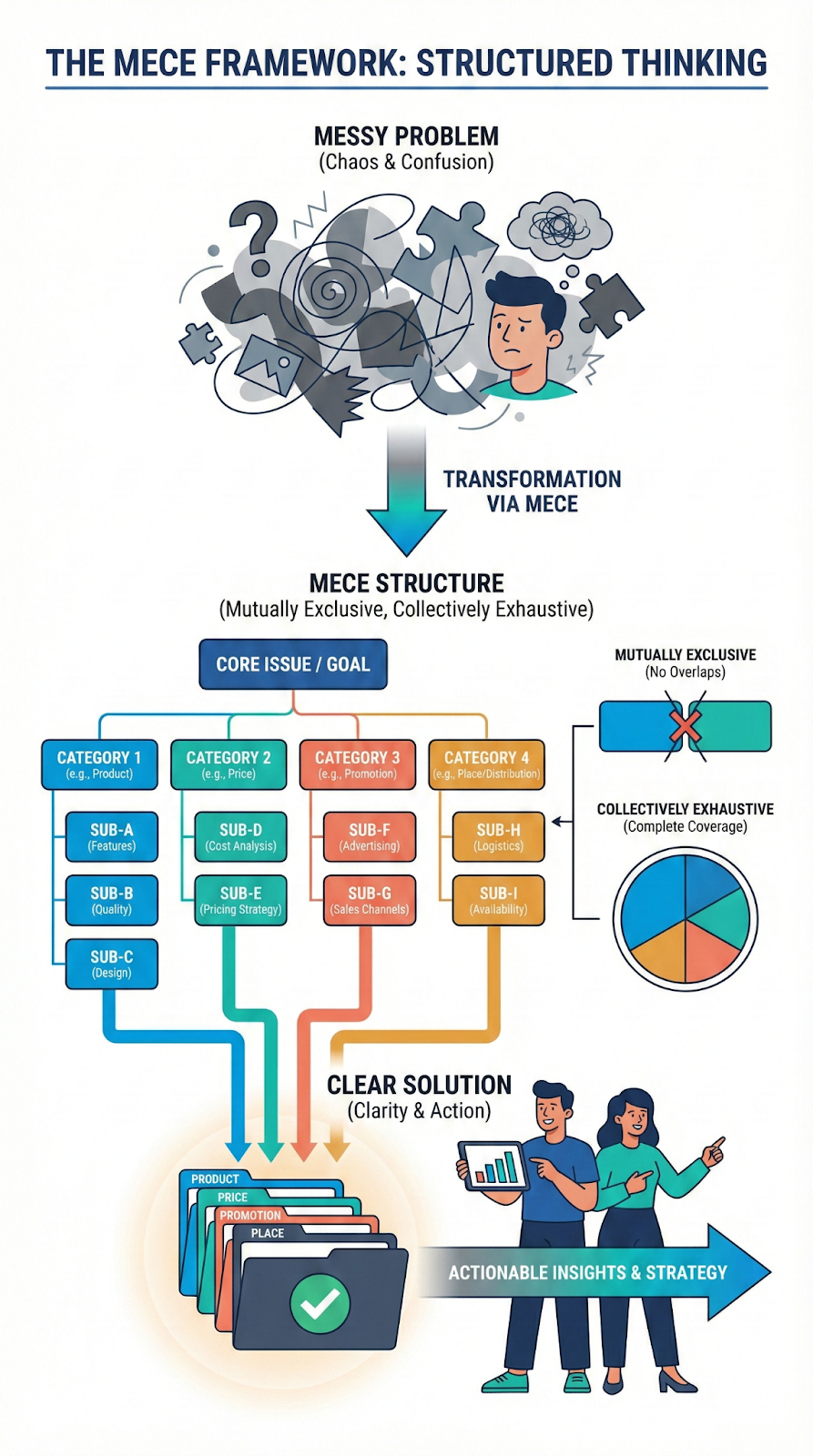
MECE stands for Mutually Exclusive, Collectively Exhaustive. It’s a principle for organizing information, ideas, or categories in a way that’s both precise and complete.
Barbara Minto developed MECE at McKinsey & Company in the late 1960s. She noticed that consultants struggled to communicate clearly, not because of language problems but because of thinking problems. People were writing without organizing their ideas first.
Her insight?
Structure your thinking before you structure your words. MECE became the backbone of how top consulting firms approach every problem. It spread to business schools, corporate strategy teams, and eventually into mainstream business thinking.
Here’s what the two parts mean:
- Mutually Exclusive means your categories don’t overlap. Each item fits into one and only one bucket. If you’re sorting customers by age, someone who is 35 can only belong to one age bracket, not two.
- Collectively Exhaustive means your categories cover everything. Nothing gets left out. When combined, all your buckets account for 100% of the possibilities.
Think of it like organizing a filing cabinet. Every document needs a home (collectively exhaustive), but no document should fit in multiple folders (mutually exclusive). If you have papers that could go in two places, your system has overlap. If you have papers with nowhere to go, your system has gaps.
Here’s a practical comparison:
| Non-MECE Segmentation | MECE Segmentation |
| Customers by hobby (indoor vs. outdoor) | Customers by age bracket (18-24, 25-34, 35-44, etc.) |
| Revenue by “big accounts” and “growing accounts.” | Revenue by geography (North America, Europe, Asia, etc.) |
| Costs by “important” and “operational.” | Costs by fixed vs. variable |
| Time by “soon” and “later.” | Time by quarter (Q1, Q2, Q3, Q4) |
- The left column creates confusion. A customer might have both indoor and outdoor hobbies. An account might be both big and growing. The categories bleed into each other.
- The right column creates clarity. There’s no ambiguity. Every customer has exactly one age. Every dollar of revenue comes from exactly one region.
This clarity is exactly why MECE matters. When your thinking is MECE, your analysis is complete, and your communication is sharp.
What Happens When Teams Think Without Structure?
Before teaching MECE, your team needs to feel the pain of unstructured thinking. Otherwise, they’ll treat MECE as “another training topic” instead of recognizing it as the missing foundation for their everyday work.
Here are the patterns I see everywhere:
1. People Talk in Circles
Everyone tries to analyze the problem from their angle, but no one is actually organizing the conversation. The result? A 30‑minute debate turns into a 90‑minute drain.
2. Work Overlaps and Critical Steps Get Ignored
Two people do the same thing. Another person does nothing, assuming someone else already handled it. And an entire important sub-problem gets skipped entirely.
3. Decisions Slow Down
When thinking is messy, the decision is likely to be messy as well. Teams end up “parking lotting” everything because no one can see the structure underlying the issue.
4. Ownership Becomes Unclear
If buckets aren’t MECE, responsibilities aren’t MECE. And if responsibilities aren’t MECE… Good luck getting accountability.
I once worked with a team analyzing why their onboarding process overwhelmed new analysts. Half the team focused on workload. Another half debated learning materials. A few discussed time zone issues.
No structure. No alignment.
When we reorganized everything into three MECE buckets: Volume, Clarity, Timing, the entire conversation shifted.
Suddenly, the root problem became obvious. This is why teaching MECE isn’t optional. It solves problems your team doesn’t even realize are problems.
Key Signs Your Team Needs MECE Training
How do you know if your team would benefit from structured thinking training? Watch for these patterns:
- Overlapping workstreams: Two people analyze the same market segment without realizing it. A cost reduction initiative duplicates work being done by another team. When you debrief projects, you discover people were covering the same ground.
- Critical gaps in analysis: The board asks about a competitor you didn’t include. A risk materializes that no one flagged. Post-mortems reveal “we didn’t think about that” as a recurring theme.
- Confusing presentations: Stakeholders struggle to follow the logic. They ask clarifying questions that reveal the presenter’s categories weren’t clean. Or worse, they nod along without really understanding, then make poor decisions based on fuzzy analysis.
- Circular brainstorming: Idea generation sessions cover the same territory repeatedly. People suggest solutions without having structured the problem first. Meetings end with long lists that no one knows how to prioritize.
- Inconsistent quality: Some team members produce airtight analysis while others turn in work full of logical gaps. There’s no shared language or framework for what “good thinking” looks like.
| 📋 Pro Tip: Self-Assessment Questions |
| Ask yourself these questions about your team’s recent work:When we divided up analysis tasks, did anyone’s scope overlap with someone else’s?In our last major decision, did we discover a critical factor only after the fact?When presenting recommendations, did stakeholders easily follow our logic or ask many clarifying questions?Do our brainstorming sessions generate organized ideas or scattered lists?If you answered “yes” to overlap, “yes” to missed factors, “no” to clear logic, or “scattered” to brainstorming, MECE training should be a priority. |
How Do You Teach MECE Thinking to Your Team? (Deep Practical Guide)
Teaching MECE isn’t a one-hour workshop. It’s a journey from understanding the concept to making it instinctive, and that journey looks different for every team.
Some people grasp it immediately. Others need weeks of practice before it clicks. Your job as a leader isn’t just to explain MECE once. It’s to create an environment where structured thinking becomes the default.
Here’s the roadmap I recommend, based on what actually works in corporate training settings.
- Start with “why”
- Introduce the concept with everyday examples
- Practice with simple categorization exercises
- Graduate to business problems
- Apply to real projects
- Make it a team standard
Let’s get in-depth!
Step 1: Start with Why
Before introducing any mechanics, help your team understand why structured thinking matters without the “why.” MECE feels like an academic exercise. With it, people see a tool that solves real problems they face.
What to share: Show examples of analysis that succeeded because it was MECE, and analysis that failed because it wasn’t. Nothing teaches faster than contrast.
Consider sharing a story like this: A team spent three weeks analyzing why customer churn increased. They looked at pricing, product quality, and customer service.
Their recommendation?
Improve customer service response times. Six months later, churn was still rising.
Why?
They’d missed a category entirely: competitive alternatives. A new entrant had launched with better features at a lower price. The team’s framework had gaps.
Ask your team: “Have you ever worked on a project where you discovered, too late, that you’d missed something important? What did that cost us?”
Let them share their own experiences. When people connect MECE to their own frustrations, motivation becomes personal.
How long this takes: One 30-45 minute session. Don’t rush it. The foundation matters.
Step 2: Introduce the Concept with Everyday Examples
Abstract definitions don’t stick. Concrete examples do.
Begin with non-business scenarios that make the principle intuitive. The goal is to help people recognize patterns, enabling them to see MECE in familiar contexts before applying it to unfamiliar ones.
Everyday examples to use:
| Scenario | Possible MECE Breakdown | Discussion Point |
| Sorting laundry | By color (whites, darks, colors) OR by fabric (delicates, regular, heavy) | Both are valid, but mixing them creates overlap |
| Organizing a grocery list | By store section (produce, dairy, frozen, etc.) | Forces you to think about every section |
| Planning a road trip | Transportation, accommodation, activities, budget | What’s missing? Food? What overlaps? |
| Cleaning a house | By room OR by task type (dusting, vacuuming, organizing) | Choosing one dimension is key |
Give each team member a scenario. Have them create their own MECE breakdown in 5 minutes. Then discuss as a group:
- “Is this breakdown mutually exclusive? Could any item fit in two categories?”
- “Is it collectively exhaustive? Is there anything that wouldn’t have a home?”
- “What’s missing? What overlaps?”
These low-stakes examples let people practice the thinking pattern without the pressure of business content. Mistakes here are learning opportunities, not career risks.
How long this takes: 45-60 minutes. Include multiple examples so the pattern reinforces.
Step 3: Practice with Simple Categorization Exercises
Now, bridge to a business context, but keep the problems simple enough that people can focus on the structure rather than the content.
Here are some exercises to run:
Exercise A: Profit Drivers
“Break down all the ways a company can increase profit.”
The classic answer: Profit = Revenue – Costs. Revenue = Price × Volume. Costs = Fixed + Variable. Each can be subdivided further.
Have teams build this out to three levels. Then compare: Did everyone arrive at the same structure? Where did approaches differ? Which is most useful?
Exercise B: Customer Segmentation
“You run a coffee shop. Segment your customers.”
Multiple valid answers exist:
- By time of visit (morning rush, midday, afternoon, evening)
- By order type (coffee only, food + coffee, specialty drinks)
- By frequency (daily regulars, weekly visitors, occasional)
- By purpose (work/study, social, grab-and-go)
The discussion: Which segmentation would help you make better business decisions? MECE is necessary but not sufficient; strategic relevance matters too.
Exercise C: Root Cause Analysis
“A website is loading slowly. What are all the possible reasons?”
Here is a sample structure:
- Server-side issues (hosting, database, code efficiency)
- Client-side issues (browser, device, local network)
- Network issues (bandwidth, CDN, DNS)
- Content issues (file sizes, number of requests, third-party scripts)
Debrief each exercise rigorously:
- Where did overlap creep in?
- What got missed?
- How could the structure be tighter?
- Did the team default to familiar categories or think from first principles?
How long this takes: 2-3 sessions of 60 minutes each, spread over 1-2 weeks.
| 💡 Pro Tip: The “Pressure Test” Technique |
| After any MECE exercise, use these two questions to pressure-test the framework:The Overlap Test: “Can you give me one example that would fit in two of these categories?” If yes, you have an overlap problem.The Gap Test: “Can you give me one example that wouldn’t fit anywhere?” If yes, you have a coverage problem.Train your team to ask these questions automatically. Eventually, they’ll pressure-test their own thinking before anyone else does. |
Step 4: Graduate to Business Problems
Now apply MECE to real business scenarios, either case studies or actual challenges your team faces. This is where the learning gets practical.
Two types of application:
Problem Structuring (Diagnostic)
“Our customer satisfaction scores dropped 15% this quarter. What are all the possible causes?”
Build an issue tree together. First level might be:
- Product/Service quality issues
- Customer experience issues
- Expectation issues (marketing overpromised)
- External factors (competitive alternatives, market changes)
Test each branch: Is it distinct from others? Does the set cover all possibilities?
Then go deeper. Under “Customer experience issues,” what are the subcategories? In-store experience? Online experience? Support interactions? Delivery/fulfillment?
Solution Structuring (Prescriptive)
“We need to reduce operating costs by 15%. What are all the levers we could pull?”
Structure might be:
- Reduce headcount costs (layoffs, hiring freeze, outsourcing)
- Reduce non-headcount costs (renegotiate contracts, cut discretionary spend)
- Increase efficiency (automation, process improvement)
- Change scope (exit low-margin activities, consolidate operations)
Again, test for MECE. Is there a cost reduction approach that wouldn’t fit somewhere?
The facilitation approach
Don’t give answers. Guide with questions:
- “What’s missing from this level?”
- “Could this item also fit under that category?”
- “How would you know if this list is complete?”
- “What would someone outside our company add?”
The goal is to build their thinking muscles, not to demonstrate yours.
How long this takes: 3-4 sessions of 60-90 minutes, spread over 2-3 weeks. Use real problems when possible; it increases engagement dramatically.
Step 5: Apply to Real Projects
The breakthrough occurs when people apply MECE in real-world work with tangible stakes.
How to implement:
Identify an upcoming project where structured thinking is critical. This might be:
- A market analysis
- A strategic recommendation
- A process improvement initiative
- A budget planning exercise
Require the team to present their MECE framework before diving into analysis. This is crucial. Most teams want to jump straight to data gathering. Force them to structure first.
The framework review:
Schedule a 30-minute “structure review” before any analysis begins. In this session:
- Have the team present their framework (issue tree, segmentation, whatever applies)
- Challenge overlaps: “Could this item fit in multiple categories?”
- Probe for gaps: “What’s missing from this picture?”
- Test for strategic relevance: “Will this structure help us answer the question we’re trying to answer?”
Make structure as important as the final answer. If the framework isn’t tight, send it back for revision.
The feedback loop:
After the project completes, debrief the framework:
- Did the structure hold up, or did we discover gaps mid-project?
- Did we have to restructure partway through? Why?
- What would we do differently next time?
How long this takes: One full project cycle (typically 2-6 weeks depending on scope). Plan for 2-3 such cycles before the skill becomes reliable.
| The MECE Framework Checklist |
Before approving any framework, run through this checklist:Mutually Exclusive Check: Each category is clearly distinct from othersNo item could reasonably fit in two categoriesCategories use a single, consistent dimensionCollectively Exhaustive Check:All possibilities have a homeAn “Other” bucket exists if needed (and is small)We’ve actively asked “what’s missing?”Strategic Relevance Check:The structure helps answer our actual questionThe level of detail matches our decision needsThe categories are actionablePrint this. Post it in your workspace. Use it every time. Each category is clearly distinct from othersNo item could reasonably fit in two categoriesCategories use a single, consistent dimensionCollectively Exhaustive Check:All possibilities have a homeAn “Other” bucket exists if needed (and is small)We’ve actively asked “what’s missing?”Strategic Relevance Check:The structure helps answer our actual questionThe level of detail matches our decision needsThe categories are actionablePrint this. Post it in your workspace. Use it every time. |
Step 6: Make It a Team Standard
The final step: embed MECE into how your team operates permanently. Skills that aren’t reinforced fade. You need systems.
Tactics that work:
- Create templates that prompt MECE structuring: For common deliverables (market analyses, business cases, project plans), build templates with sections that require MECE thinking. The template should ask: “What are all the categories? Are they mutually exclusive? Are they collectively exhaustive?”
- Add “Is this MECE?” to your review checklists: Every time you review work, check the structure before you check the content. If the framework is weak, the content will be too.
- Make structured thinking part of performance evaluation: When providing feedback, comment specifically on the analytical structure, rather than just the conclusions. “Your recommendation was sound, and I particularly appreciated how cleanly you structured the competitive analysis. The MECE breakdown of competitor types made it easy to see the full picture.”
- Create a shared vocabulary: When someone proposes an analysis, it is normal to ask, “Is that MECE?” When someone spots an overlap, they should feel comfortable saying: “I think we have an exclusivity problem here.” Shared language accelerates shared practice.
- Assign rotating “MECE champions”: On each project, designate a person responsible for ensuring framework quality. They don’t own the analysis; they own the rigor. Rotate this role to build capability across the team.
How long before it sticks: Expect 3-6 months before MECE becomes genuinely instinctive. The habit forms through repetition. Your job is to create enough repetition that the pattern becomes automatic.
Self-directed training is effective, but it requires time. If you want faster results, consider bringing in experts who’ve done this before.
High Bridge Academy’s Structured Problem-Solving Workshops compress months of learning into intensive, hands-on sessions. Led by former McKinsey and BCG consultants, these workshops combine theory with practice on real business problems.
For teams with specific challenges, customized workshops tailor content to your industry, your problems, and your skill gaps. Available online or in-person, in multiple languages.
The investment in formal training pays back quickly, in better analysis, faster decisions, and clearer communication.
Common MECE Mistakes and How to Avoid Them
Even teams that understand MECE make predictable errors. Here’s what to watch for:
Mistake 1: Over-Segmentation
Creating too many granular categories can dilute focus and overwhelm stakeholders. A framework with 15 branches isn’t more rigorous; it’s harder to use.
How to avoid: Start with 3-5 main branches at each level. If you need more granularity, add depth (more levels) rather than breadth (more branches at the same level).
Mistake 2: False Exclusivity
Defining categories that appear separate but overlap in practice. “Domestic customers” and “Large accounts” might seem distinct until you realize a large account can be domestic.
How to avoid: For each pair of categories, ask: “Could something belong to both?” If yes, redefine the boundaries.
Mistake 3: Incompleteness Due to Bias
Missing entire dimensions because of unconscious bias, limited perspective, or anchoring on familiar solutions. Your team analyzes digital marketing channels and forgets offline entirely.
How to avoid: Actively ask “What are we not considering?” Include diverse perspectives in structuring sessions. Use “Other” buckets deliberately, then challenge whether “Other” should become its own branch.
Mistake 4: Force-Fitting Standard Frameworks
Trying to apply familiar frameworks (like the 4Ps of marketing) to problems they don’t fit. Every case is different; off-the-shelf structures often lack relevance.
How to avoid: Build problem-specific frameworks from first principles. Use standard frameworks as inspiration, not templates.
Mistake 5: Skipping the Testing Step
Assuming your framework is MECE without verification. The structure looks good, so you dive into analysis, only to discover gaps later.
How to avoid: Always test. For exclusivity: “Can I clearly assign each item to exactly one bucket?” For exhaustiveness: “Is there anything that doesn’t fit anywhere?”
How to Reinforce MECE as a Lasting Habit?
Training introduces the concept. Reinforcement makes it permanent. Here’s how to embed MECE into your team’s operating rhythm:
- Create MECE checklists for deliverables: Before any analysis goes to stakeholders, require a “MECE check.” Is the framework mutually exclusive? Is it collectively exhaustive? Make this a formal gate in your review process.
- Build it into meeting agendas: When structuring problems in meetings, explicitly call out “Let’s make sure this is MECE.” Use whiteboards to visualize structures. Challenge each other in real-time.
- Assign “MECE champions” on projects: Designate someone responsible for framework quality. They don’t own all the analysis; they own the rigor of the structure. This role rotates, building capability across the team.
- Review past analyses for gaps and overlaps: During project retrospectives, examine your frameworks to identify any gaps or overlaps. Where did you miss something important? Where did you duplicate effort? Learn from the patterns.
- Celebrate structured thinking: Recognize team members who create especially elegant MECE frameworks. Share examples of excellent structuring in team meetings. Make analytical rigor something people take pride in.
| 🎮 Fun Activity: The Weekly MECE Puzzle |
| Each week, post a challenge for the team: “Create a MECE breakdown of all the reasons someone might be late to work.”Let people submit answers anonymously. Review them together, discussing which approaches were strongest and why. Award a small prize for the most elegant solution. This keeps MECE top of mind without feeling like training. It becomes part of team culture. |
How To Measure Your Team’s Progress?
How do you know if MECE training is working? Track both qualitative and quantitative indicators:
| Metric | What to Measure? | Target |
| Analysis quality | % of deliverables passing MECE review on first submission | >80% |
| Rework reduction | Hours spent fixing framework issues post-review | Decrease 50% |
| Decision speed | Time from problem identification to recommendation | Decrease 25% |
| Stakeholder clarity | Feedback scores on presentation logic | Increase to >4.2/5 |
| Team confidence | Self-assessment of ability to structure problems | Increase to >4.0/5 |
Be patient with timelines.
Teams typically show noticeable improvement within 4-6 weeks of consistent practice. Mastery, where MECE becomes instinctive, takes 3-6 months.
Don’t expect perfection immediately. The goal is progression. Track whether frameworks are getting tighter, whether reviews are catching fewer issues, and whether stakeholders are following logic more easily.
Ready to Train Your Team to Think Like Top Performers?
Teaching your team MECE-based structured thinking might be the highest‑leverage leadership move you make this year.
When people think clearly, everything else improves: meetings, output, accountability, decision quality, and overall momentum. You don’t need complex frameworks or heavy training. You only need a consistent habit of breaking down problems cleanly so nothing overlaps and nothing gets ignored.
Start with one exercise. Use a simple bucket structure in your next meeting. Encourage the team to test for overlaps and gaps. Repeat this for a few weeks, and you’ll notice how the entire rhythm of your team begins to shift toward clarity.
And if you want this transformation to happen faster, the High Bridge Academy Consulting Bootcamp gives your team the practical drills, templates, and coaching used by top consulting firms to build MECE muscle that lasts.
Your team can think clearly; they just need the right structure.