


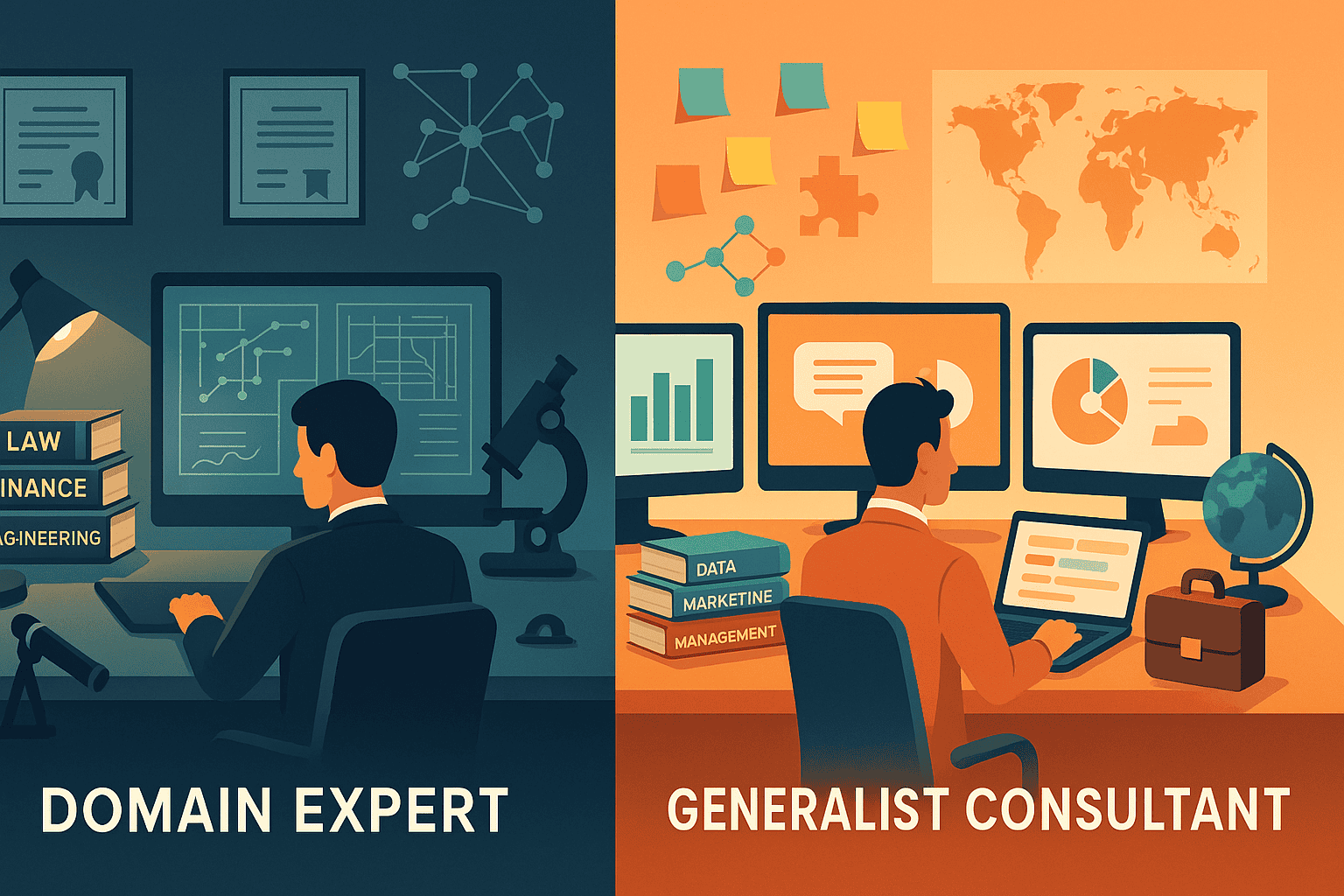
Should you become a domain expert or stay a generalist in consulting?
I’ve coached dozens of consultants who freeze when facing this question. They spend months second-guessing, hoping the “right answer” will magically appear. Some pick specialization because it sounds smart. Others stay broad because they fear missing out. Both groups end up confused and frustrated.
Here’s the truth: This choice shapes everything. Your career trajectory. Your earning potential. How much do you actually enjoy Monday mornings? And most consulting firms won’t tell you what they really value in each path, so you’re left guessing.
In this blog, you’ll learn:
- The real differences between domain experts and generalists (and why most advice gets this wrong)
- Which path actually creates better opportunities based on your natural strengths
- How to make this decision with clarity instead of anxiety
Let’s get started.
Why Does Choosing Between Domain Expertise and Generalist Paths Matter?
Most consultants think they can figure this out later.
“I’ll just take whatever projects come my way and see where it goes.”
But here’s the reality: Your first 2 to 3 years set the trajectory for everything that follows. I’ve watched talented consultants get stuck in a weird middle zone after five years because they never made an intentional choice. They weren’t sufficiently specialized to be experts. They weren’t strategic enough to be valued generalists.
The hidden cost? You spend years building a career that doesn’t align with your vision.
Let me break down why this decision matters:
It shapes how firms see you
Domain experts are often called upon for specific, high-stakes projects. You become the person they need when the problem is complex and the client expects deep knowledge.
Generalists get broader exposure but sometimes lack perceived depth. Both paths have different promotion timelines. Specialists often reach a senior consultant more quickly within their domain. Generalists take slightly longer but have more flexibility in where they land.
It impacts your exit opportunities
Specialists secure senior industry roles more quickly because they already speak the language. A healthcare consultant transitioning to the pharmaceutical industry doesn’t need months to catch up.
Generalists pivot across sectors more easily. However, you may need to demonstrate your depth in interviews.
It affects your daily work satisfaction
Do you love mastering one thing deeply?
Or does variety keep you engaged?
According to the U.S. Bureau of Labor Statistics, specialized consultants often command higher median wages, but generalists report higher job mobility.
Understanding what type of work truly energizes you matters more than compensation alone. If you’re still unsure which path aligns with your personality, preparing for consulting interviews gives you time to reflect on what you actually want from this career.
Here’s how these paths look:
| What Changes? | Domain Expert Path | Generalist Path |
| Project types | Deep, specialized, repeat industries | Varied, cross-industry, broad |
| Learning curve | Steep initially, then mastery | Continuous learning across fields |
| Market value | Premium in specific sectors | Flexibility across opportunities |
So what exactly separates these two paths?
Let’s break it down.
What Does Domain Expertise Really Look Like in Consulting?
Here’s what most people get wrong about specialization.
They believe domain expertise means working in a single industry. That’s NOT it.
Real domain expertise encompasses deep knowledge, a proven track record, and a trusted advisor status. It’s the difference between someone who’s done healthcare projects and someone healthcare executives call by name when they need answers. Most people confuse specialization with merely repeating similar projects.
Here’s what it actually takes:
Level 1: Industry Familiarity
You’ve worked on 3 to 5 projects in the same sector. You know the jargon, the basic business models, and how deals get structured. Clients see you as competent but not essential.
I worked with a consultant who’d done retail projects for two years. She could talk about inventory turns and same-store sales. But when clients faced tough pricing decisions, they didn’t ask for her by name.
This is where most people stop.
If you want to stand out from candidates who stop at familiarity, showcasing your motivation to go deeper can make all the difference in interviews.
Level 2: Recognized Specialist
Now you’re getting somewhere.
You’re requested by name for specific challenges. You’ve built proprietary knowledge or methods that solve problems faster than others can. You predict industry-specific challenges before clients even mention them.
One of my mentees became the go-to person for hospital system mergers. She didn’t just understand healthcare. She knew which integration approaches actually worked in that context and which ones failed despite looking good on paper.
This takes 4 to 7 years of focused, intentional work.
Level 3: Trusted Authority
This is rare.
Clients seek your advice beyond project scope. You shape industry conversations through speaking, writing, or advisory boards. Firms use your name to win new business because prospects recognize your reputation.
I know a partner-level domain expert in financial services who gets calls from CEOs asking, “What do you think we should do?” before they’ve even scoped a project.
This level is extremely valuable and extremely hard to reach.
What Domain Experts Actually Do Differently
Here’s what separates real experts from people who just have experience:
- They speak the client’s language without translation: No need to explain context. The conversation starts three steps ahead.
- They know which “best practices” actually work: Theory sounds great. They know what fails in implementation for that specific industry.
- They have networks that open doors: When you need an intro to a VP at a competitor, they make one call.
- They command premium rates: Clients pay more because the risk of hiring someone less experienced is too high.
| Pro Tip: Domain expertise isn’t about loving one industry. It’s about becoming the person clients trust when the stakes are highest. If you’re not willing to commit at that level, that’s okay. Just don’t call yourself a specialist yet. |
If you want to develop the consulting skill set that makes you valuable in either path, High Bridge Academy’s Consulting Bootcamp offers structured training from ex-MBB consultants that can accelerate your growth significantly.
What Does the Generalist Consulting Path Actually Give You?
Let’s clear something up right now.
Being a generalist doesn’t mean being a jack of all trades. It’s not about doing a little bit of everything and never going deep. That’s a recipe for mediocrity.
Real generalists build transferable problem-solving muscle. The best ones have a superpower: pattern recognition. They see solutions in one context and apply them brilliantly in another.
Here’s what that actually looks like:
Cross-Pollination Thinking
You spot solutions from one industry that can be applied to another. This is where generalists create unexpected value.
I coached a generalist who solved a healthcare staffing problem using retail supply chain thinking. The hospital executives were blown away. They’d been stuck in “how healthcare always does it” mode. She brought a completely fresh lens.
This makes you valuable in transformation projects where traditional playbooks are no longer effective. Clients pay for fresh perspectives, not just industry knowledge. And here’s the bonus: you’re never stuck when one market tanks. While specialists worry about their sector’s health, you move where the opportunities are.
Faster Adaptation to Change
Generalists are comfortable with ambiguity and new contexts. Why?
Because you’ve done it before.
You build new expertise quickly. Each time you enter a new industry, you get better at the learning process itself. I watched a generalist pivot from financial services to healthcare tech in six months. She didn’t know medical devices, but she knew how to learn fast and ask the right questions.
This matters more as industries become increasingly blurred and converge. Tech touches everything now. Generalists thrive in that environment. You follow opportunities, not just job openings in one narrow sector.
Broader Network Across Sectors
Your connections span industries, not just one vertical.
You become a connector between different business worlds. One of my colleagues has built relationships across the automotive, consumer goods, and logistics sectors. When a company needed help understanding how direct-to-consumer models could work in their industry, guess who they called?
This opens unique exit opportunities. Executive recruiters see you as versatile, someone who can lead in different contexts.
What Generalists Actually Do Differently
Here’s what sets strong generalists apart:
- They ask, “What problem are we really solving?” not “What does this industry do?”
- They bring structured thinking, not industry templates
- They learn fast and synthesize across contexts
- They thrive on variety and new challenges
The best generalists aren’t good at everything. They excel at learning anything and applying patterns across various contexts.
Building these transferable problem-solving skills early in your career provides a solid foundation to excel in either path. Many generalists also find that answering behavioral questions becomes easier because they can draw examples from diverse experiences across industries.
So which path actually wins?
Let’s look at the real trade-offs.
5 Critical Differences That Will Shape Your Career
There’s no “better” path here. Only a better fit.
I’ve seen phenomenal success in both directions. Specialists commanding premium rates. Generalists leading firms. However, here are the trade-offs that nobody honestly discusses.
Understanding these helps you choose with clarity instead of guessing.
1. Speed to Mastery vs. Breadth of Experience
This is about how fast you want to become an expert versus how much variety you need to stay engaged.
The Domain Expert Route:
You become highly skilled in one area faster. Clients trust you earlier in your career because you already speak their language and understand their problems.
However, here’s the catch: you may feel that the work becomes repetitive by year 4 or 5. The challenges start looking similar. The excitement fades.
The Generalist Route:
You stay intellectually stimulated longer. Every project teaches you something new. A retail transformation in Q1. A tech company’s pricing strategy in Q2. You’re always learning.
But you might feel like you’re always catching up on context. While the specialist dives straight into solutions, you’re still asking basic industry questions.
What this means for you: “Do I love going deep or going wide?”
2. Market Value: Premium Rates vs. Market Flexibility
Your earning potential and career security appear to be completely different depending on the path you choose.
The Domain Expert Route:
You can command 20% to 40% higher rates in your specialty.
I know a healthcare specialist who charges nearly double what generalists at her level of experience earn. Why? Because when a hospital system needs merger advice, they want someone who’s done it ten times before.
But when your industry contracts, so do your opportunities.
The Generalist Route:
You can move where the opportunities are. Economic downturn in financial services? You pivot to tech or manufacturing. You’re never fully dependent on one sector’s health.
However, you may need to compete more on price until you prove your value in each new context.
| Career Stage | Domain Expert | Generalist |
| Years 0 to 3 | Building focused expertise | Building a broad toolkit |
| Years 4 to 7 | Premium rates in specialty | Flexibility across sectors |
| Years 8+ | Industry authority status | Cross-industry leadership |
3. Client Relationships: Depth vs. Diversity
The quality and breadth of your professional network will be shaped differently based on your path.
The Domain Expert Route:
You build deep, multi-year client relationships. I’ve seen specialists work with the same three clients for years. Those clients become advocates for your career. They refer you. They follow you if you change firms.
The Generalist Route:
You meet diverse leaders across industries. Your network is wider but relationships may be shallower. You’re not the person they call every time. But you know people everywhere, which opens different doors.
4. Career Ceiling: Different but Both High
Both paths can take you to the top, but the definition of “the top” looks different.
The Domain Expert Route:
Path to industry practice leadership. Potential board positions in your sector. A former colleague became the global head of healthcare consulting at a top firm by age 38.
The Generalist Route:
Path to firm-wide strategy leadership. CEO track roles in diversified companies. One generalist I coached landed a Chief Strategy Officer role at a Fortune 500 because she understood multiple business models.
The truth?
Both can reach partner level, just via different routes.
As you progress toward consulting leadership roles, the skills that matter shift from technical expertise to team management and client authority, regardless of your specialization.
5. Job Security: Different Risk Profiles
Economic downturns and market shifts will affect your career stability in completely opposite ways.
The Domain Expert Route:
Very secure when your industry is growing. But more vulnerable during sector-specific downturns. I watched retail specialists struggle to secure projects in 2020, while e-commerce specialists thrived.
The Generalist Route:
More resilient to single-industry shocks. You adapt and pivot. But you face more competition in general hiring because everyone thinks they can be a generalist.
During the 2008 financial crisis, generalists found work outside banking while finance specialists waited for their sector to recover.
I’ve coached consultants in both paths through economic uncertainty. The winners aren’t those who picked the “right” path. They’re the ones who made their choice and built deliberately.
Now here’s how to actually make this decision…
4 Questions That Will Tell You Which Path Fits You Better
Forget career guides and generic advice.
The right path depends on how you’re wired, not what sounds good on LinkedIn. I use these four questions with every consultant I coach. Your honest answers will point you clearly in one direction.
Let’s go through them.
Question 1: What Energizes You: Mastery or Variety?
Think about your past experiences.
Have you ever gotten obsessed with understanding something deeply? Spent hours researching one topic until you felt like you owned it?
Or do you get bored once you “figure something out” and immediately want a new challenge?
Here’s what this reveals:
- Domain experts get energy from becoming the best. They love the satisfaction of mastery.
- Generalists get energy from tackling new challenges. They love the thrill of unfamiliar problems.
Ask yourself this: Think about the best project or class you ever experienced. What made it great? Was it becoming really good at something, or was it the novelty and challenge?
Your answer matters more than you think.
If you’re still preparing to break into consulting, mastering case interviews is your first step, regardless of which path you eventually choose.
Question 2: How Do You React to Uncertainty?
Be honest here.
Do you prefer building on what you know? Does expertise give you confidence?
Or do you love starting fresh in unfamiliar territory? Does ambiguity excite you?
What successful consultants tell me:
Domain experts say: “I love that feeling of being the expert in the room. I like having answers.”
Generalists say: “I love that feeling of figuring out a totally new puzzle. I like asking questions.”
Neither is better. But knowing your preference matters because consulting throws uncertainty at you constantly. The question is: what kind of uncertainty do you handle best?
Your ability to handle pressure also plays a huge role in which path suits you. Staying calm under uncertainty is a skill you can develop, but understanding your natural comfort zone helps you choose the right environment from the start.
Question 3: Where Do You Want to Be in 10 Years?
Career vision clarity helps more than people realize.
If you envision:
- Leading a specific industry practice → Domain path
- Running a department in one company → Domain path
- Joining a board in a specific sector → Domain path
If you envision:
- Leading firm-wide initiatives → Generalist path
- CEO of a diversified company → Generalist path
- Starting your own cross-industry venture → Generalist path
I coached two consultants with completely different visions. One wanted to become the top voice in sustainable energy consulting. Domain path made sense. The other wanted to run a strategy for a private equity firm across portfolio companies. The generalist path fits perfectly.
Their outcomes matched their visions because they chose intentionally.
Question 4: What Do Your Strengths Suggest?
Your natural wiring matters more than what sounds impressive.
| You Might Be a Natural Domain Expert If… | You Might Be a Natural Generalist If… |
| You love deep research and becoming the “go-to” person | You love synthesizing ideas from different fields |
| You have patience for incremental expertise building | You get restless doing similar work repeatedly |
| You enjoy teaching others about your specialty | You enjoy learning from others in new fields |
| You’re energized by recognition as an authority | You’re energized by solving new types of problems |
The honest truth?
You can’t fight your natural strengths for long. I’ve watched consultants burn out trying to be something they’re not. Those who thrive are those who lean into their natural way of thinking and working.
I’ve never seen someone sustainably happy in a path that fights their natural strengths. Choose based on who you actually are, not who you think you should be.
But what if you’re still not sure?
Here’s what to do…
What to Do If You’re Still Early in Your Career (Or Stuck Between Both)?
Not knowing is actually smart, not weak.
Most consultants don’t commit to a path in their first year. Some don’t decide until year three or four. I’ve coached many people who tested both directions before making a choice.
Here’s the practical approach that works.
The “Test Both” Strategy (First 2 to 3 Years)
You don’t need to decide immediately. Use your early years to gather real data about yourself, not just opinions.
If you’re currently a generalist:
- Take at least 2 to 3 projects in one industry to test depth
- Notice how you feel when you build specialized knowledge
- Ask yourself: “Am I bored or engaged by project three in this sector?”
If you’re currently a specialist:
- Request one cross-industry project per year
- Notice how you handle the learning curve
- Ask yourself: “Do I miss my deep expertise or love the variety?”
I coached a consultant who spent two years testing both approaches. She completed three financial services projects in a row, then took on a consumer goods project. By year three, the answer was obvious. She felt energized by depth and bored by constantly starting over in new industries.
Your body tells you before your brain does. Pay attention.
The Hybrid Path (Yes, It Exists)
Here’s the truth most people miss.
Some of the best consultants build a hybrid approach. You don’t have to choose between “one industry forever” or “everything all the time.”
What this looks like:
- Deep expertise in 2 to 3 related industries (not just one)
- Or deep expertise in one capability across industries
- Example: I know a consultant who specializes in pricing strategy across retail, hospitality, and consumer goods
Why this works:
You get the premium value of specialization. You retain the flexibility for broader applications. You avoid the monotony of pure specialization.
The caveat? This takes longer to build and requires intentional positioning. You can’t accidentally stumble into this. You have to craft it deliberately.
Building a hybrid path also requires strong communication skills in interviews so you can articulate your unique positioning clearly to potential employers.
Signs You Should Commit to One Path
Commit to domain expertise if:
- You’re 3+ years in and genuinely excited about industry depth
- You’re getting repeat client requests in your sector
- You see a clear path to industry leadership
Commit to generalist if:
- You’ve tried specializing and felt constrained
- You thrive on the variety of different challenges
- You want maximum career flexibility
The worst thing you can do is drift for seven years without deciding. By then, you’re neither a specialist nor a strategic generalist. You’re just someone with experience but no clear positioning.
Choose deliberately. Even if you choose wrong, you can course correct. But drifting? That’s harder to fix.
The 3 Biggest Mistakes People Make (And How to Avoid Them)
I’ve watched smart consultants make these mistakes repeatedly.
The painful part? These are completely avoidable. Most people don’t realize they’re stuck until it’s too late, and by then, they’ve wasted years building a career that doesn’t fit.
Here’s how to spot and avoid each trap:
| Mistake | What It Looks Like? | The Real Cost | How to Avoid It? |
| Choosing for prestige | Picking paths that sound impressive | Burnout and resentment | Choose based on what energizes you |
| Waiting too long | Drifting without deciding | Unclear positioning by year 7 | Commit by year 3 to 4 |
| Switching without rebuilding | Pivoting but expecting instant credibility | Starting over at square one | Plan a 2 to 3 year transition strategy |
Mistake #1: Choosing Based on What Sounds Impressive
The trap looks like this:
“I want to be a strategy generalist at McKinsey because it sounds prestigious.”
Or: “I want to be a fintech expert because it’s hot right now.”
Why this fails:
You’re optimizing for perception, not satisfaction or fit.
What happens:
- You burn out because the work doesn’t match your wiring
- You compete against people who genuinely love that path
- You resent the career you built for external validation
How to avoid it:
Ask yourself one simple question: “Would I still choose this path if nobody knew my job title?”
If the answer is no, you’re choosing wrong.
I coached a consultant who left a “prestigious” generalist role at a top firm for focused healthcare work at a smaller consultancy. Everyone thought she was crazy. However, she told me later that it was the best decision she had ever made, as she finally felt like herself at work.
She also learned that articulating your passion authentically matters more than chasing brand names when it comes to long-term career satisfaction.
Mistake #2: Waiting Too Long to Choose
The trap sounds rational:
“I’ll just keep doing whatever projects come my way and decide later.”
Why this fails:
After 5 to 7 years, you’re neither a specialist nor a strategic generalist. You’re just experienced without clear positioning.
What happens:
- Firms don’t know how to staff you
- You get passed over for both specialist and leadership roles
- Your resume looks scattered, not strategic
How to avoid it:
By year 3 to 4, you should have:
- A clear point of view about your direction
- Concrete steps toward building either depth or strategic breadth
- A story that explains your choices
The truth nobody tells you? Optionality decreases over time, not increases. The longer you wait, the more difficult it becomes to make a choice.
Mistake #3: Trying to Switch Paths Without Rebuilding Credibility
The trap sounds like this:
“I’ve been a specialist for 6 years. Now I want to pivot to being a generalist.”
Why this is hard:
Your market reputation is built. Clients see you through your track record. You can’t just announce you’re something different now.
How to do it right:
If switching from specialist to generalist:
- Take strategic projects outside your domain
- Build a narrative about transferable thinking
- Expect to “prove yourself” again
If switching from generalist to specialist:
- Pick an emerging field with less entrenched competition
- Commit fully for 2 to 3 years
- Build visible expertise through writing or speaking
Switching paths is possible. But it requires intentional repositioning, not just wishful thinking.
The Choice Is Yours. Here’s How to Own It!
Both paths work. But they work differently.
The key isn’t picking the “right” one based on trends or what sounds prestigious. It’s choosing based on self-awareness. I’ve seen outstanding careers built as domain experts. I’ve seen equally impressive careers built as generalists.
What matters most? Intentionality over ambiguity.
Here’s what to do next:
- Reflect on the four questions from earlier. Your honest answers matter more than any career guide.
- Test both approaches if you’re early in your career. Give yourself permission to experiment.
- Make a conscious choice by year 3 to 4. Don’t drift into year seven without making a decision.
- Own your path and build deliberately from there.
If you want structured guidance on building a consulting career that actually fits who you are, High Bridge Academy’s Consulting Bootcamp can help. Developed and delivered by 60+ ex-MBB consultants who’ve succeeded in both paths, we offer personalized coaching to help you make this decision with confidence and build the career you want, not the one you think you should have.
Start your journey today and build the consulting career that truly fits you.